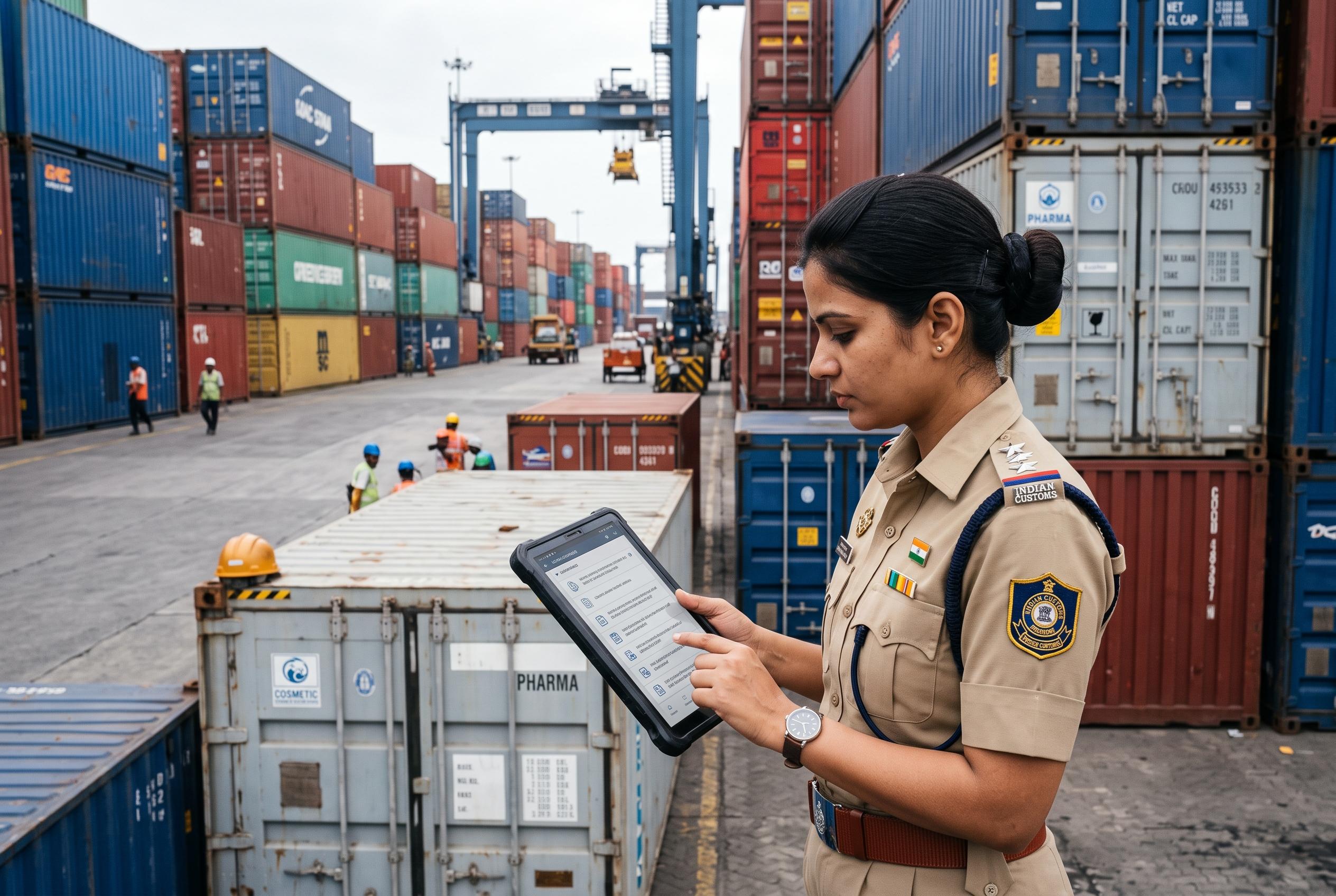

India’s customs authorities have implemented a comprehensive seven-checklist system for importing cosmetics, drugs, and medical devices, aiming to streamline clearance and reduce port delays amid ongoing system integrations.
According to Circular No. 40/2026-Customs, reproduced by S C J Associates and Taxguru, (scjassociates.in) India’s customs authorities have moved imported cosmetics, drugs and medical devices on to a seven-checklist clearance system that officers must apply before granting “out-of-charge”, the formal release that allows goods to leave customs control. The change matters because the circular says the supporting regulatory documents are not yet fully integrated into SWIFT 2.0, so field officers are being told to follow a standard document-by-document process instead of relying on looser, port-by-port scrutiny. (scjassociates.in)
The Economic Times and Moneycontrol reported, (economictimes.indiatimes.com) that importers are now expected to upload the relevant papers on e-SANCHIT so customs staff can verify them at the out-of-charge stage, a workflow the government is presenting as part of the Central Drugs Standard Control Organisation’s ease-of-doing-business push. Business Standard’s account of the circular says field formations are to be sensitised to carry out those checks at release, underscoring that the board wants the instruction treated as an operational rule rather than a broad policy signal. (drugscontrol.org)
What looks, in some headlines, like a single checklist is more granular in the underlying annexure. The circular text reproduced by Taxguru shows seven distinct buckets: cosmetics; drugs in the form of active pharmaceutical ingredients and finished formulations; drugs imported for personal use or in small quantities by a government hospital or autonomous medical institution; drugs imported for examination, test or analysis; medical devices including in vitro diagnostics; certain special-purpose medical-device imports; and raw materials or components used to manufacture medical devices. (taxguru.in) That is a wider and more segmented compliance net than the shorter summaries first suggested. (taxguru.in)
For cosmetics, the checklist goes well beyond asking whether a consignment has a registration certificate. The annexure reproduced by Taxguru requires self-certified copies of the relevant CDSCO registration, invoice, packing list, country-of-origin certificate, storage-premises licence and a certificate of analysis or batch-release certificate, (taxguru.in) while also calling for label matching, a declaration that no animal was used in testing, and a declaration that the product does not contain hexachlorophene. The same annexure says new cosmetics imported under Form COS-3 should be referred to the CDSCO port office, and it includes a six-month condition tied to the use-before or expiry date. (taxguru.in)
The drug requirements are similarly detailed. Taxguru’s reproduction of the annexure says API and finished-drug shipments should carry a Form 41 registration certificate and a Form 10 import licence where applicable, with labels that match the licence, batch information, storage conditions and manufacturing and expiry or re-test dates. (taxguru.in) For APIs, the checklist also calls for a readable QR code carrying data such as the product identification code, batch number, batch size, manufacturer details, import-licence number and any special storage requirements. The same annexure says drug consignments should have more than 60 per cent residual shelf life at the time of import; below that threshold, they are to be referred to the CDSCO port office. (taxguru.in)
Medical devices are not being treated as a simple extension of the drug list. The annexure says routine device imports should carry an MD-15 import licence, or in the case of specified Class A devices, a registration number, (taxguru.in) and it sets residual shelf-life thresholds that vary by product life: at least 40 per cent for devices with a 90-day shelf life, 50 per cent for those between 90 and 365 days, and 60 per cent for those lasting longer than a year. Separate entries cover devices imported for clinical investigation, testing, evaluation, demonstration, training or personal use under MD-17, MD-19 or MD-21 permissions, while manufacturers importing components are asked for MD-05 or MD-09 licences depending on device class. (taxguru.in)
Trade advisers have welcomed the attempt to make release decisions more predictable, while warning that the outcome will depend on how evenly the rules are applied across ports. The Economic Times reported, (economictimes.indiatimes.com) that Sivakumar Ramjee of Nangia Global described the circular as “a monumental shift from discretionary manual vetting” and said a standard electronic verification process should cut port dwell times and demurrage costs for importers of medical supplies. Business Standard and Moneycontrol both carried Rajat Mohan’s caution that the reform will only succeed if it produces “predictable, uniform verification” rather than becoming one more discretionary checkpoint inside the clearance chain. (drugscontrol.org)
The practical test will come before SWIFT 2.0 document integration is fully in place. The circular itself says that integration work is still under way, (scjassociates.in) which means the promise of quicker release depends, for now, on how faithfully officers use the lists and how consistently traders upload clean records to e-SANCHIT. That is one reason the instruction was still being amplified across Gujarati and Hindi news outlets by Monday evening, with Bombay Samachar and Prabhasakshi both re-circulating the message to importers and brokers, (bombaysamachar.com) a sign, by inference, that the measure is being pushed as an immediate compliance step rather than a background regulatory tidy-up. (bombaysamachar.com)
Disclaimer: This article is intended to inform and educate, not to recommend or endorse any financial product, investment or strategy. Please consider your own financial circumstances and seek professional advice where appropriate before making financial decisions.