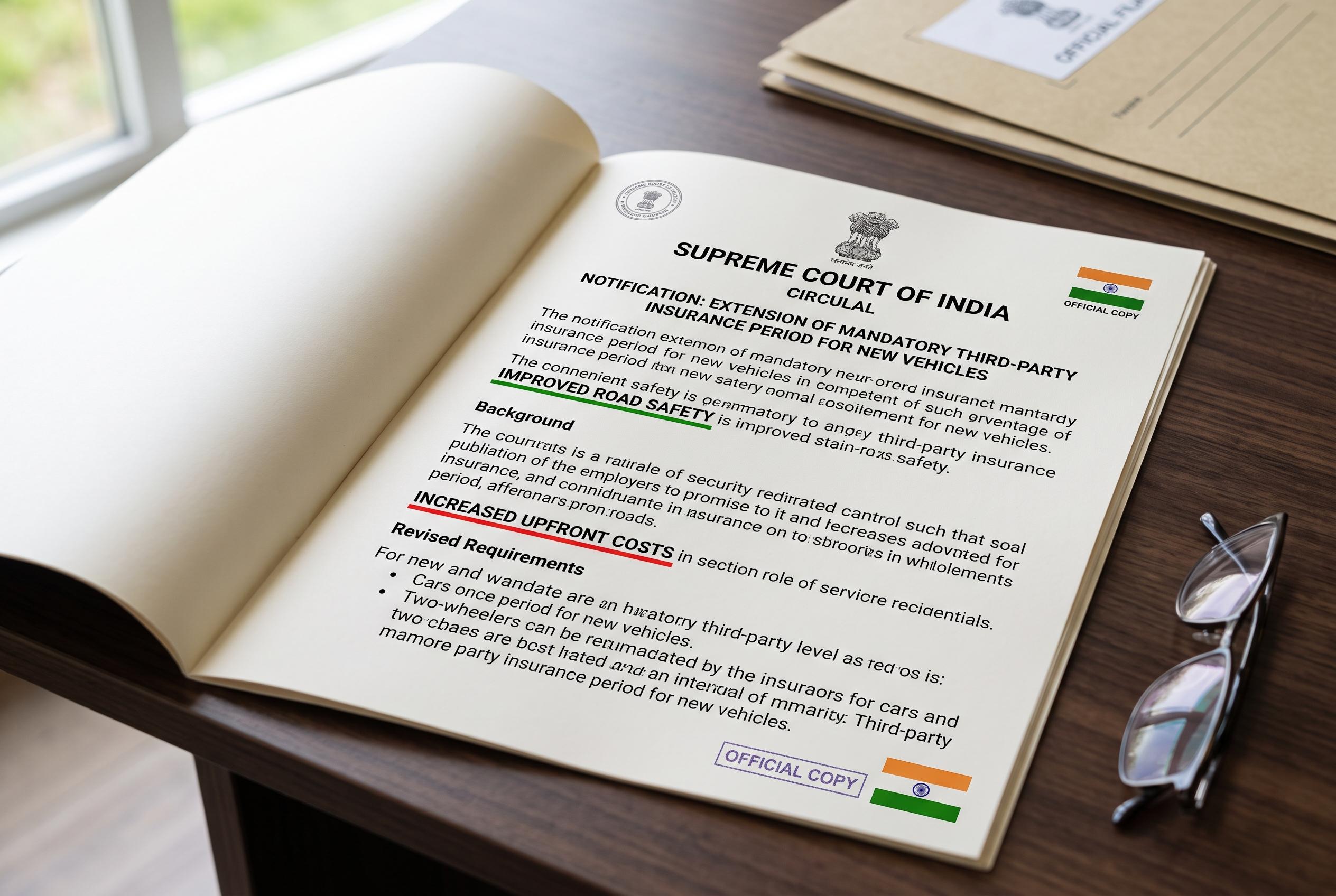

India’s top court has extended mandatory third-party insurance periods for new vehicles, increasing upfront costs but aiming to improve road safety and crash victim payouts.
India’s top court has effectively raised the cost of buying a new car or motorcycle by extending compulsory third-party insurance cover for fresh registrations, a move designed to reduce the number of uninsured vehicles on the road and improve payouts to crash victims. According to the Insurance Institute of India and a Ministry of Road Transport and Highways circular, new four-wheelers must carry at least 3 years of third-party cover, while new two-wheelers must have 5 years, following the Supreme Court’s directions.
Third-party insurance is the most basic form of motor cover. It pays compensation when an insured vehicle injures someone or damages another person’s property, but it does not cover the owner’s own vehicle. The court’s intervention reflects a long-running problem in India, where a significant number of cars and bikes still operate without insurance despite the legal requirement under the Motor Vehicles Act, leaving accident victims and their families to chase compensation through lengthy claims processes.
The practical effect is that buyers will now face a higher upfront bill at the showroom. Indian publication Aaj Tak said the added premium will be folded into the on-road price of the vehicle, with the increase varying by insurer and model. It cited a Tata Tiago base variant in New Delhi, where insurance already contributes roughly ₹30,000 to the purchase cost, and said a Hero Splendor Plus buyer could also see a noticeable jump once the longer policy period is applied.
The move is aimed at improving compliance as much as consumer protection. The ministry’s circular said the longer cover should make more vehicles insurable from day one, while the court also asked regulators and transport authorities to work on a system that could deny fuel to uninsured vehicles at petrol pumps. Whether that mechanism becomes practical nationwide remains to be seen, but the immediate result is clear: buying a new vehicle in India is set to become more expensive, even if the extra cost is tied to a longer safety net.
Disclaimer: This article is intended to inform and educate, not to recommend or endorse any financial product, investment or strategy. Please consider your own financial circumstances and seek professional advice where appropriate before making financial decisions.