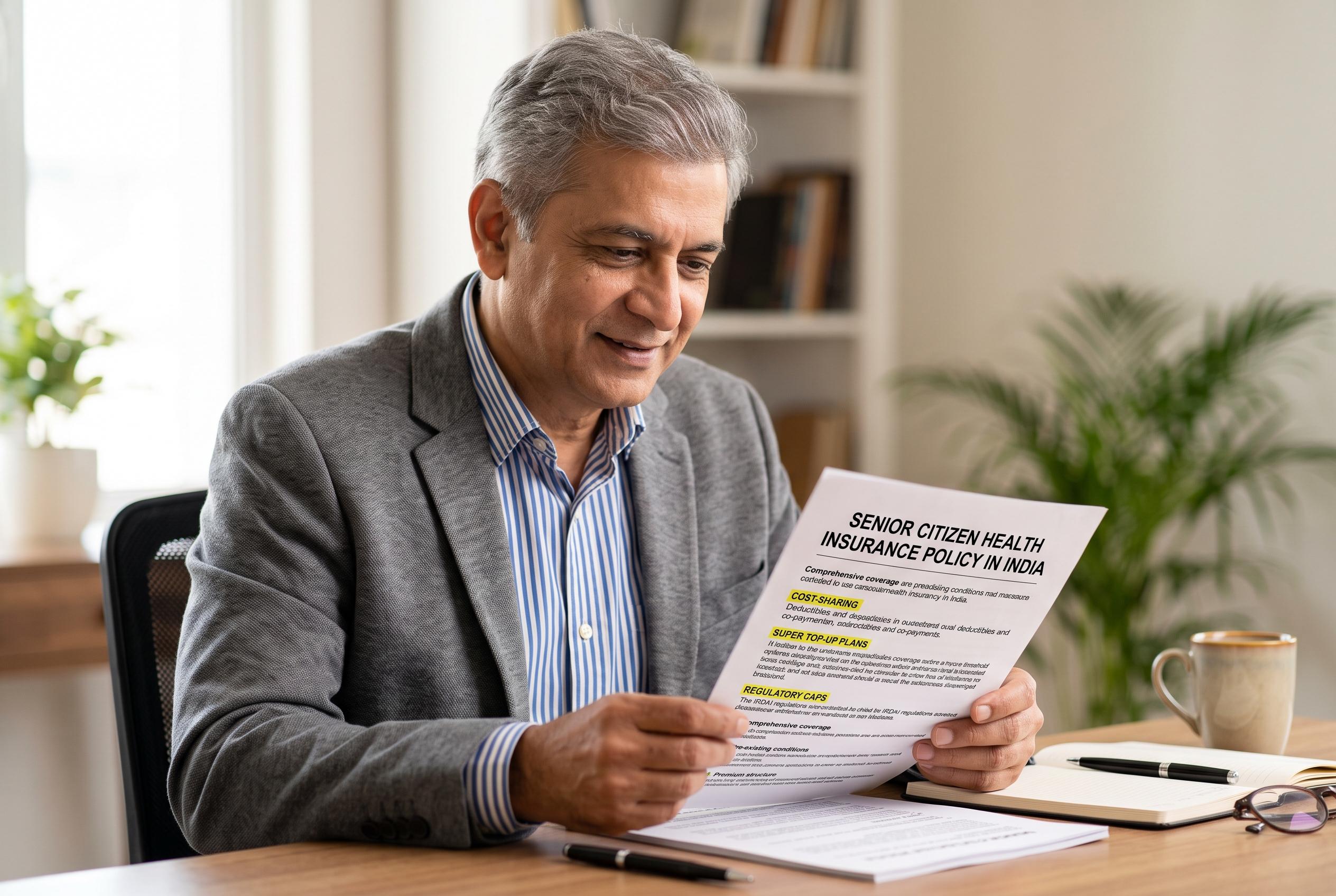

New options such as cost-sharing, super top-up plans, and regulatory caps are helping India’s older population access more affordable health coverage, reshaping the traditional challenge of rising premiums with age.
Buying health insurance after 60 is no longer the exception it once was, and insurers in India now offer products aimed specifically at older customers. The challenge is cost: premiums rise with age and medical risk, but according to ET Online, seniors can still build meaningful protection without opting for an expensive high-value standalone policy.
One of the most effective ways to keep premiums in check is to accept some cost-sharing. Vineet Gupta of ManipalCigna Health Insurance told ET Online that plans with co-payments or deductibles can significantly reduce annual premiums because the policyholder agrees to cover part of the bill upfront. Another commonly recommended structure is to pair a modest base policy with a super top-up plan, which activates only after claims cross a chosen threshold. ET Online said this can create cover of ₹1 crore at a much lower cost than buying a single large policy.
There is also some regulatory relief. Shilpa Arora of Insurance Samadhan told ET Online that since January 2025, the Insurance Regulatory and Development Authority of India has capped annual renewal increases for senior citizens at 10% without prior approval, giving policyholders more predictability. Business Standard has likewise reported that this limit helps older customers plan for renewal costs more confidently.
Experts also say family arrangements matter. If an employer allows dependent parents to be covered under group health insurance, that can be a useful supplement, but Policybazaar’s Siddharth Singhal warned ET Online that such cover depends on employment and may disappear after a job change or retirement. For many households, a separate individual policy for the older parent is often cheaper than adding them to a family floater, because a floater is usually priced according to the oldest member and one claim can affect the whole family’s benefits.
Public schemes can help, but they are not a complete answer. ET Online reported that the Ayushman Vay Vandana Card provides ₹5 lakh a year for people aged 70 and above, regardless of income, with no waiting period for pre-existing illnesses. Gurmeet Singh of IFFCO-TOKIO General Insurance told ET Online that this should be treated as a first layer of protection, not a substitute for private cover. For many seniors, the best approach is a mix of individual insurance, a super top-up plan and any available employer-linked cover, chosen according to age, medical history and budget.
Disclaimer: This article is intended to inform and educate, not to recommend or endorse any financial product, investment or strategy. Please consider your own financial circumstances and seek professional advice where appropriate before making financial decisions.