
Self-help groups have transformed small savings into a community-based financial system that challenges traditional formal banking models, prioritising trust, accessibility, and cultural relevance for women in rural India.
Self-help groups have long been presented as a route to cheap credit, but their deeper innovation lies elsewhere: they turned tiny, regular savings by poor rural women into a financial discipline that formal institutions often failed to design for. Rather than placing the male head of household at the centre of anti-poverty efforts, the model placed women at the heart of the system, and in doing so created a local financial practice built on trust, routine and proximity.
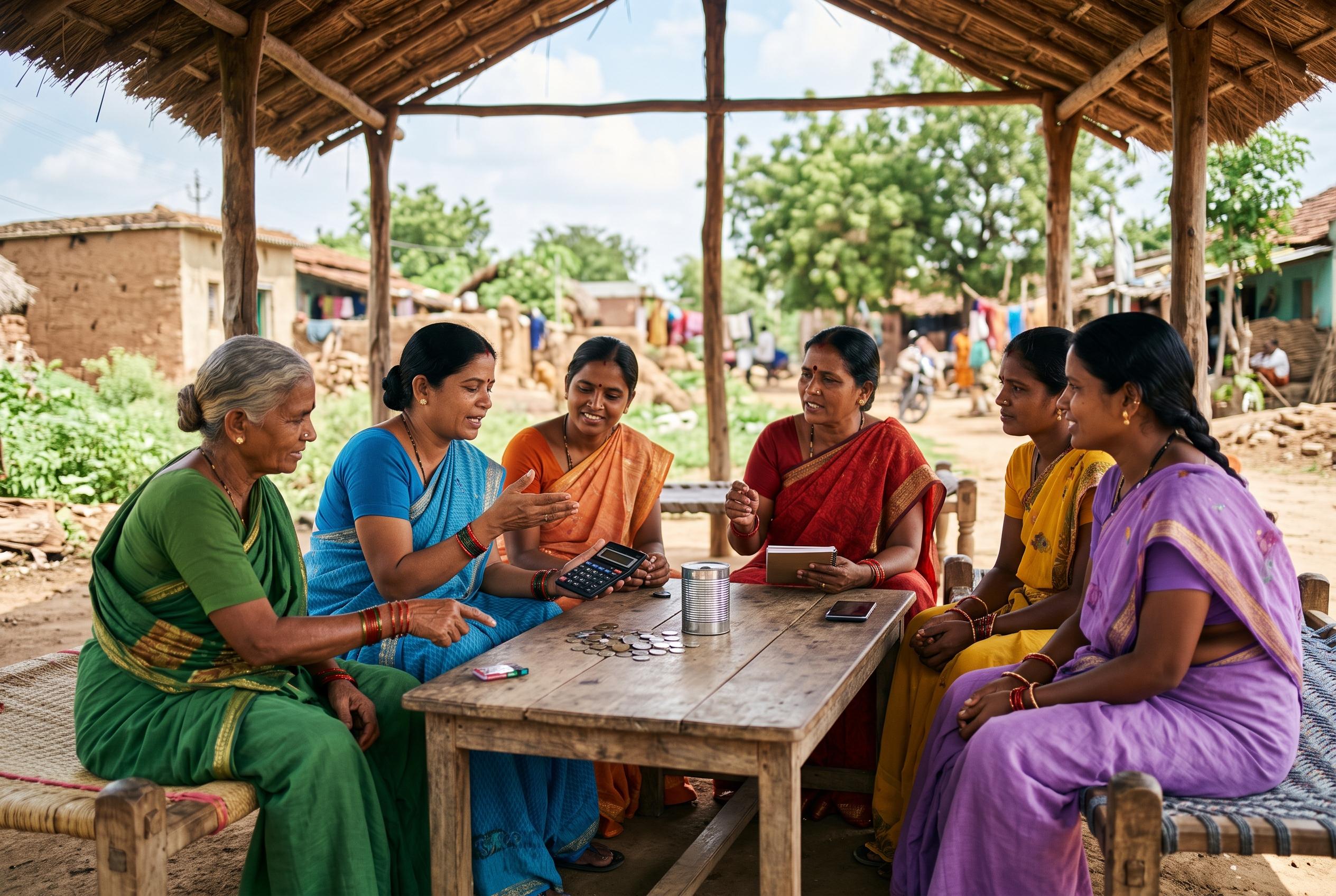
According to the material on the movement, the appeal was not based on high returns. Members contributed fixed amounts weekly or monthly, met on a set day near home and pooled the money in a familiar setting. The design mattered as much as the money itself. Women did not need a lecture in financial literacy; they needed a product that fit the realities of their lives. In many informal systems, safety and convenience matter more than yield, and even low or no interest does not stop people saving when the alternative is keeping cash exposed or spending it.
The groups then evolved beyond saving. Members lent to one another from the common pool and charged interest at local market rates, creating a closed-loop system that functioned like a village bank. The surplus was often shared in culturally familiar ways, including festival gifts, which helped anchor the model in community life. The wider framework also became a path to formal banking through the Self-Help Group-Bank Linkage Programme, which NABARD launched in 1992 to connect unbanked rural households with institutions that would otherwise have remained distant.
Yet the article argues that the state later narrowed the idea by treating self-help groups mainly as vehicles for subsidised lending and grant-funded livelihood schemes. That shift, it says, left many groups with idle cash while some members could not borrow because of repayment problems elsewhere in the system. Other accounts of SHGs emphasise that they do much more than move money: they can build confidence, collective bargaining power, social participation and, in some places, a way out of dependence on moneylenders.
The article’s most striking example comes from Ananthapur in Andhra Pradesh, where one group treated insurance as an extension of saving. Faced with a product that could not be bought through monthly premiums because the cover was too small, the members arranged annual payments instead, took interest-free loans to meet the cost and used group funds to cover part of the premium. The point, the article suggests, is not that poor households cannot save or insure themselves, but that formal providers too often design products for their own convenience rather than for the last mile. If institutions focused on access, trust and ease of use, the savings of the poor could be formalised without stripping away the local logic that made them work in the first place.
Disclaimer: This article is intended to inform and educate, not to recommend or endorse any financial product, investment or strategy. Please consider your own financial circumstances and seek professional advice where appropriate before making financial decisions.