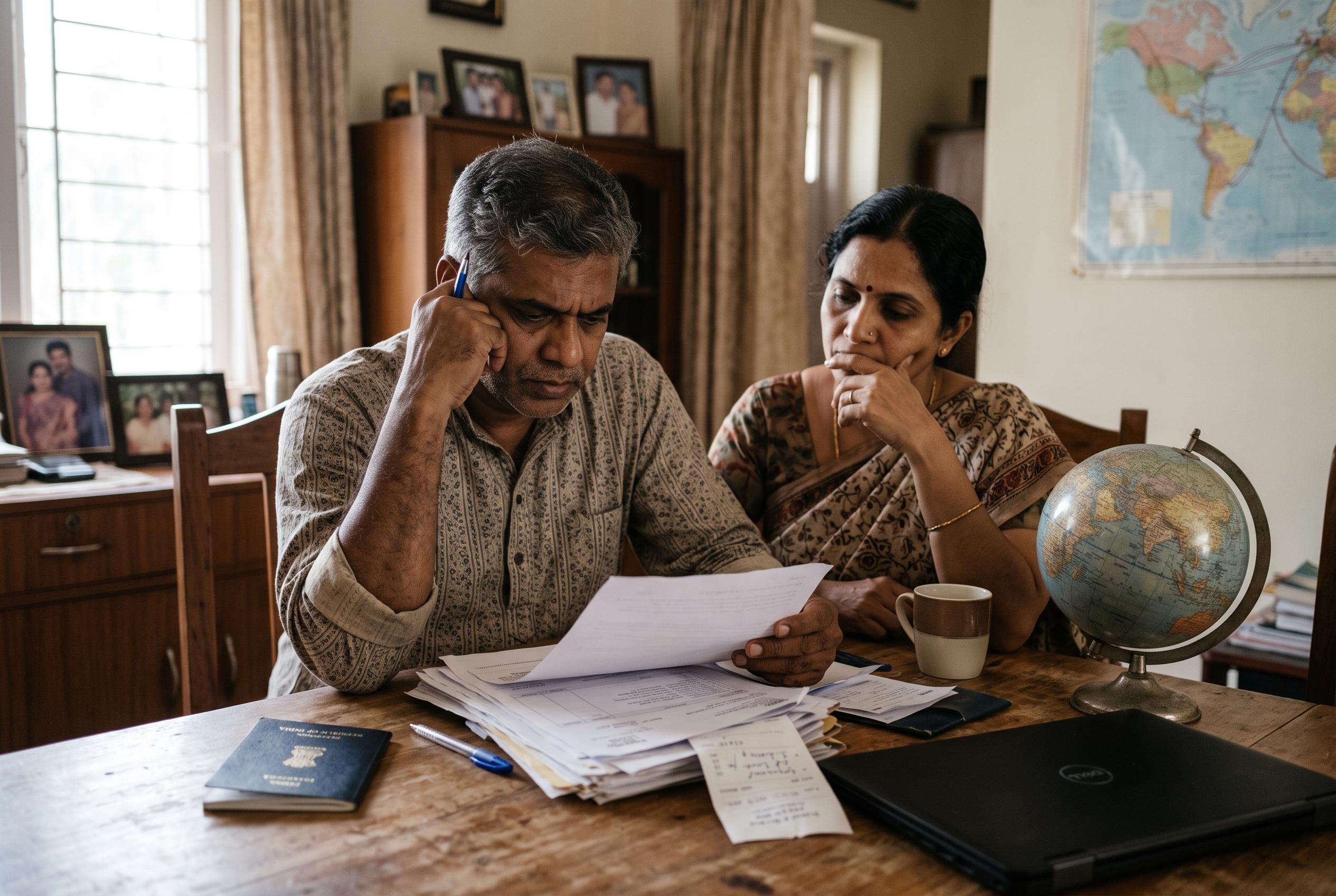

The real expense of studying abroad for Indian students has surged past expectations, prompting families to reconsider their financial strategies amidst currency fluctuations and rising tuition fees, risking long-term financial stability.
For Indian families, the dream of an overseas degree can come with a hidden price tag that is often larger than expected and harder to escape than tuition alone. Fees, accommodation, food, insurance, travel and study materials all pile up over several years, while inflation and annual fee increases can steadily push the bill higher. The biggest variable may be the rupee itself: even a modest slide against the dollar can add sharply to the final cost by the time a course ends.
That risk is no longer hypothetical. NDTV has reported that a two-year master’s programme in the United States, once often estimated at ₹60 lakh to ₹70 lakh, can now cross ₹1 crore once currency movement is taken into account. LiveMint has said that some undergraduate courses abroad now cost about ₹2.5 crore in total, with projections that the same outlay could approach ₹5 crore by 2036 if present trends continue. Moneycontrol has also noted that parents need to budget for far more than tuition alone, treating overseas education as a multi-year financial plan rather than a one-time payment.
The strain is not limited to the headline cost. HSBC’s 2024 Quality of Life Report, cited in the lead article, found that Indian parents spend an average of $62,364 a year, or roughly ₹52 lakh, on a child’s overseas education. The report estimated that financing a three-year foreign degree could absorb 48% of a parent’s retirement savings, rising to 64% for a four-year course. That makes the trade-off stark: what looks like a family investment today can become a retirement threat tomorrow.
Financial advisers increasingly warn that the real danger lies in funding the shortfall with assets that were never meant to support education in the first place. Redeeming mutual funds, breaking fixed deposits or dipping into retirement money may solve an immediate cash gap, but it can also destroy years of compounding. The smarter approach, according to the lead article, is often a mix of savings and an education loan, with the balance set according to income, existing wealth, age and long-term goals.
The problem, however, is that many parents still assume the child will graduate, secure a strong overseas salary and clear the debt quickly. That may happen, but the plan needs to survive less favourable outcomes too: a longer job search, lower-than-expected earnings or a decision to return to India. As the lead article argues, an education loan can be repaid over time; lost retirement growth cannot. In one example cited there, a Gurgaon couple faced a choice between exhausting their portfolio to pay the full cost of a son’s degree or covering only part of it and allowing the rest to be financed through a loan. The difference determined whether they would run out of money in their late sixties or preserve financial independence well into old age.
That is why planners say families should set clear rules before a child leaves for college: which assets are available for education, and which are off limits because they must protect the parents’ future. In an environment where rupee weakness, foreign inflation and rising tuition are all pushing costs higher, the most important question may not be whether an overseas degree is worth it. It is whether a family can afford it without undermining its own security.
Disclaimer: This article is intended to inform and educate, not to recommend or endorse any financial product, investment or strategy. Please consider your own financial circumstances and seek professional advice where appropriate before making financial decisions.