

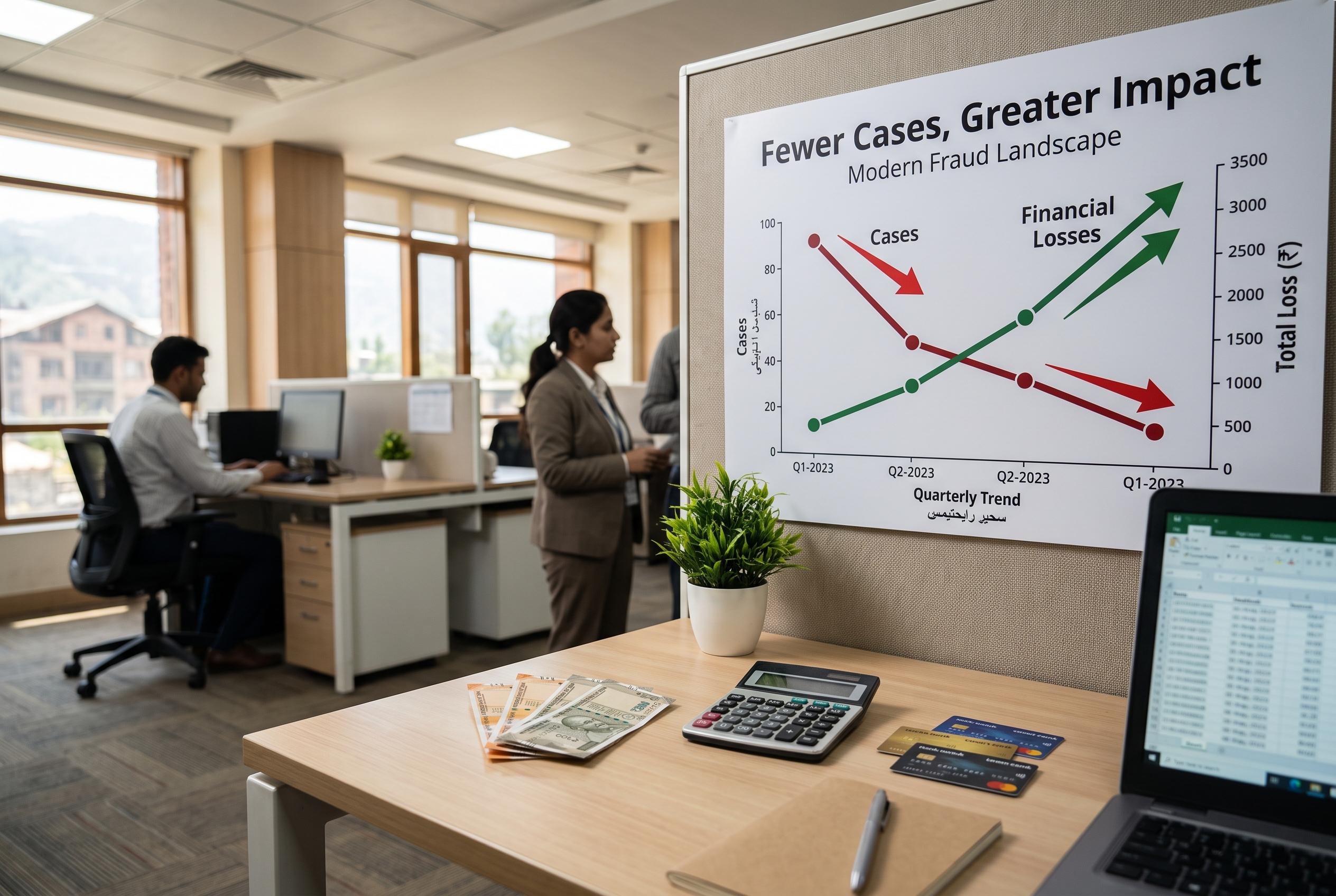

Reported banking fraud cases in Jammu and Kashmir have declined sharply over three years, yet the total amount lost has surged, highlighting a shift towards fewer but more costly incidents, according to Union finance ministry data.
Banking and financial fraud in Jammu and Kashmir has become less frequent but far more expensive, with the value of reported cases climbing sharply even as the number of incidents fell, according to data the Union finance ministry placed before Parliament on August 3.
The figures, drawn from Reserve Bank of India records, show 868 fraud cases across scheduled commercial banks and financial institutions in the Union territory over the three financial years from 2023-24 to 2025-26. Those cases involved ₹322.31 crore, but only ₹12.80 crore was recovered.
The pattern changed markedly over that period. Reported cases fell from 467 in 2023-24 to 298 in 2024-25 and then to 103 in 2025-26. Yet the money involved rose from ₹47.55 crore to ₹81.27 crore and then surged to ₹193.49 crore in the latest year, the highest annual figure in the three-year span.
That means the volume of cases dropped by nearly 78 per cent while the value involved increased by more than four times. The average exposure per case rose from roughly ₹10 lakh in 2023-24 to about ₹27 lakh in 2024-25 and nearly ₹1.88 crore in 2025-26, suggesting a shift from smaller, more numerous incidents towards fewer but much larger frauds.
Recovery remains limited. Banks recovered ₹3.23 crore in 2023-24, ₹2.65 crore in 2024-25 and ₹6.92 crore in 2025-26, leaving the three-year recovery rate at less than 4 per cent of the total amount involved.
The Jammu and Kashmir numbers sit within a much larger national trend. According to the same Parliamentary data, scheduled commercial banks and all-India financial institutions reported frauds worth about ₹91,631 crore across the country over the three years. Jammu and Kashmir’s share was about 0.35 per cent of that total.
Nationally, the biggest losses were tied to lending and other advance-related frauds, while card and internet frauds involved far smaller sums. Separate RBI reporting highlighted that the overall value of banking frauds in India rose sharply in 2025-26 even as the number of cases fell, reinforcing the same pattern seen in Jammu and Kashmir: fewer incidents, higher-value losses.
The ministry also said the figures for Jammu and Kashmir do not refer to Jammu and Kashmir Bank alone. The data cover frauds reported by scheduled commercial banks, excluding regional rural banks, and by all-India financial institutions operating in the territory, with no bank-wise breakup provided in the parliamentary reply.
On recovery and victim compensation, the ministry said the RBI does not maintain state-wise and category-wise data in the precise format sought by lawmakers. It added that there are no fixed timelines for recovery because cases often move through several agencies and forums, including police, the Serious Fraud Investigation Office, the Central Bureau of Investigation, debt recovery tribunals and courts.
Disclaimer: This article is intended to inform and educate, not to recommend or endorse any financial product, investment or strategy. Please consider your own financial circumstances and seek professional advice where appropriate before making financial decisions.



