

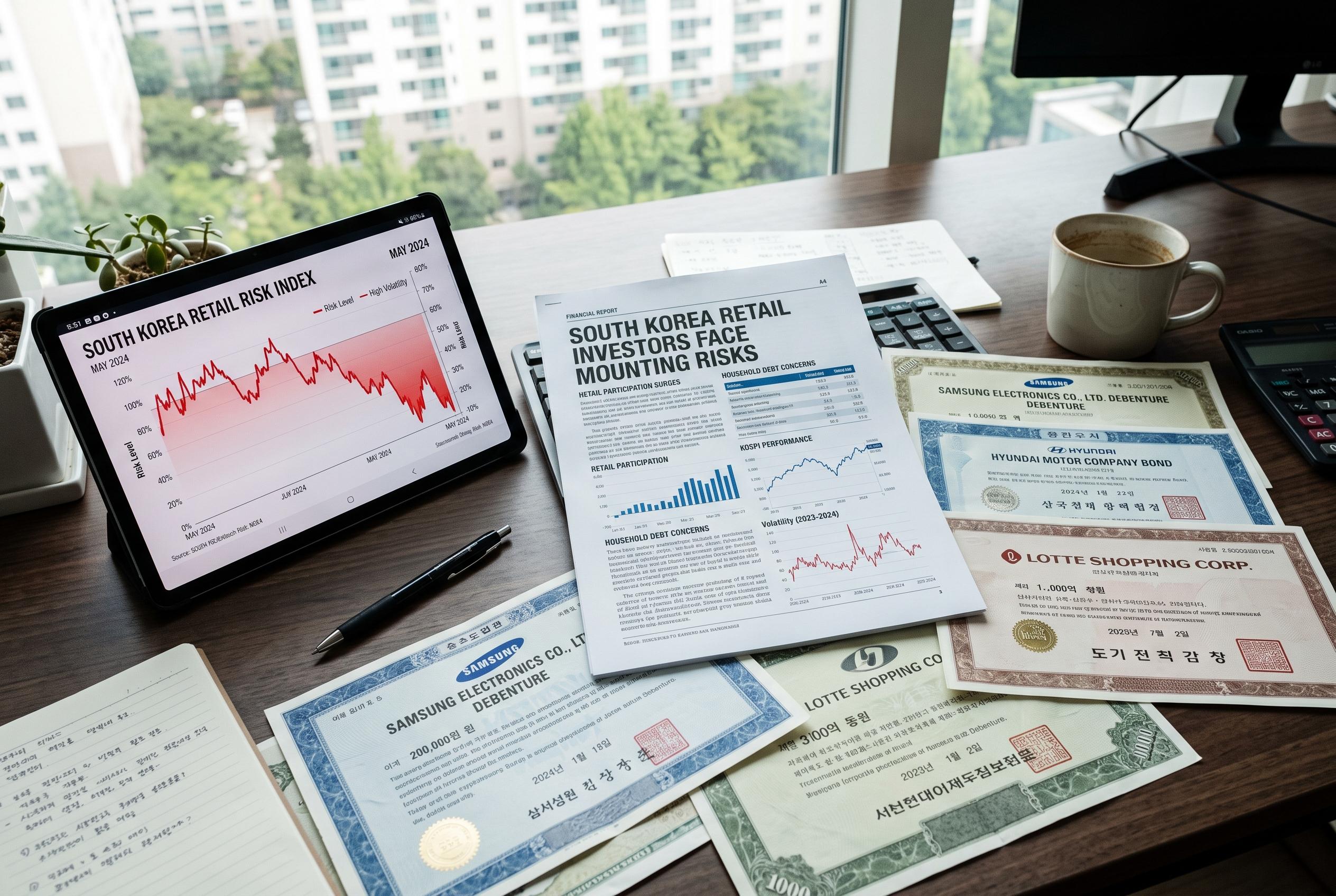

Retail investors in South Korea are increasingly being pushed into the riskiest corner of the corporate bond market, as securities firms offload unsold speculative-grade paper amid fears of rising defaults and limited regulatory safeguards.
Retail investors in South Korea are increasingly being pushed into the riskiest corner of the corporate bond market as securities firms offload unsold speculative-grade paper from institutional deals, raising fears that ordinary savers are being left to absorb losses from failing companies.
According to the Financial Investment Association’s bond data centre, total net purchases of corporate bonds from January 1 to August 5 came to 14.5221 trillion won, down 35.7% from 22.5887 trillion won in the same period a year earlier. Yet the share bought by individuals rose to 24.8% from 20.5%, suggesting that private investors are taking a larger slice of a shrinking market.
The shift reflects a market in which better-quality bonds are typically absorbed by institutions during bookbuilding, while retail channels are often left with the leftovers. For BBB-rated and lower issues, underwriters frequently take on unsold allocations and then place them with individuals through retail desks, meaning bonds rejected by professional buyers can end up in household portfolios under the lure of higher yields.
The concern is sharpened by the fact that retail investors face few formal barriers to entry. In practice, anyone with a securities account can buy corporate bonds through mobile or online trading platforms without mandatory training or a minimum deposit. That has fuelled alarm after a series of defaults and distress cases, including the collapse linked to JTBC debt and the recent move by JR Global Reit into EOD and rehabilitation proceedings, which revived memories of the 2013 Tongyang Group scandal.
Consumer advocates say the answer is not necessarily to ban weaker companies from issuing debt, but to make retail access much harder. Jeong Ho-cheol of the Citizens’ Coalition for Economic Justice said investors should scrutinise financial health carefully when credit ratings weaken, but added that ordinary individuals cannot always detect signs as severe as complete capital erosion. He argued that securities firms should be forced to give stronger warnings and that compulsory education or higher deposit thresholds should be considered for risky bond purchases.
There is also debate over whether the old rules should be brought back. Before a 2012 revision to the Commercial Act, bond issuance limits were tied to equity, which effectively blocked companies with eroded capital from issuing debt. Some market participants now say the tighter approach should be revisited, but others warn that cutting off funding altogether could deepen distress among marginal borrowers. One anonymous bond-market source said raising the buying threshold, rather than shutting the issuance door completely, would be the more practical fix.
Financial regulators have also been reminding investors that even safer bonds can produce losses if sold before maturity when interest rates rise. The Financial Supervisory Service has said a 30-year government bond yielding 3% could lose about 17% of its market value if market rates rise by one percentage point, underscoring that bond investing is not risk-free even before credit quality is considered.
Disclaimer: This article is intended to inform and educate, not to recommend or endorse any financial product, investment or strategy. Please consider your own financial circumstances and seek professional advice where appropriate before making financial decisions.



