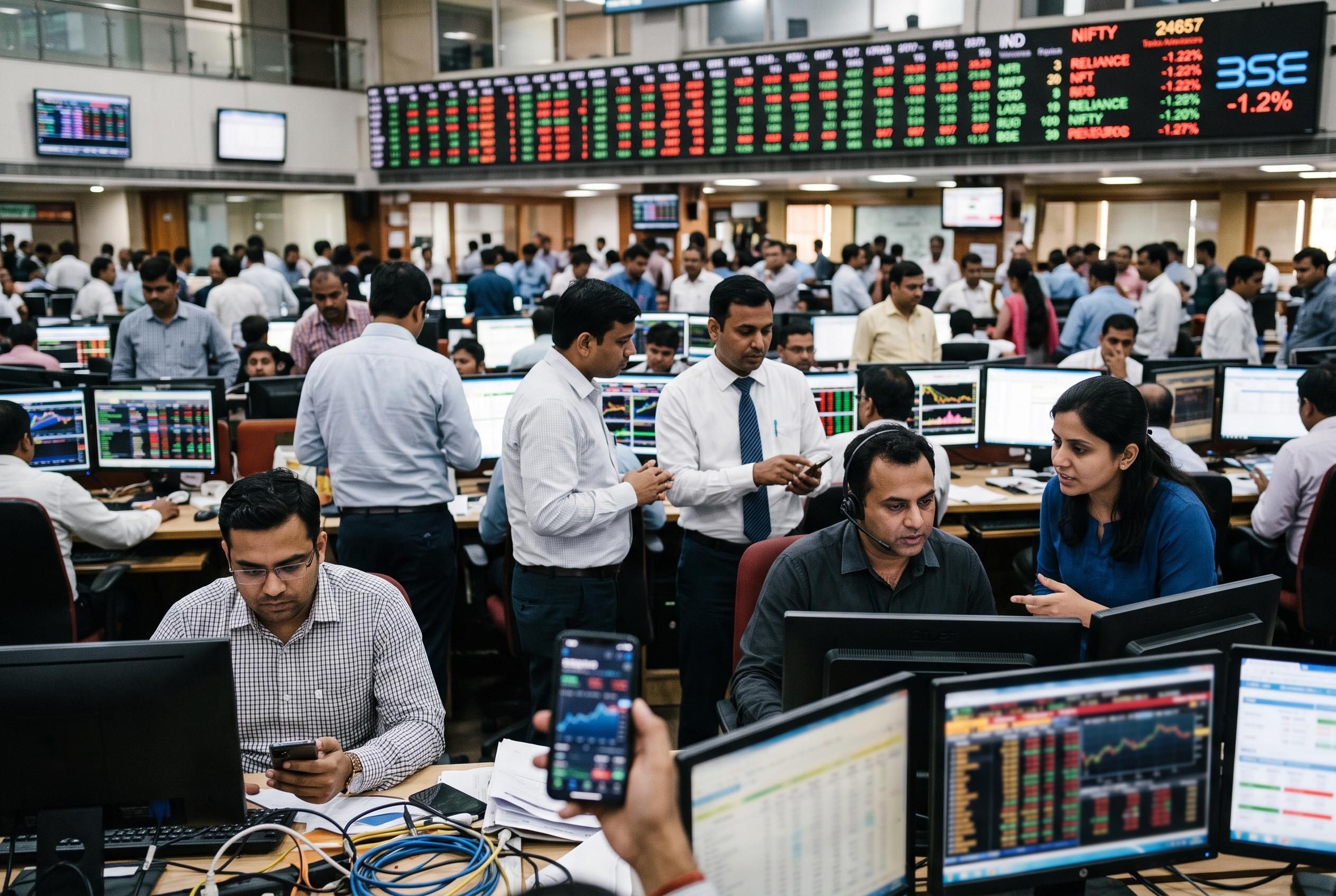

The Nifty fell 1.64% to a fresh 52-week low as rising oil prices, a weaker rupee, elevated bond yields and persistent overseas selling intensified pressure on Indian shares.
Indian equities fell sharply on Thursday, with the Nifty sliding to a fresh 52-week low as investors continued to unload riskier assets amid a mix of rising crude oil prices, persistent foreign selling and firmer global bond yields. The benchmark index dropped 1.64% to 22,231.80, while the Sensex declined 1.44%, or 1,045.46 points, to 71,593.24.
The day’s losses deepened after a weak opening, with the Nifty sinking to an intraday low of 22,179.90 and moving below its earlier low from April 2, 2026. The Sensex also stayed under pressure throughout the session, trading between 72,693.97 and 71,327.75 before ending close to its weakest level of the day. HDFC Securities said the Nifty has now fallen more than 10% from its early-August peak of 24,774 and is almost 16% below its record high of 26,373.
The selling was broad-based. Every sectoral index finished lower, with metals, real estate, media, autos, energy and fast-moving consumer goods among the worst hit. Technology shares held up better than the broader market, but not enough to offset the slide. The Nifty Midcap 100 lost 2.53%, while the Nifty Smallcap 100 declined 2.34%, and HDFC Securities said the advances-to-declines ratio slipped to 0.30, underlining the market’s weak breadth.
Currency and debt markets added to the pressure. The rupee closed at 96.78 against the US dollar after touching an all-time low of 97.10 during the session. Brent crude rose above $104 a barrel, while the yield on India’s 10-year government bond climbed to about 7.2%, a two-year high. The US 10-year Treasury yield remained around 5.3%, keeping global borrowing costs elevated and pressuring risk assets across markets.
Market participants also pointed to the Reserve Bank of India’s recent 25-basis-point repo rate increase to 5.50% and its shift to calibrated tightening as another source of concern. Sandip Jha, chief product officer at Godrej Wealth, said the market was caught in what he described as a “perfect storm” of crude above $100, sustained foreign institutional investor selling, hawkish central bank policy, high US yields and a weaker rupee. Shrikant Chouhan, head of equity research at Kotak Neo, said the rate rise had not eased concerns and that global risk aversion was pushing overseas investors towards dollar assets.
Technical analysts said the Nifty has already broken below its 200-week exponential moving average at 22,379, a level often watched by traders for signs of longer-term support. Pabitro Mukherjee, deputy vice-president for research at Bajaj Broking, said any rebound could meet resistance in the 22,400-22,600 range, while a further decline could drag the index towards 22,000 and then 21,750. For now, investors appear to be looking mainly for a domestic catalyst, and Siddhartha Khemka, head of research at Wealth Management, Motilal Oswal Financial Services, said the earnings season may be the only credible near-term trigger.
Disclaimer: This article is intended to inform and educate, not to recommend or endorse any financial product, investment or strategy. Please consider your own financial circumstances and seek professional advice where appropriate before making financial decisions.