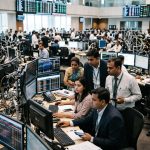

Despite mounting climate disasters and rising public debt, global markets remain resilient, with investors focusing on technology and AI-led growth while hedging against potential downturns through gold and currencies.
Markets are proving surprisingly resilient in the face of geopolitical conflict, heavy public borrowing and renewed climate damage, even as investors have become more willing to shrug off bad news. Europe’s summer wildfire season has underscored the scale of that risk: Euronews reported that burned land has already reached the size of Luxembourg, while the World Health Organization has warned that wildfire incidents in Europe have climbed sharply over the past four years.
The fires have been especially severe in Spain, France, Portugal, Italy and Turkey, where the damage is not limited to forests and homes. According to Euronews, evacuations have run into the hundreds of thousands and the wider economic fallout is hitting public finances, insurers and tourism. That broader point matters for investors because climate shocks increasingly translate into real claims, weaker output and higher long-term rebuilding costs.
Fiscal pressures are mounting at the same time. France’s debt burden is well above the Maastricht benchmark, Japan remains among the most indebted advanced economies and Germany is no longer comfortably below the 60% debt-to-GDP threshold, as the source article notes. In the US, Bloomberg reported that a recent 30-year Treasury sale produced the highest yield in about 25 years, a sign that lenders are demanding more compensation for government borrowing.
Yet investors have not reacted with the caution those risks might suggest. Market breadth has improved beyond the largest technology names, which is healthier than a narrow rally, but it does not eliminate the possibility that expectations have become too optimistic. The main driver of growth still looks heavily dependent on government spending, easier financial conditions and concentrated investment tied to artificial intelligence.
That concentration risk is now drawing attention from some of the world’s biggest investors. Norway’s sovereign wealth fund has recently pointed to the dangers of a market increasingly shaped by enthusiasm for artificial intelligence, while South Korea’s KOSPI has been lifted by a small group of semiconductor giants, Samsung Electronics and SK Hynix, according to Bloomberg. The problem is not that these companies lack strength, but that crowded leadership leaves portfolios vulnerable if sentiment turns.
The same logic applies to portfolio construction. For shorter horizons, fixed income can still serve as a stabiliser because it reduces volatility and helps investors avoid selling risk assets during downturns. For longer horizons, however, the question is less about short-term price swings and more about preserving purchasing power and meeting objectives after inflation. That is why the old 60/40 model is being challenged, with some strategists, including Morgan Stanley’s Mike Wilson, arguing for greater weight in gold as a hedge against inflation and fiscal strain.
Currencies and precious metals remain part of the same debate. The article points out that Japan’s role as the largest foreign holder of US government debt reflects the carry trade, which can unwind abruptly when volatility rises. It also argues that gold and silver retain strategic value because they sit outside the credit system and continue to attract central banks and long-term investors. In that sense, the central message is straightforward: markets may stay buoyant for longer than sceptics expect, but the margin for disappointment is shrinking.
Disclaimer: This article is intended to inform and educate, not to recommend or endorse any financial product, investment or strategy. Please consider your own financial circumstances and seek professional advice where appropriate before making financial decisions.