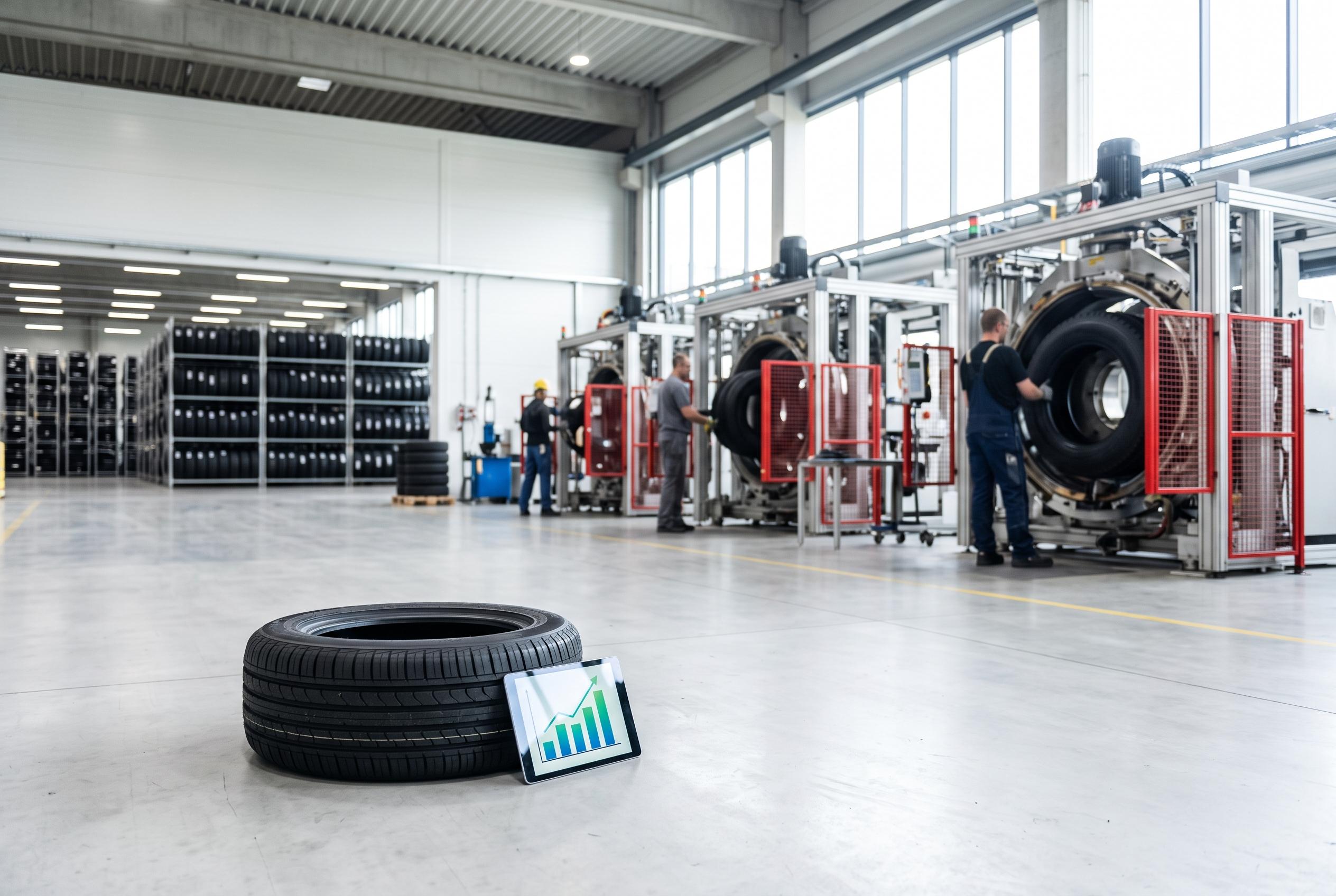

JK Tyre & Industries announced a 25% increase in domestic sales volumes for the June quarter, driven by strong demand and rural infrastructure growth, despite margins contracting due to raw material costs and international disruptions.
JK Tyre & Industries said its domestic business posted a sharp rise in volumes in the June quarter, even as a steep jump in raw material costs and pressure at its Mexican unit dragged on profits.
The company said domestic sales volumes climbed 25% from a year earlier, helped by strong demand from original equipment makers and solid momentum across replacement tyres and other segments. Management said the gap between volume growth and revenue growth reflected pricing effects, with price rises feeding through gradually rather than all at once.
That stronger demand backdrop has not yet translated into better margins. Consolidated EBITDA fell to ₹268 crore from ₹424 crore a year earlier, while the margin dropped to 6.8% from 10.9%. Profit after tax slumped to ₹43 crore from ₹309 crore, as the company absorbed about a 20% sequential increase in raw material costs, which it linked to disruption in West Asia.
Anshuman Singhania, managing director, said the company had already implemented cumulative price increases of about 11% and planned further hikes of 5% to 6% to help offset input costs. Sanjeev Aggarwal, chief financial officer, said JK Tyre expected EBITDA margins to return to the 11% to 13% range in the second half of FY27, supported by cost cuts, a richer product mix and operating leverage.
The outlook for demand remains constructive. The company pointed to record performance in India’s auto industry and said farm tyre volumes rose 22% year on year, helped by rural demand and infrastructure spending. It is also pushing ahead with a ₹4,980 crore expansion in passenger car radial and truck and bus radial capacity at Chennai, while its electric vehicle tyre business is gaining traction with double-digit volume growth.
Internationally, JK Tornel in Mexico was hit by geopolitical disruption, input shortages and labour-related productivity talks, though Arun Bajoria, executive director and president for international operations, said those issues had been resolved and production had normalised. He also said the renewal of the US-Mexico-Canada Agreement for 10 years should keep the duty structure favourable to Mexico.
Debt rose by ₹500 crore sequentially to ₹4,945 crore, mainly because of expansion-related borrowing and higher working capital needs. Aggarwal said leverage remained comfortable, but added that debt could rise by another ₹500 crore to ₹700 crore in FY27 as the company funds new capacity and supports a higher operating base.
Disclaimer: This article is intended to inform and educate, not to recommend or endorse any financial product, investment or strategy. Please consider your own financial circumstances and seek professional advice where appropriate before making financial decisions.