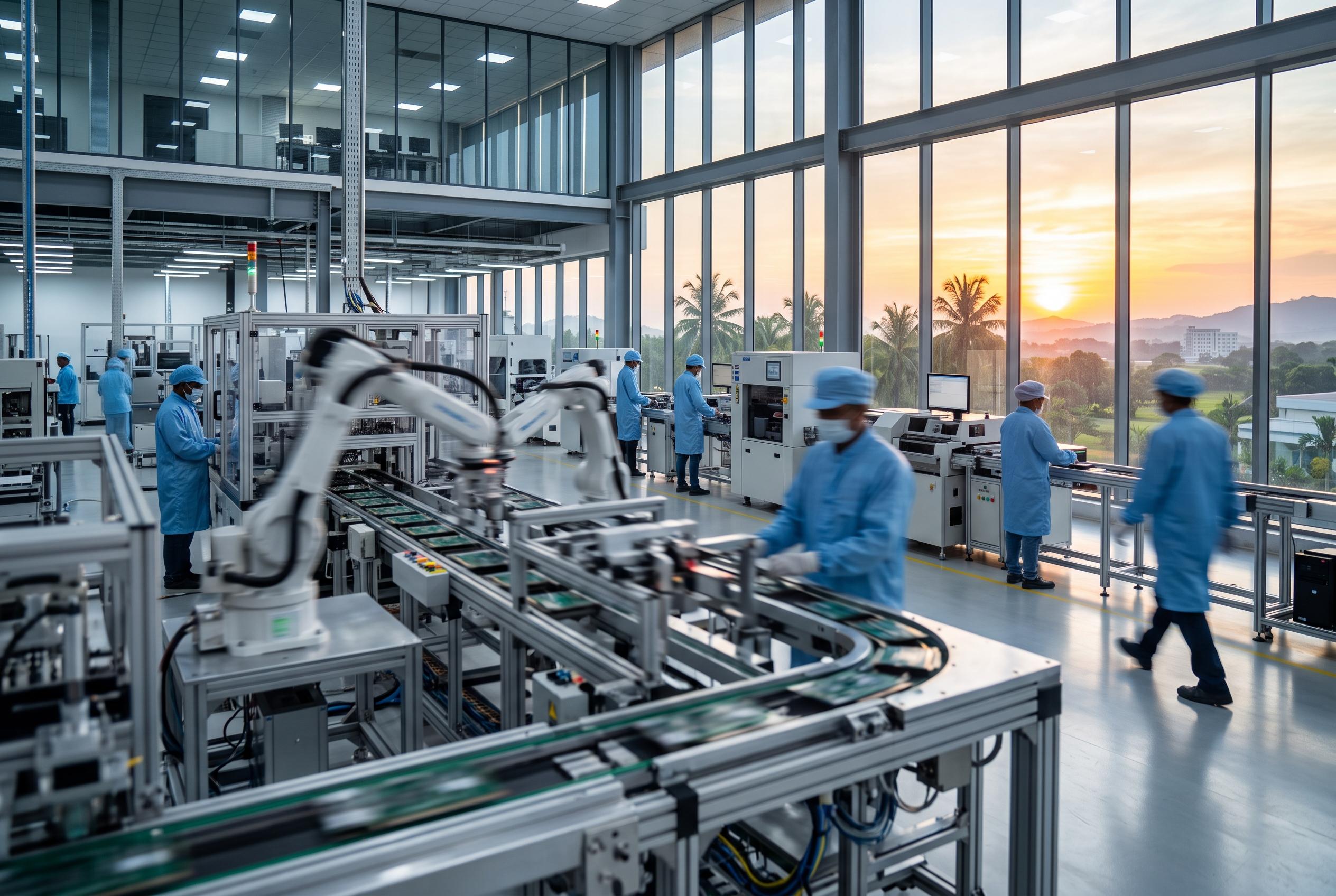

India launches a comprehensive push into semiconductor manufacturing, aiming to reduce reliance on China by expanding into mature-node chip production and building a resilient electronics industry through substantial government support and foreign demand.
India is trying to repeat its iPhone manufacturing success in a far more demanding arena: semiconductors. Over the past five years, the country has lifted its share of global iPhone output from China to about 25%, helped by a ₹30,000 crore incentive scheme that encouraged Apple and its suppliers to shift production. Now New Delhi wants to use a similar mix of policy support and industrial targeting to build a foothold in chipmaking, starting with mature nodes rather than cutting-edge processors. Those older 28-nanometre-and-above chips remain essential for cars, appliances, telecom gear and internet-connected devices, and still account for the bulk of global semiconductor volumes. Reuters-style reporting on the sector suggests the government sees this as an opening to reduce dependence on China while still tapping strong domestic demand.
The next phase of that push is Semicon 2.0, which the government has approved with an additional ₹1.27 trillion in support for fabrication plants, outsourced semiconductor assembly and test facilities, packaging operations and design firms. LiveMint reported that the wider package also includes a separate ₹62,500 crore mobile-phone manufacturing scheme, underscoring the government’s effort to deepen local production across the electronics chain. According to Business Standard, India’s current strategy is deliberately focused on assembly, testing and packaging because these projects require less capital and can come on stream faster than full-scale fabs. Industry groups say that is important in a market where China still has a sizeable cost advantage and scale remains decisive.
The first signs of traction are already visible. Micron, Kaynes Technology and CG Power have begun operations under the earlier incentive framework, while more projects cleared in the second phase are expected to come on line over the next year or two. Companies involved in the sector say global customers are not approaching India only for cheaper production, but also to diversify supply chains away from China. Kaynes Semicon says its output is already fully booked by customers in the US, Europe and Japan, while Suchi Semicon in Surat has also reported strong foreign demand for its planned expansion. Their executives argue that India’s combination of government backing, rising electronics manufacturing and geopolitical de-risking gives it a credible pitch, even if it is still early days.
Demand at home is part of the case for expansion. According to the Indian Electronics and Semiconductors Association, India met only 9% of its semiconductor needs domestically in 2021, and the market was then worth $27 billion. Business Standard reported that the association expected the market to keep growing rapidly as mobile phones, wearables, IT systems, industrial equipment, 5G and cloud infrastructure all drive consumption. More recent government estimates place demand far higher, with officials now talking about a $150 billion market by 2030 as artificial intelligence adds fresh pressure on supply.
The harder test will be in fabrication, where India remains at the beginning of the curve. Tata Electronics is building the country’s first major silicon fab in Gujarat at a cost of about $11 billion, but it is not expected to be operational until mid-2028. By contrast, China is still pouring much larger sums into mature-node capacity and is expected to widen its lead in that segment over the next few years. Even so, analysts say India’s approach is strategically sensible: build where entry barriers are lower, use packaging and testing to establish capability, then expand into more advanced manufacturing. The government’s ambition is bold enough to match the scale of the challenge, with a stated aim of making India one of the world’s top five semiconductor powers by 2032.
Disclaimer: This article is intended to inform and educate, not to recommend or endorse any financial product, investment or strategy. Please consider your own financial circumstances and seek professional advice where appropriate before making financial decisions.