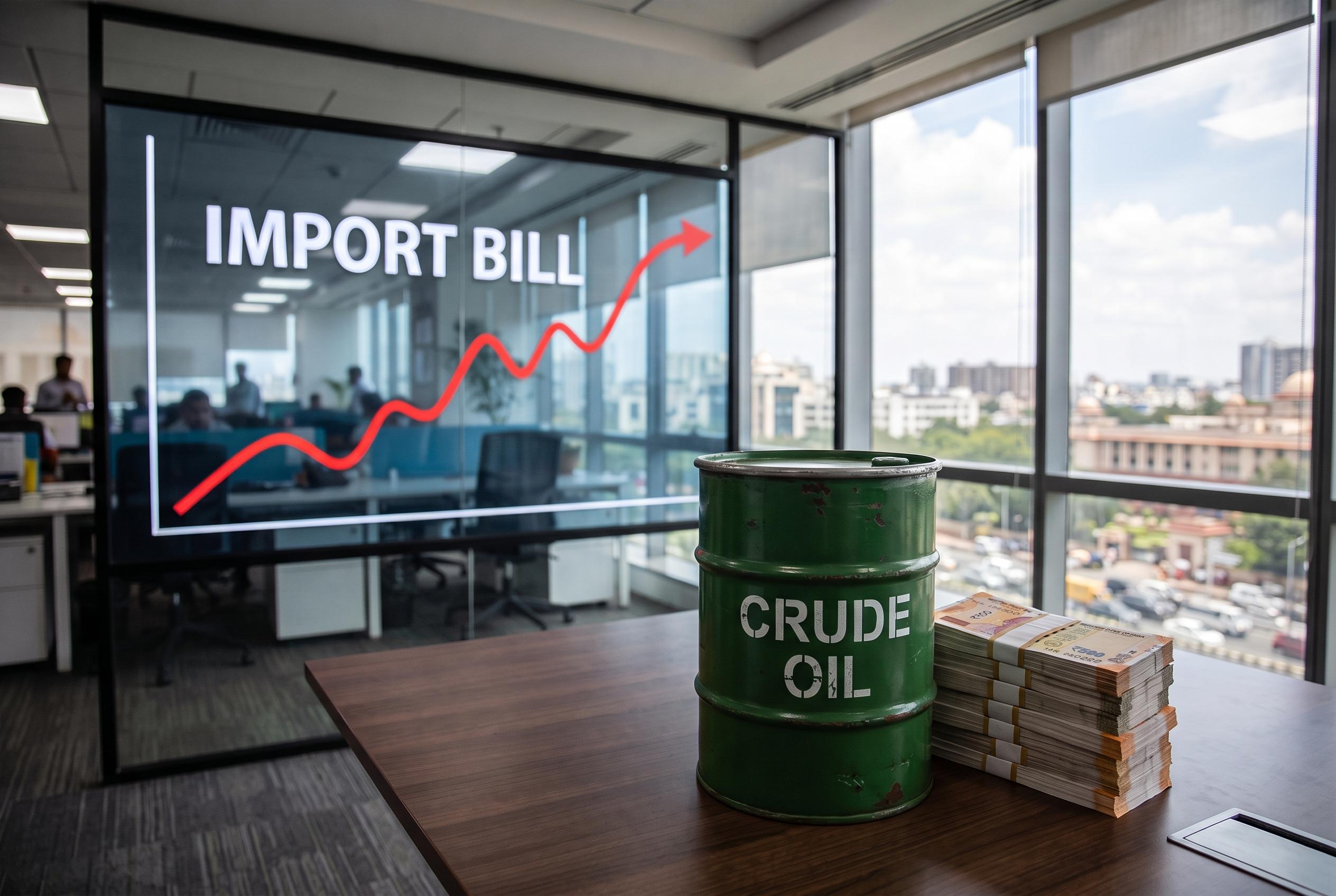

India’s crude oil import bill surged to $49 billion in Q2 2026-27 despite purchasing less oil, as global prices and geopolitical tensions drove costs higher amid a softer rupee and supply route concerns.
India’s crude oil import bill climbed sharply in the April-to-June quarter of fiscal 2026-27, even though the country bought less oil than a year earlier. According to data cited by TV9 Hindi and LiveMint, the cost of imports rose to about $49 billion, up from roughly $39 billion in the same period last year, as higher global prices and a weaker rupee outweighed the fall in volumes.
The trade figures show how exposed India remains to swings in the oil market. The country imported 59.7 million tonnes of crude in the quarter, down from about 73 million tonnes a year earlier, yet still paid far more for the smaller haul. LiveMint said the average price of imported crude rose to around $113 a barrel from nearly $67 a barrel in the corresponding quarter a year ago, highlighting how quickly external shocks can feed through to India’s energy costs.
The increase came amid renewed volatility in West Asia, where tensions had raised concerns over supply routes, including the Strait of Hormuz. India sources close to 90% of its crude needs from abroad, and a large share of those shipments typically passes through the Gulf. Industry commentary cited by India Briefing said around 2.5 million to 2.7 million barrels a day move through that corridor, underscoring why disruptions there can ripple through the Indian economy.
Currency weakness added to the pressure. Because India buys crude in dollars, a softer rupee makes every barrel more expensive in local terms. The TV9 Hindi report noted that even a $1-a-barrel rise can add roughly $2 billion to India’s annual import bill, given the scale of the country’s crude purchases.
Russia remained India’s biggest supplier in the quarter, accounting for more than 40% of total imports, according to the TV9 Hindi report. The United Arab Emirates followed with a 14.6% share, while Saudi Arabia supplied 9.9%, Venezuela 5.2% and Oman 4.5%. Earlier reporting by Business Standard and The New Indian Express also showed Russia holding its lead among Indian buyers in February 2026, despite political pressure from Washington.
The changing mix of suppliers reflects a broader effort by Indian refiners to balance price, availability and geopolitical risk. Times of India reported that India increased purchases from Russia and kept UAE inflows near record levels in June as refiners looked to secure supply after the reopening of the Strait of Hormuz. That diversification has not shielded India from higher costs, but it has helped maintain flows as the market has grown more unstable.
Disclaimer: This article is intended to inform and educate, not to recommend or endorse any financial product, investment or strategy. Please consider your own financial circumstances and seek professional advice where appropriate before making financial decisions.