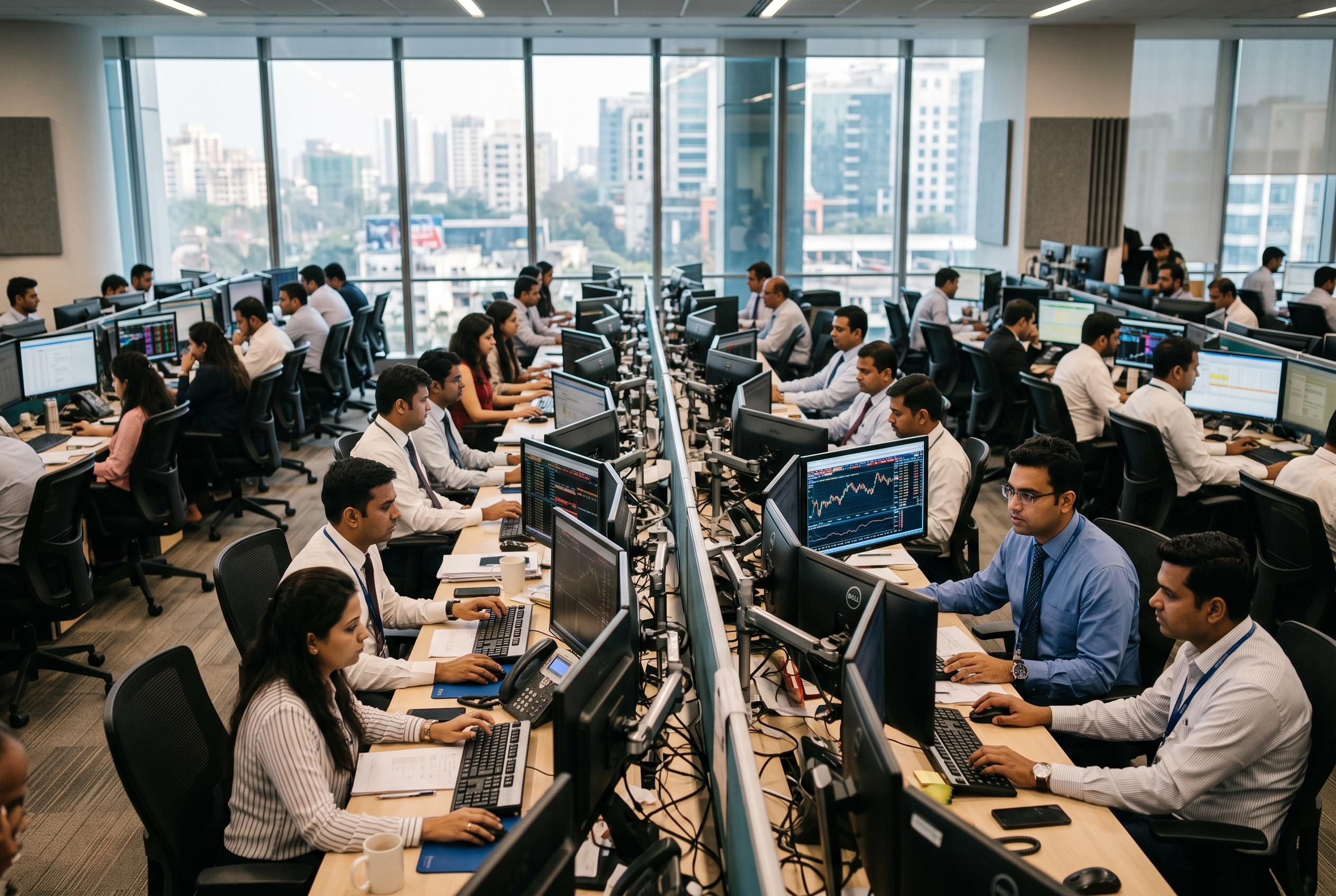

India’s National Stock Exchange, a dominant force in the country’s equities market, is poised to raise around 22,562 crore rupees through a proposed IPO, as it faces scrutiny over trading dependency and industry risks.
India’s biggest stock exchange is preparing for an initial public offering that could raise about 22,562 crore rupees through an offer for sale, with 23 existing investors, including State Bank of India and Bank of Baroda, trimming holdings. The listing has drawn attention because the National Stock Exchange sits at the centre of India’s market activity, even though the investment case remains tied to the risks of trading volumes, regulation and market sentiment.
Founded in 1992, NSE has built an outsized position in India’s equities market. By FY26, it accounted for 93% of cash market activity and 99.7% of equity futures turnover, underlining how deeply it is embedded in daily market trading. According to Groww, the issue is also being discussed around a price band that places the upper end at 1,785 rupees a share, with investor categories and minimum application sizes likely to matter for demand.
The business, however, is heavily dependent on transactions. In FY26, about 79% of operating income came from transaction charges, and around 60% of that was linked to options trading. NSE has tried to widen its income base through data and colocation services, which rose 9.5% to 1,955.9 crore rupees. Even so, revenue fell 3% to 16,601 crore rupees in FY26 as rule changes curbed activity in both cash equities and derivatives, reducing transaction income by 4%.
Profitability remains strong despite that slowdown. Net profit rose 11% year on year to 10,302 crore rupees, while the EBITDA margin stood at 66.9%, ahead of BSE’s 64%, according to the figures cited in the lead report. NSE also had no debt and held a net cash reserve of 17,976 crore rupees as of 31 March 2026, which gives it a balance-sheet cushion that many listed financial firms lack.
Still, the risks are real. As of 30 June 2026, NSE had 13.24 crore registered investors, but almost half of its revenue came from its top 10 trading members, showing how concentrated its business remains. That leaves it exposed to regulatory changes, technology failures, cyber threats and abrupt shifts in policy. For long-term investors willing to accept market risk, the exchange’s dominance and debt-free balance sheet may look attractive, but the IPO appears better suited to those who understand that exchange earnings rise and fall with trading activity.
Disclaimer: This article is intended to inform and educate, not to recommend or endorse any financial product, investment or strategy. Please consider your own financial circumstances and seek professional advice where appropriate before making financial decisions.