

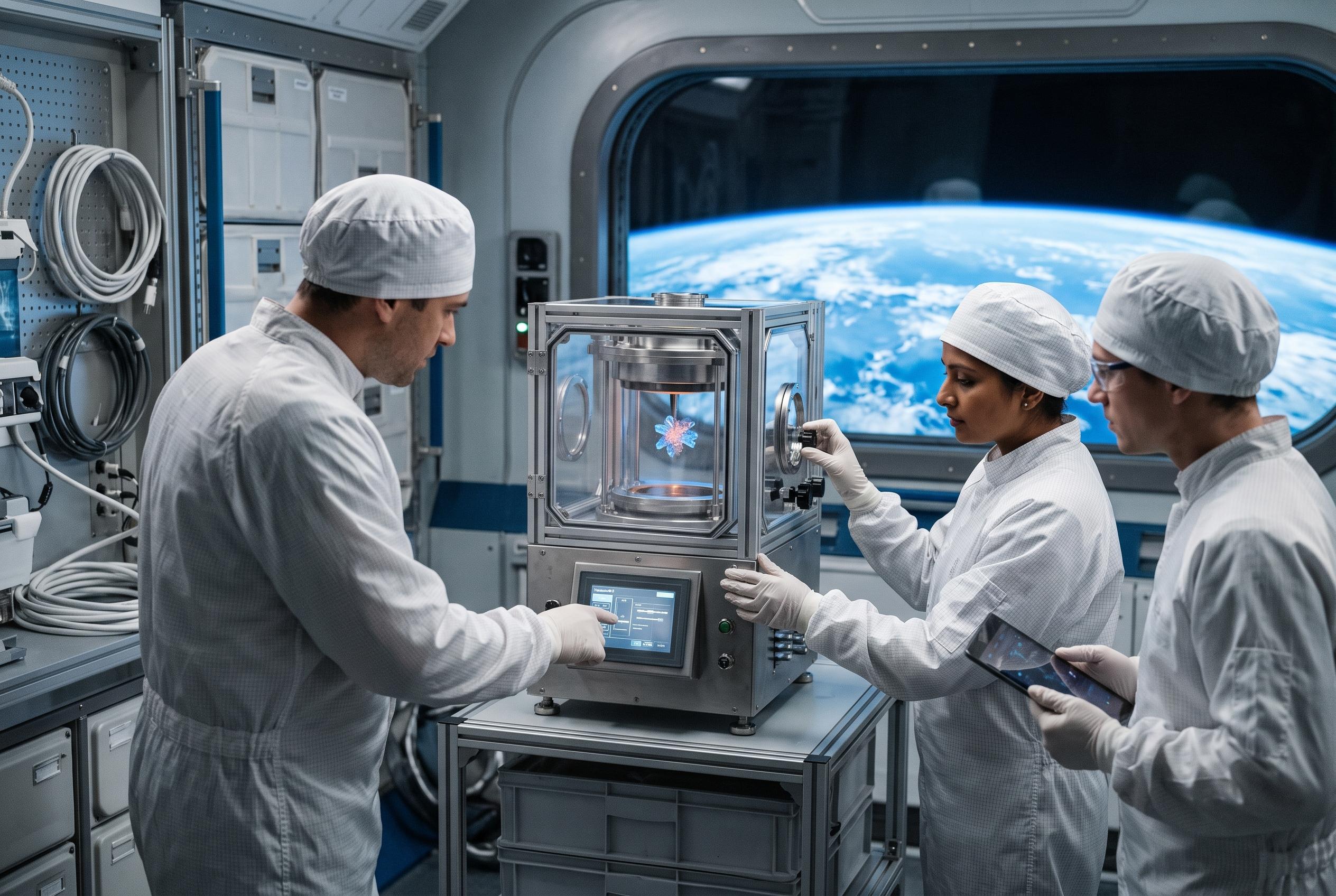

Indian startups are progressing from microgravity research to attempting commercial production of medicines in orbit, seeking to harness low Earth orbit conditions for drug crystallisation and advanced materials, despite significant logistical and regulatory challenges.
Indian startups are beginning to test a bold idea: that some medicines may be better made in orbit than on Earth. What was once a niche field of microgravity research is moving towards commercial manufacturing, with firms now looking beyond observation and towards production of drug crystals and advanced materials in low Earth orbit. According to Inc42, the question is no longer whether space alters biological processes, but whether those conditions can be turned into a repeatable industrial advantage.
That ambition has already produced early proof points. Rediff reported this month that Odisha-based Serendipity Space successfully demonstrated drug crystallisation in a near-space mission, using an orbital-class satellite prototype with an autonomous pharmaceutical factory called Alchemy. The company, supported by the Tata Institute of Fundamental Research balloon facility in Hyderabad, says microgravity can produce more uniform crystal structures, which may improve a drug’s solubility, stability and effectiveness. The Indian Express likewise reported that the Bhubaneswar-based start-up has flight-tested a prototype satellite designed to carry out key steps in pharmaceutical manufacturing under microgravity conditions.
Other Indian space ventures are pursuing related models. Inc42 said Ethereal is developing a reusable upper stage for microgravity experiments, while AnduraX is working on reusable spaceplanes for pharmaceutical companies and Akashalabdhi is building modular inflatable habitats for low Earth orbit. The New Indian Express reported separately that one Indian start-up is designing satellites that can manufacture pharmaceuticals in space and then return them to Earth, suggesting the market may ultimately extend beyond research missions to actual production and recovery systems.
For now, the near-term opportunity appears to lie in drug crystallisation and protein folding, areas where microgravity can help scientists control structures that are hard to reproduce on the ground. But the commercial hurdles remain formidable. Launch costs are high, access to orbital platforms is limited and validation can take years, while regulatory approval, payload recovery and mission reliability all add complexity. Inc42 noted that support from IN-SPACe, the Technology Adoption Fund and the planned Bharatiya Antariksh Station could help move Indian experiments from isolated tests to repeatable missions. Still, as global players such as Merck and Redwire push ahead, India’s challenge is to turn promising demonstrations into a workable manufacturing sector.
Disclaimer: This article is intended to inform and educate, not to recommend or endorse any financial product, investment or strategy. Please consider your own financial circumstances and seek professional advice where appropriate before making financial decisions.



