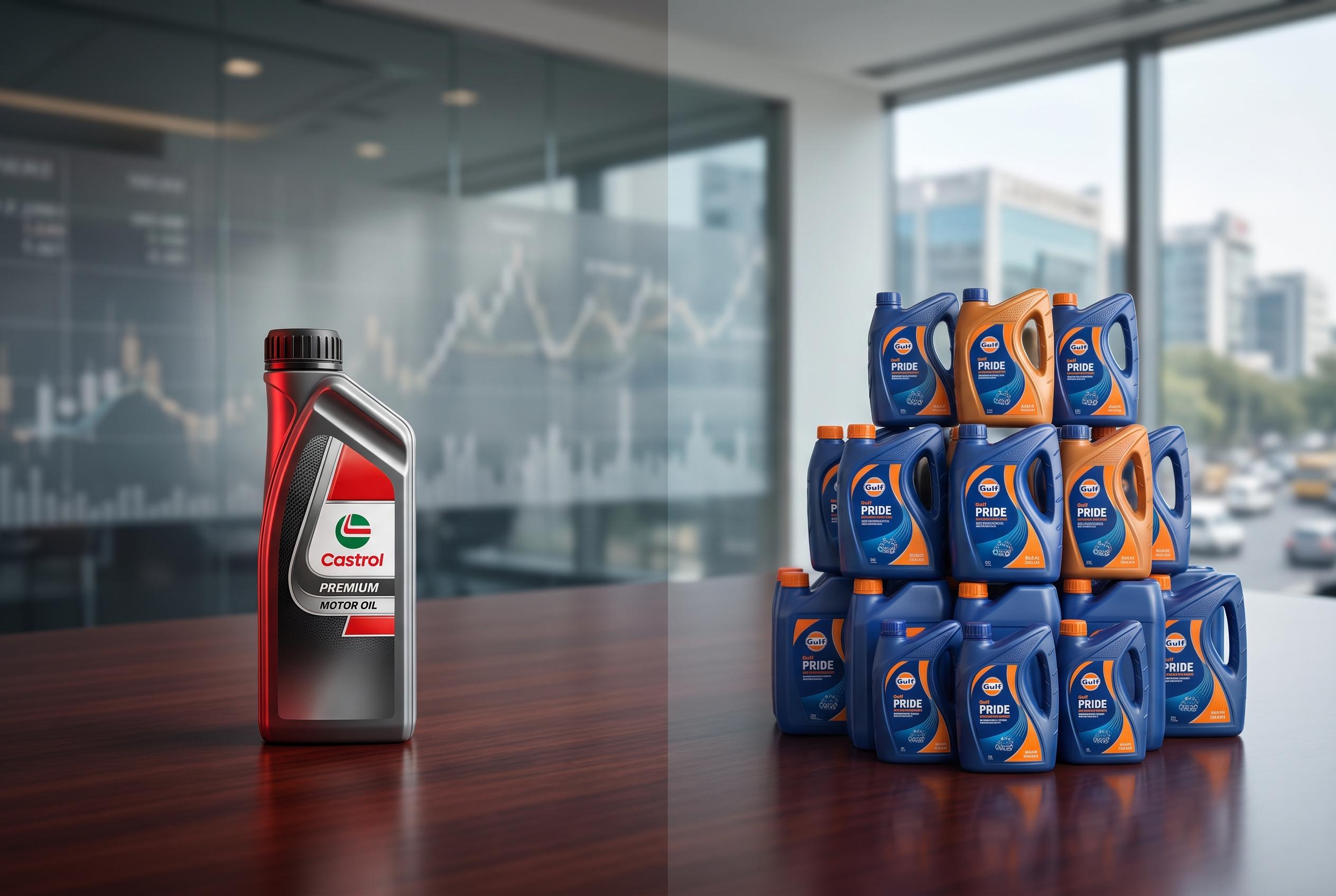

Castrol India and Gulf Oil Lubricants India navigate challenging terrain through different growth playbooks, highlighting a premium versus volume approach in a competitive market.
Castrol India and Gulf Oil Lubricants India have both held up well in a difficult operating environment, but they are doing so through different playbooks. Trade Brains reports that Castrol is leaning on premium products, wider distribution and brand-led selling, while Gulf Oil is pushing harder on volume growth, customer relationships and operational flexibility.
The comparison comes at a time when India’s lubricant makers are still dealing with higher raw material costs, supply chain interruptions and shifting consumer demand. Moneycontrol’s latest financial data shows Castrol India with a market value of ₹18,981 crore and shares around ₹192, about 11% below their 52-week high of ₹216. Gulf Oil Lubricants India has a market capitalisation of ₹5,903 crore, with shares near ₹1,191, roughly 10% below a 52-week high of ₹1,331. Castrol trades at a price-to-earnings ratio of 17.5, while Gulf Oil stands at 14.6, both above the industry’s 13.2.
On the operating side, Castrol reported revenue growth of 25% year on year to ₹1,871 crore in the quarter cited by Trade Brains, helped by strength in consumer, industrial and institutional demand. Gulf Oil posted faster top-line growth of 32.5% to ₹1,320.4 crore in its quarter, underscoring the momentum behind its volume-led strategy. Profitability also improved at both companies, with Castrol delivering EBITDA growth of 41% and profit after tax growth of 43%, while Gulf Oil recorded EBITDA growth of 34.6% and PAT growth of 31.9%.
Their strategies reflect those different priorities. Castrol has been expanding its premium lubricant range, including more fully synthetic products, and is deepening its reach through a distribution network that it says now covers about 160,000 retail outlets, alongside around 45,000 rural outlets and a larger workshop presence. Gulf Oil, by contrast, is focusing on relationships with original equipment manufacturers, distributors and industrial customers, with Trade Brains saying it works with more than 50 OEMs and over 1,000 industrial clients. The company has also broadened its portfolio beyond lubricants, including moves into electric-vehicle-linked businesses through Tirex Chargers and ElectreeFi.
Both companies still face an uncertain second half of the year. Trade Brains says Castrol expects inflationary pressure and uneven monsoon patterns to weigh on demand, while Gulf Oil is prioritising supply chain resilience and continued growth. For now, Castrol appears to be winning on premium positioning and brand strength, while Gulf Oil is showing that scale and flexibility can also deliver in a tough market.
Disclaimer: This article is intended to inform and educate, not to recommend or endorse any financial product, investment or strategy. Please consider your own financial circumstances and seek professional advice where appropriate before making financial decisions.