

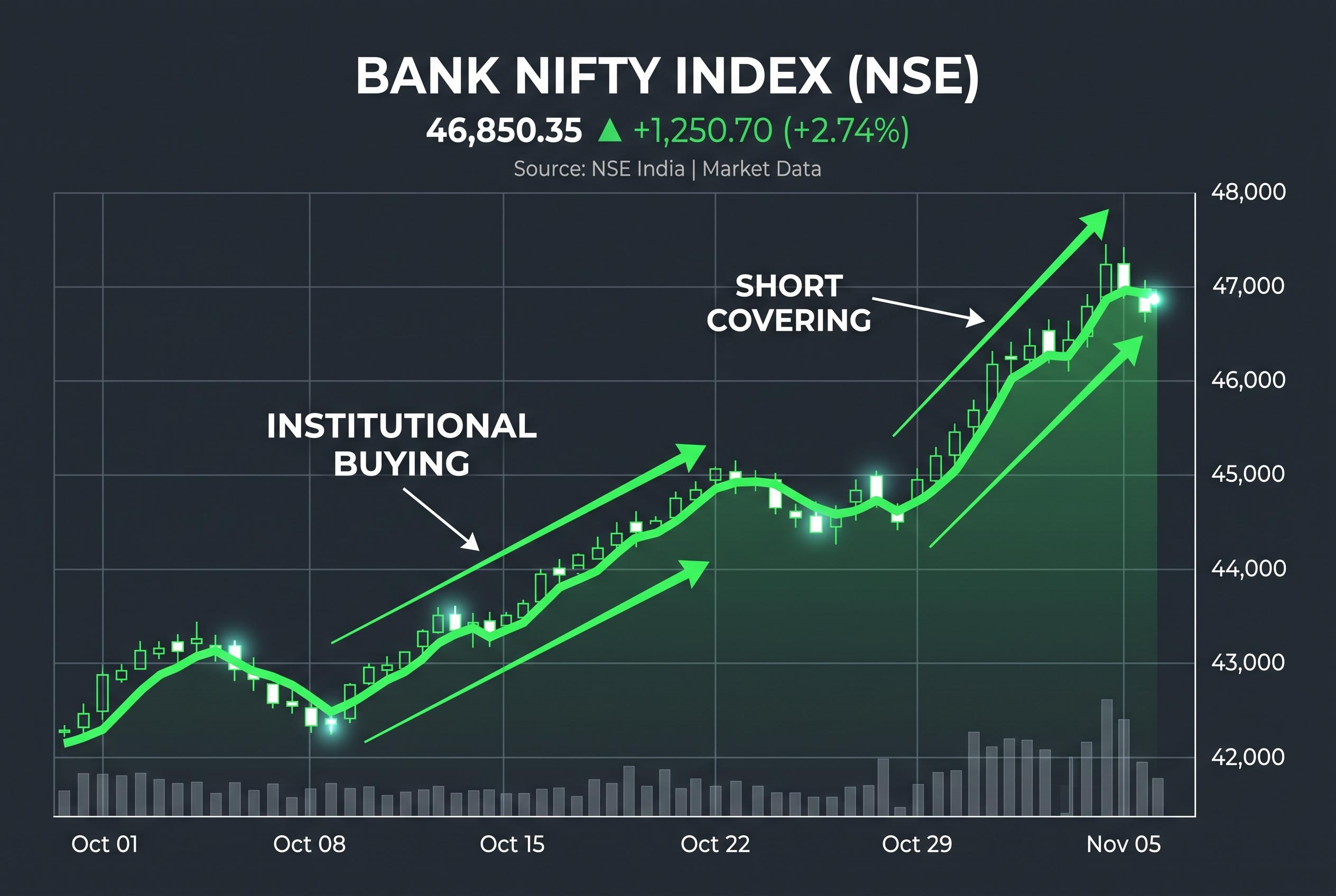

Bank Nifty extends recovery with strong institutional support and short covering, approaching key resistance levels as traders await SBI earnings to determine next move.
Bank Nifty extended its recent recovery on Thursday, signalling that buyers still have the upper hand after the index pushed out of a tight consolidation band. The move came as foreign institutional investors turned net buyers in index futures and data pointed to short covering, a combination that often helps reinforce momentum in the near term.
The index closed at 58,063, above its rollover cost of 57,177, which market participants will read as a sign of underlying strength. The options structure was also broadly constructive, with a put-call ratio of 0.96, max pain at 58,000 and call open interest clustered at 58,500, suggesting the market may need fresh buying to sustain a move higher. On the downside, 57,500 has emerged as a notable support area.
Technically, the session marked a clean upside break from the previous narrow range, with the index posting a higher high and finishing up 347 points after a daily range of 352 points. That build on earlier signs of resilience in the banking pack. Moneycontrol reported in July that Bank Nifty had crossed 58,000 for the first time in that phase of the rally, while other market commentary in July and February pointed to the index holding above key moving averages and defending important support zones.
The next test arrives with State Bank of India’s results due during market hours, which could inject sharp volatility because of the lender’s heavy weight in the index. Traders will focus on net interest margin, asset quality and any update on fundraising plans. For now, the near-term bias remains constructive, but the market is likely to respect the 58,008 and 57,951 levels as key short-term pivots before deciding whether the move toward 58,500 to 58,700 can extend.
Disclaimer: This article is intended to inform and educate, not to recommend or endorse any financial product, investment or strategy. Please consider your own financial circumstances and seek professional advice where appropriate before making financial decisions.



