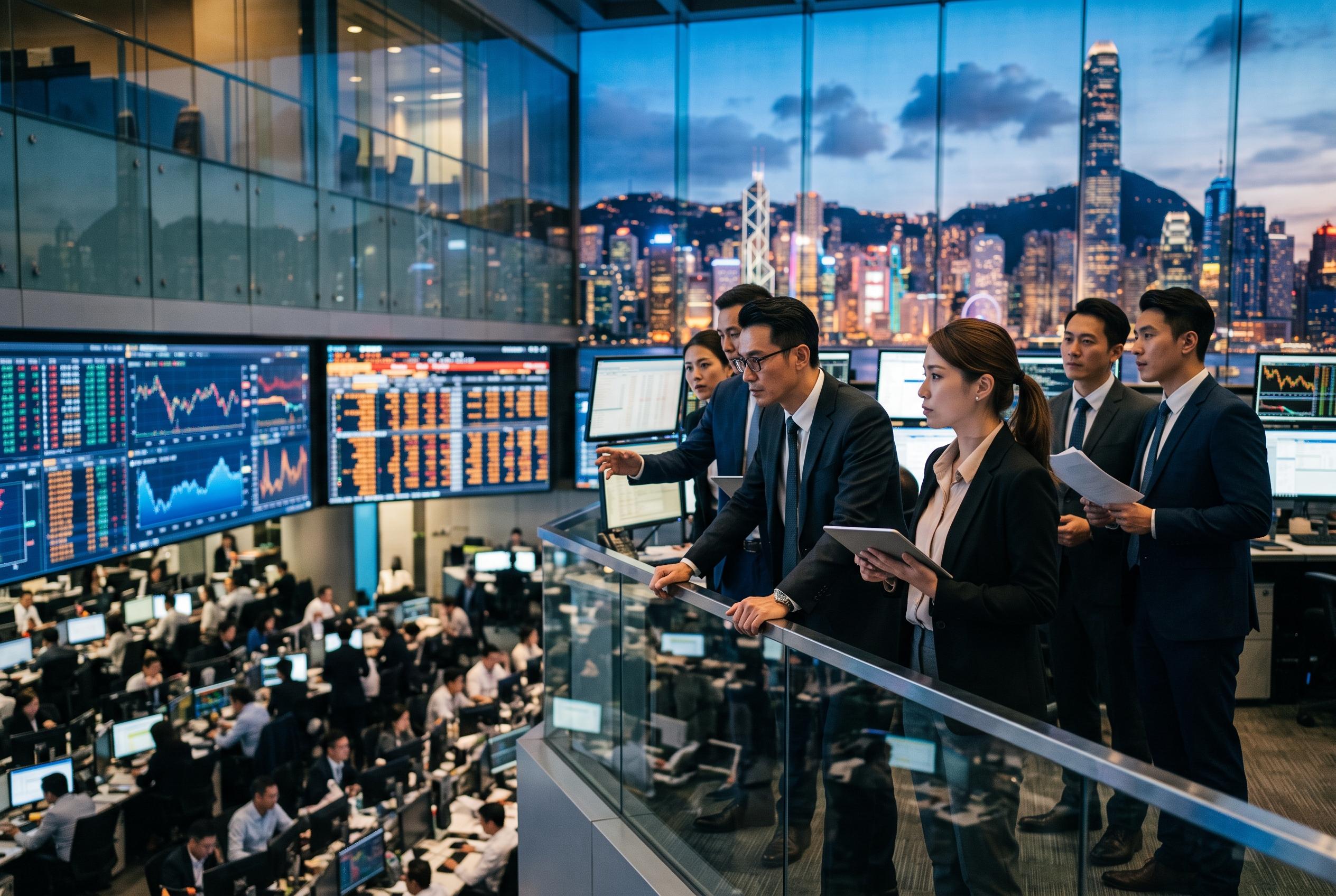

A regional scramble for AI-related assets has propelled South Korean and Japanese stock indices to record highs in 2026, driven by major investments, export growth, and investor speculation, despite mounting geopolitical and economic risks.
What looked at first like another brisk semiconductor bounce in Tokyo and Seoul has grown into one of 2026’s defining market trades: a regional scramble for anything tied to artificial intelligence, still powerful enough in early September to lift South Korean shares almost 9% for the month and leave Japan’s Nikkei up 6.5%, according to Reuters (tradingview.com). Fresh fuel came from Nvidia’s plan to invest up to US$100bn in OpenAI, with the first data-centre equipment due in the second half of 2026, even as investors bought insurance alongside the rally and pushed gold to a record US$3,755.47 an ounce (tradingview.com).
The scale of the move had already become clear by mid-May. Reuters reported then that SK Hynix was nearing a US$1tn valuation, the Kospi was up 88% for 2026 and MSCI’s Asia-Pacific benchmark outside Japan was hovering near its record high (investing.com). That optimism was unfolding against a tense geopolitical backdrop: Donald Trump was due in Beijing for talks with Xi Jinping aimed at preserving a fragile trade truce while managing flashpoints including the Iran war and arms sales to Taiwan, a reminder that the AI story never had the field to itself (investing.com).
By 1 June, the rally had picked up harder evidence from the real economy. Reuters said Samsung Electronics had begun shipping samples of its latest high-bandwidth memory chip, sending the shares up almost 10%, while South Korea’s exports rose at their fastest annual pace in more than four decades to a record US$87.75bn in May (marketscreener.com). Yet that same report showed how quickly the narrative could be interrupted: stalled Gulf peace talks drove Brent up 2.1% to US$93.02 a barrel and US crude 2.6% to US$89.61, keeping alive fears that energy costs would bleed back into inflation and rates (marketscreener.com).
As the summer wore on, the machinery of the trade became part of the story. Chris Weston of Pepperstone told Reuters that “we’d need to see something leftfield to derail the upbeat flows”, while the agency said momentum funds and options buyers were helping to turn the tech advance into a self-reinforcing move (tradingview.com). Europe lagged, Chinese blue chips barely moved and yet Asian chip-heavy benchmarks kept grinding higher, underscoring how concentrated the enthusiasm had become around a narrow cluster of AI-linked stocks (tradingview.com).
That concentration also made the market unusually violent. On 3 July, after the Kospi had sunk nearly 8% the previous day, AP reported that it rebounded 5.8% to 8,088.34, with Samsung Electronics up 8.2% and SK Hynix up 10.9%; in Tokyo, the Nikkei rose 1.5% to 69,744.07 and Kioxia jumped 9.2% (apnews.com). Stephen Innes of SPI Asset Management said the episode showed “how quickly a stretched rubber band can snap back when everyone leans the same way”, capturing a market in which conviction and leverage were clearly amplifying each other (apnews.com).
AP’s reporting a week later showed just how far Seoul’s AI champions had travelled into global capital markets. SK Hynix raised about US$26.5bn through American depositary shares in what AP described as the biggest-ever US share sale by a foreign company; the stock opened at US$170 after pricing at US$149 and finished its Nasdaq debut at US$168.01, up 13.1% (apnews.com). AP also noted that the Seoul-listed shares had surged 634% over the previous year, but warned that genuine profit growth in memory chips was reviving an older question: whether the vast sums pouring into chips and data centres will generate enough productivity and earnings to justify these valuations (apnews.com).
Currency markets told a related, but not identical, story. Reuters had the dollar at 157.88 yen in mid-May and 156.46 yen in February, when analysts said a push towards 160 could trigger intervention warnings from Tokyo (investing.com). By 4 September, Yonhap reported that the won had strengthened to 1,350.4 per dollar, its strongest level since 30 June 2025, as foreign investors bought a net 479.3bn won of local shares and exporters, including SK Hynix, converted dollar proceeds into the local currency (en.yna.co.kr).
The groundwork for all this was laid well before the summer’s fever pitch. In February, Reuters said a decisive election win for Japanese Prime Minister Sanae Takaichi had sharpened expectations of reflationary policies, lifting the Nikkei 3.9% to fresh highs while South Korea’s tech-heavy index gained 4.1% (lse.co.uk). Marc Jocum of Global X ETFs Australia called Japan “a reform story with meaningful momentum”, though the price of that enthusiasm was visible too: two-year Japanese government bond yields climbed to 1.3%, their highest since 1996, as investors anticipated more borrowing and fiscal support (lse.co.uk).
Taken together, the reporting points to something more complicated than a simple risk-on burst. Asia’s AI trade has been sustained by real export growth, tangible demand for memory chips and a powerful global search for beneficiaries rather than spenders, but it has also repeatedly run into the same hazards: dearer oil, policy uncertainty, geopolitical shocks and nagging doubts about whether the spending boom will pay back (investing.com). The result is a market capable of pushing South Korea’s currency and share prices sharply higher, but just as capable of lurching the other way when one of its crowded semiconductor trades starts to unwind.
Disclaimer: This article is intended to inform and educate, not to recommend or endorse any financial product, investment or strategy. Please consider your own financial circumstances and seek professional advice where appropriate before making financial decisions.