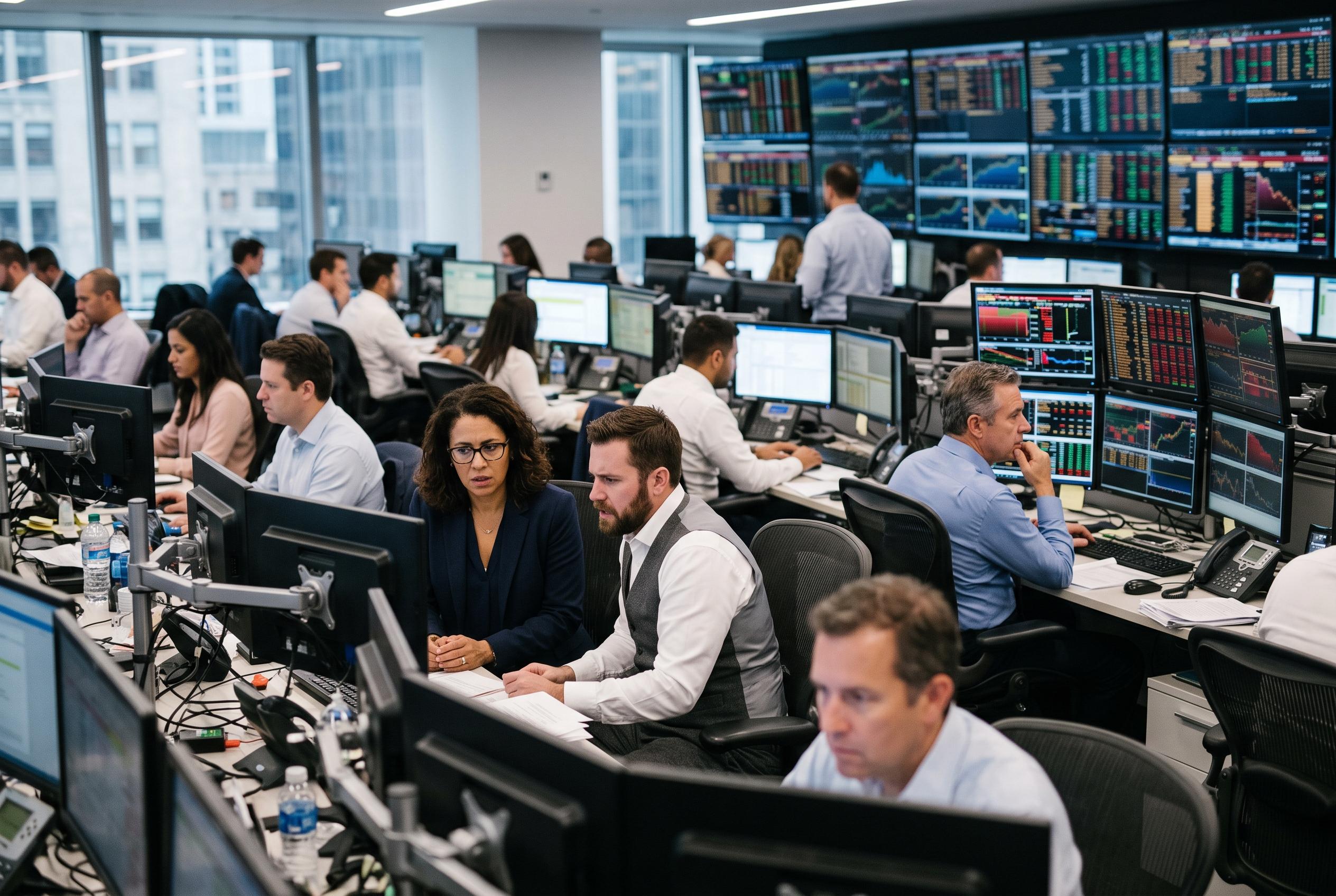

A broadening sell-off and warnings from the IMF are intensifying fears that the AI boom has become a source of systemic risk for investors and the wider economy.
The latest warning signs in US markets have sharpened concerns that the artificial intelligence trade may be losing momentum just as it became the dominant force in equity investing. MktContext said its market timer has turned to “PAUSE”, arguing that the rally has failed to hold above record levels and that narrow market leadership is giving way to broader weakness as volatility rises and investors rush to cut exposure.
That reading tallies with the latest market action. On 16 October 2026, the Nasdaq Composite fell 2.1% and ended the week down 4.5%, while the S&P 500 and Dow Jones Industrial Average also slipped, according to Kiplinger. Semiconductor shares fell for a ninth straight session, deepening doubts about whether the AI boom can keep supporting the wider market. Nvidia and CoreWeave were among the names that lagged, while Treasury yields moved lower as investors reassessed the outlook for growth and interest rates.
The International Monetary Fund has added to the sense of unease. In a recent warning, the fund said the AI build-out has become a potential source of systemic risk if investor enthusiasm carries valuations too far. The IMF identified three main dangers: a sharp fall in AI-related share prices, rising government bond yields and a major cyberattack on critical infrastructure, especially financial institutions. It also pointed to the scale of cross-investment inside the technology sector, where firms have committed roughly $950 billion in equity and debt against about $1.4 trillion in expected revenue, a web of exposure that could amplify any sudden correction.
Those fears are not new. S&P Global Market Intelligence reported in mid-2024 that AI enthusiasm had been a major force behind the broader market’s gains, with the S&P 500 hitting repeated highs and AI-linked stocks rising far faster than the market as a whole. But some analysts have long cautioned that the story could become overextended. Paul Schatz, president of Heritage Capital, told S&P Global Market Intelligence that the AI rally was “absolutely not sustainable”, even as he said the technology remained a powerful long-term theme. More recently, Bank of America has warned that a break in the AI trade could alter the usual relationship between stocks and bonds, while other market watchers say the current pullback may still fall short of the scale of the dot-com collapse. For now, the message from traders is less about certainty than strain: the market is no longer rewarding the AI narrative with the same confidence, and that shift is beginning to matter.
Disclaimer: This article is intended to inform and educate, not to recommend or endorse any financial product, investment or strategy. Please consider your own financial circumstances and seek professional advice where appropriate before making financial decisions.