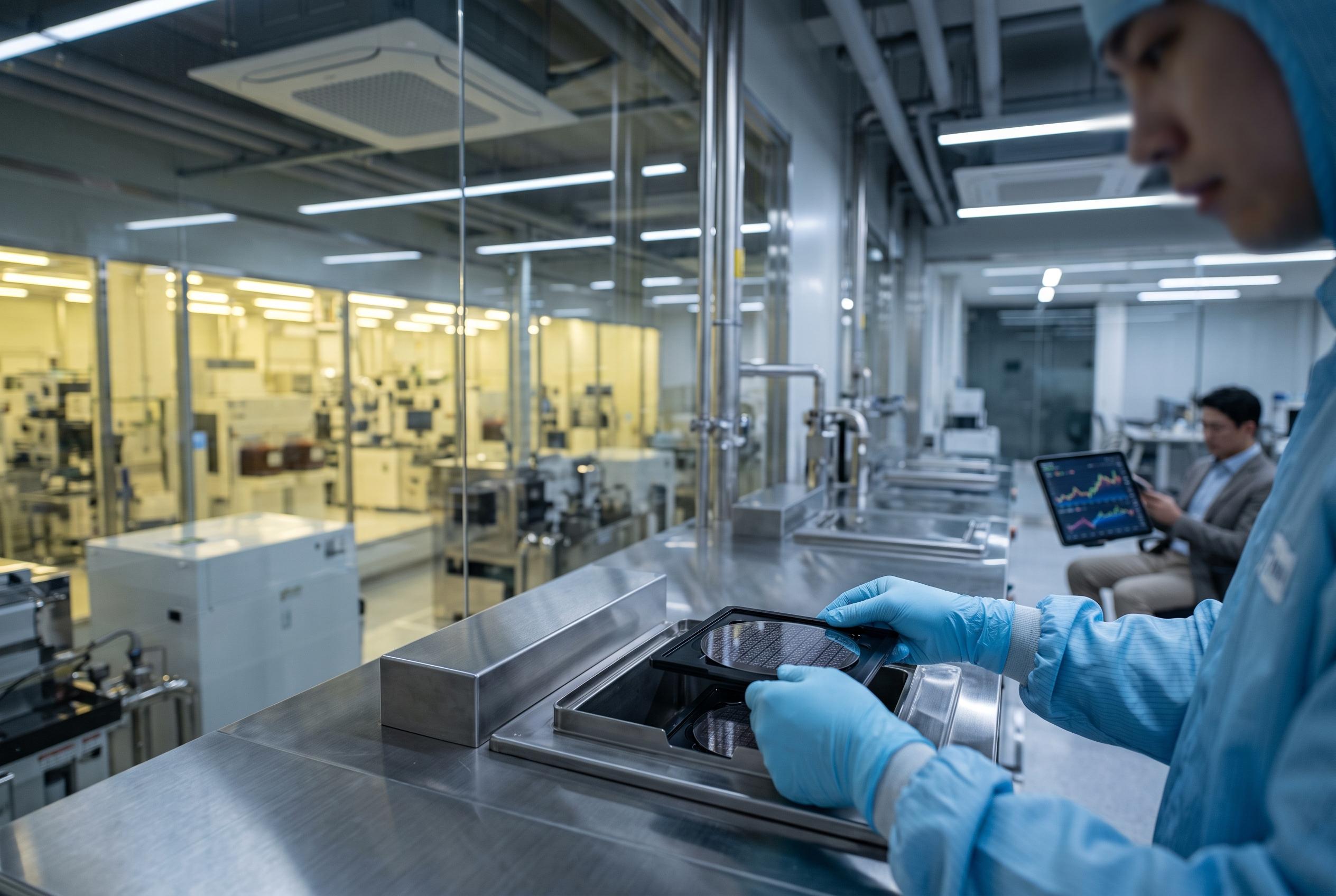

Korean semiconductor giants Samsung Electronics and SK hynix are at the centre of a market rally driven by an AI memory boom, tight supply, and renewed interest in industrial and energy stocks linked to infrastructure and nuclear power expansion.
Samsung Electronics, SK hynix and a cluster of related Korean stocks drew investor attention on Wednesday as the market continued to price in a prolonged shortage of conventional DRAM and firmer pricing for high-bandwidth memory, or HBM, the fast-growing chip used in artificial intelligence systems. That backdrop helped keep semiconductors, nuclear and power infrastructure shares near the top of the market watch list.
According to Naver Pay Securities data cited by the report, the most-searched names before the opening bell were Samsung Electronics, SK hynix, Doosan Enerbility, HLB and KEPCO Engineering & Construction. The pattern pointed to a market split between memory-chip optimism and renewed interest in power-generation and industrial stocks linked to AI data centres, nuclear power and broader infrastructure spending.
Samsung Electronics and SK hynix both finished the previous session with uneven trade, reflecting the tension between stronger AI-linked demand and pressure from rising US Treasury yields. Samsung Electronics slipped 1.10% to 269,500 won, after briefly climbing as high as 276,000 won, while SK hynix rose 1.02% to 1,783,000 won after touching an intraday peak of 1,824,000 won. The broader technology backdrop was firmer, however, with the Philadelphia Semiconductor Index and Micron both gaining, which supported expectations that sentiment could recover.
The underlying investment case for memory remains tied to supply. Samsung has said at its Korea Premium Week 2026 event that HBM could account for more than one-third of total DRAM wafer capacity by the third quarter of 2027. As HBM production expands, capacity for ordinary DRAM is expected to shrink from 73% of the market in 2025 to 65% in 2026 and 59% in 2027. Analysts say that shift is tightening supply for legacy DRAM at the same time as AI demand continues to expand. S&P Global Market Intelligence has separately described the AI memory boom as diverting production away from conventional DRAM and pushing prices higher, while reports from the industry point to an exceptionally tight capacity environment.
Analysts are also warning that the squeeze may last for years rather than quarters. SK Group chairman Chey Tae-won has said the memory-chip shortage could persist until around 2030, according to Tom’s Hardware, and suggested that wafer supply is trailing demand by more than 20%. The same report said customers have even discussed direct investment in SK hynix production lines and equipment purchases to secure supply, an unusually aggressive response that reflects how central memory has become to AI infrastructure.
KB Securities analyst Kim Dong-won argued that the current market structure itself helps explain the tightness. He said that when a new product family consumes roughly 30% of total DRAM wafer capacity in only a few years, it is unsurprising that standard DRAM supply becomes scarce. Samsung’s HBM4 sales mix is expected to rise sharply, from 40% in 2026 to 80% in 2027, and some forecasts now point to HBM prices more than doubling in 2027. TrendForce has also reported that HBM3E spot prices are running well above long-term contract levels, with Samsung said to have locked in around 70% of its memory capacity through 2031.
That same AI build-out is spilling over into industrial and energy stocks. Doosan Enerbility rose 2.76% in after-market trade on the previous session to 81,900 won and remained in focus as investors looked for exposure to nuclear power, large reactors, small modular reactors and gas turbines. The company is also seen as a possible beneficiary of rising electricity demand from AI data centres and from long-running investment in US power grids and nuclear capacity. A separate report from CBC Globe, however, noted that nuclear-related shares were broadly weaker in the Korean market on 29 September, underlining that sentiment around the theme remains volatile even as the longer-term investment case stays intact.
HLB also stayed on investors’ screens after its US subsidiary Elevar Therapeutics won Food and Drug Administration approval for the bile-duct cancer treatment Riviput. The drug was cleared as a second-line treatment for adults with unresectable locally advanced or metastatic cholangiocarcinoma with FGFR2 gene fusions or rearrangements. HLB shares closed the previous after-market session up 2.99% at 41,350 won, as traders focused on how quickly the company can commercialise the treatment in the US.
KEPCO Engineering & Construction rose 2.64% in after-market trade to 124,300 won and was also pulled into the nuclear theme. With domestic and overseas policy discussions still pointing towards expanded nuclear capacity, the company remains a closely watched name in the reactor-design and project-management chain. Other shares tied to infrastructure, energy security and large industrial projects also attracted attention. Daewoo E&C rose 2.07% after being named as the winning bidder for a first construction package in the Yongin advanced system semiconductor cluster national industrial complex, where Samsung’s first chip manufacturing facility is expected to be built. POSCO International climbed 7.17% after analysts flagged its resilience during an energy-price rally, while Hanmi Semiconductor gained 2.38% as investors rotated from chipmakers into equipment suppliers that benefit from stronger HBM investment.
Disclaimer: This article is intended to inform and educate, not to recommend or endorse any financial product, investment or strategy. Please consider your own financial circumstances and seek professional advice where appropriate before making financial decisions.