

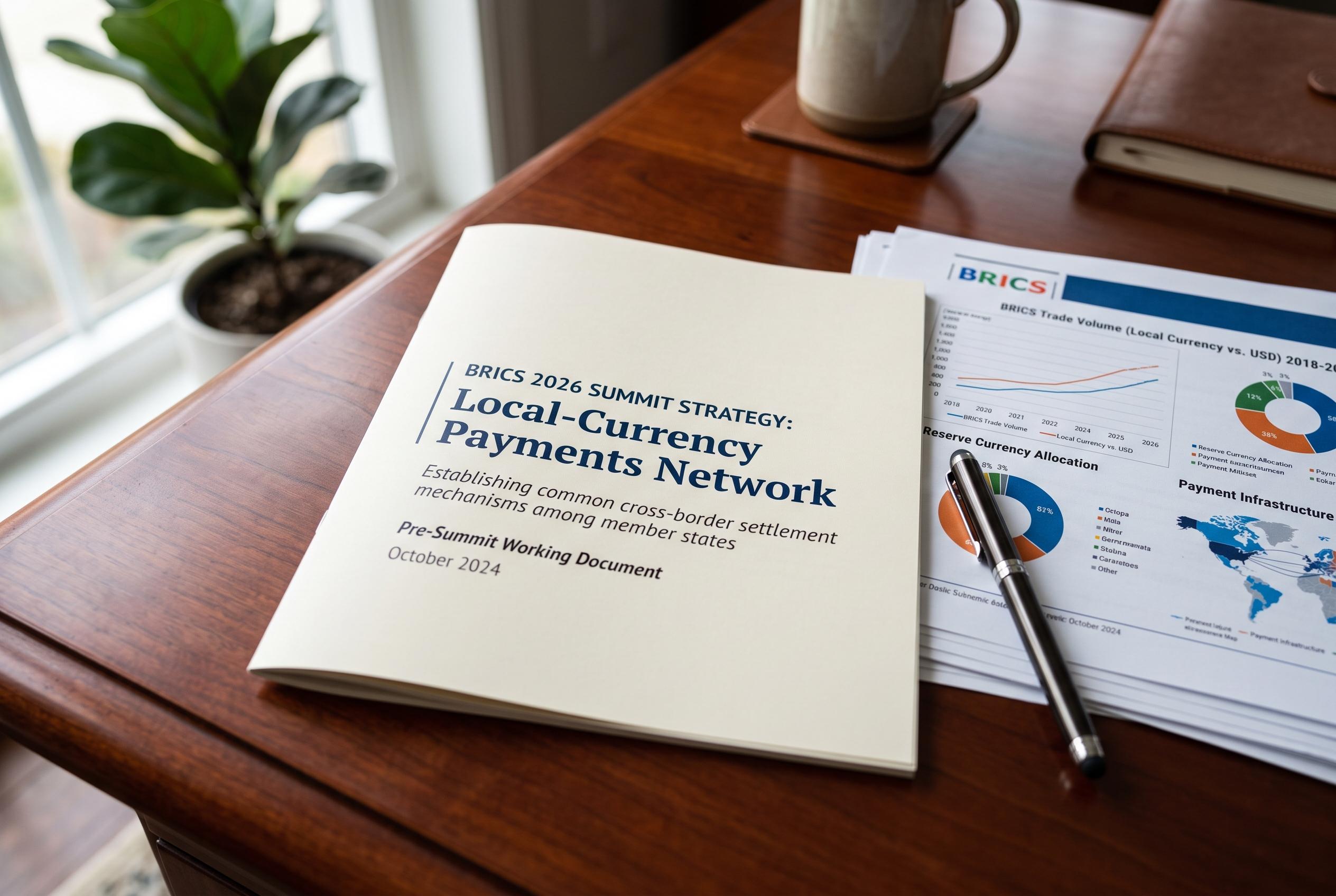

As India prepares to host the 2026 BRICS summit, the group is moving away from a common currency towards building a resilient cross-border payments infrastructure, signalling a significant shift in its economic strategy.
India is set to host the next BRICS summit in New Delhi on September 12-13, 2026, and the meeting is increasingly being framed as a test of whether the bloc can turn years of anti-dollar rhetoric into working financial infrastructure. Rather than pursuing a single BRICS currency, the focus has shifted towards a cross-border payments network that would connect national systems and let member states settle trade more directly in their own money.
That approach reflects a broader change in tone across the group. The article notes that India has backed away from the idea of a common BRICS currency and instead favours local-currency settlement. Subrahmanyam Jaishankar, India’s foreign minister, has made clear that New Delhi does not see the bloc’s role as replacing the dollar outright, but as building alternatives that reduce its reach.
The practical case for that shift is already visible in the numbers. By early 2026, more than 85% of intra-BRICS+ trade was being settled in local currencies, up from 65% at the end of 2024, according to the lead article. It also says Russia and China now conduct around 90% of their bilateral trade in roubles and yuan. A separate BRICS-focused summary says the proposed BRICS Pay system is intended to link existing national rails such as India’s Unified Payments Interface, Russia’s System for Transfer of Financial Messages, China’s Cross-Border Interbank Payment System and Brazil’s Pix.
BRICS Pay, as described by its backers, would not be a single wallet or a new currency, but a layered system combining messaging, settlement and consumer-facing applications. The aim is to make direct currency exchange possible without routing every transaction through the dollar. Supporters say the design would make the network more resilient if one node were disrupted and would help countries trade and travel with less reliance on Western-controlled channels.
The geopolitical stakes are significant. The article says Donald Trump warned his Cabinet in July 2025 that the bloc’s purpose was to weaken the US economy and threatened tariffs of up to 100% on countries pushing de-dollarisation. Luiz Inácio Lula da Silva, Brazil’s president, rejected that warning. At the same time, Jim O’Neill, who coined the original BRIC acronym, has softened his scepticism and launched a new BRICS+ Thinking platform to examine how payment technology is changing the economics of the project.
Russia’s own legal changes add another layer to the picture. Vladimir Putin has signed legislation that formalises the rules around digital currencies and digital rights. According to TASS, only registered entities will be allowed to operate exchanges, retail investors will face an annual cap of 300,000 roubles on trading the most liquid cryptocurrencies and qualified investors will face no such limit. The law still bans the use of digital currencies as legal tender or domestic payment instruments, but it does permit their use in foreign trade settlements and mining.
Taken together, the summit in New Delhi and Moscow’s regulatory shift point to the same conclusion: the BRICS agenda is moving away from symbolic talk of monetary unity and towards more mundane but potentially more consequential plumbing. The bloc appears to be building a payments architecture first, with digital assets and local-currency clearing doing the heavy lifting.
Disclaimer: This article is intended to inform and educate, not to recommend or endorse any financial product, investment or strategy. Please consider your own financial circumstances and seek professional advice where appropriate before making financial decisions.



