

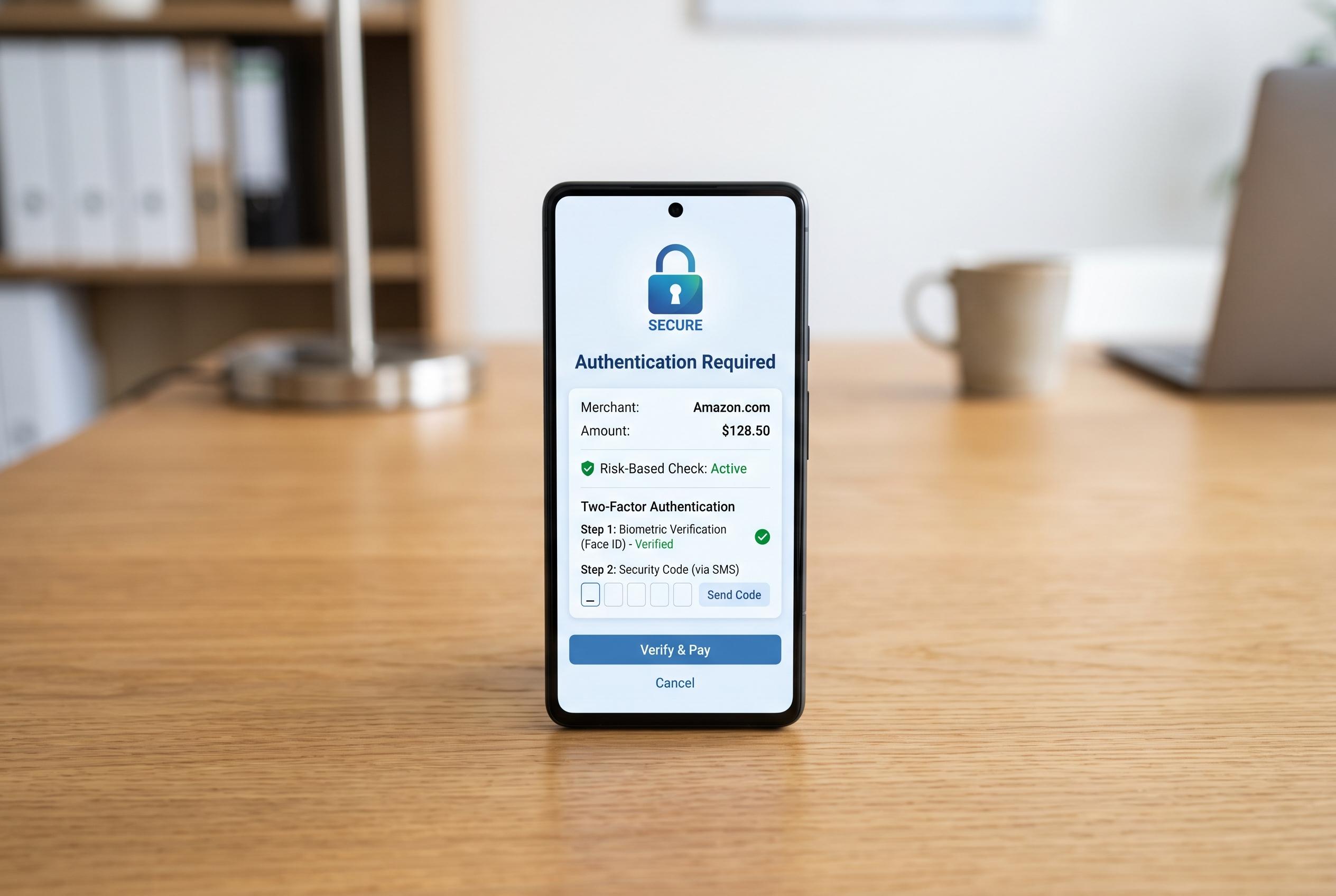

As digital payment security evolves with multi-factor authentication and risk-based checks, merchants and consumers face new opportunities and challenges in reducing fraud without compromising convenience.
Every time a customer clicks “Pay Now”, a set of identity checks may begin before the transaction is approved. In digital payments, those checks are increasingly built around two familiar concepts: two-factor authentication and multi-factor authentication. Both are designed to make it harder for stolen passwords, card details or account credentials to be used for fraud.
Authentication in payments is simply the process of confirming that the person making the purchase is the rightful account holder. As CSO Online explains, 2FA adds a second layer beyond a password, usually combining something the user knows with something the user has. In practice, that can mean a PIN plus a one-time code sent to a phone, or a password followed by approval in a banking app.
MFA is broader. TechRepublic notes that 2FA uses exactly two factors, while MFA can use two or more. In payments, that difference matters most when a higher-risk transaction calls for extra checks, such as a fingerprint, a device trust signal or an app-based approval on top of a password and OTP. In other words, every 2FA setup is a form of MFA, but not every MFA setup stops at two steps.
The main authentication factors are usually grouped into three categories: something you know, something you have and something you are. A password or PIN belongs in the first group, a phone or security token in the second, and biometrics such as fingerprint or face recognition in the third. Security specialists say stronger systems mix categories rather than repeating the same kind of check twice, because two knowledge-based factors are easier to compromise than a password paired with a biometric check.
In online payments, the process often runs in the background. Techtarget describes frictionless authentication as a risk-based approach that allows ordinary purchases to pass with little disruption while flagging suspicious activity for deeper review. That is one reason 3D Secure 2.0 has become so important. It gives card issuers and payment providers a way to assess risk, factor in signals such as device trust and location, and only interrupt the customer when necessary.
The regulatory push has also been a major driver. According to Checkout.com, strong customer authentication requirements in the European Union’s PSD2 regime have made multi-layer checks a standard part of many card payments. In India, the Reserve Bank of India requires two-factor authentication for eligible card transactions. In the United States, issuer-led tools such as 3D Secure 2.0 are more common, but they still rely on MFA principles to reduce fraud.
For merchants, the appeal is obvious: fewer stolen-credential attacks, lower fraud losses and fewer chargebacks. PYMNTS reported in 2024 that 43% of e-commerce executives believed 2FA could help mitigate fraud, reflecting the pressure on retailers to protect checkout flows without adding too much friction. That balance is critical, because extra steps can also frustrate customers and raise basket abandonment if the process is slow or unreliable.
There are limits, though. SMS codes can be delayed, intercepted or defeated through SIM swap attacks, and phishing scams still trick users into handing over one-time passwords. That is why many providers are shifting towards app-based approvals, biometric checks and risk-based authentication. For businesses, the best systems keep routine purchases simple while reserving stronger verification for unusual, high-value or high-risk activity. For users, the basics remain the same: never share an OTP, enable biometric sign-in where possible and report a lost device quickly.
Disclaimer: This article is intended to inform and educate, not to recommend or endorse any financial product, investment or strategy. Please consider your own financial circumstances and seek professional advice where appropriate before making financial decisions.



