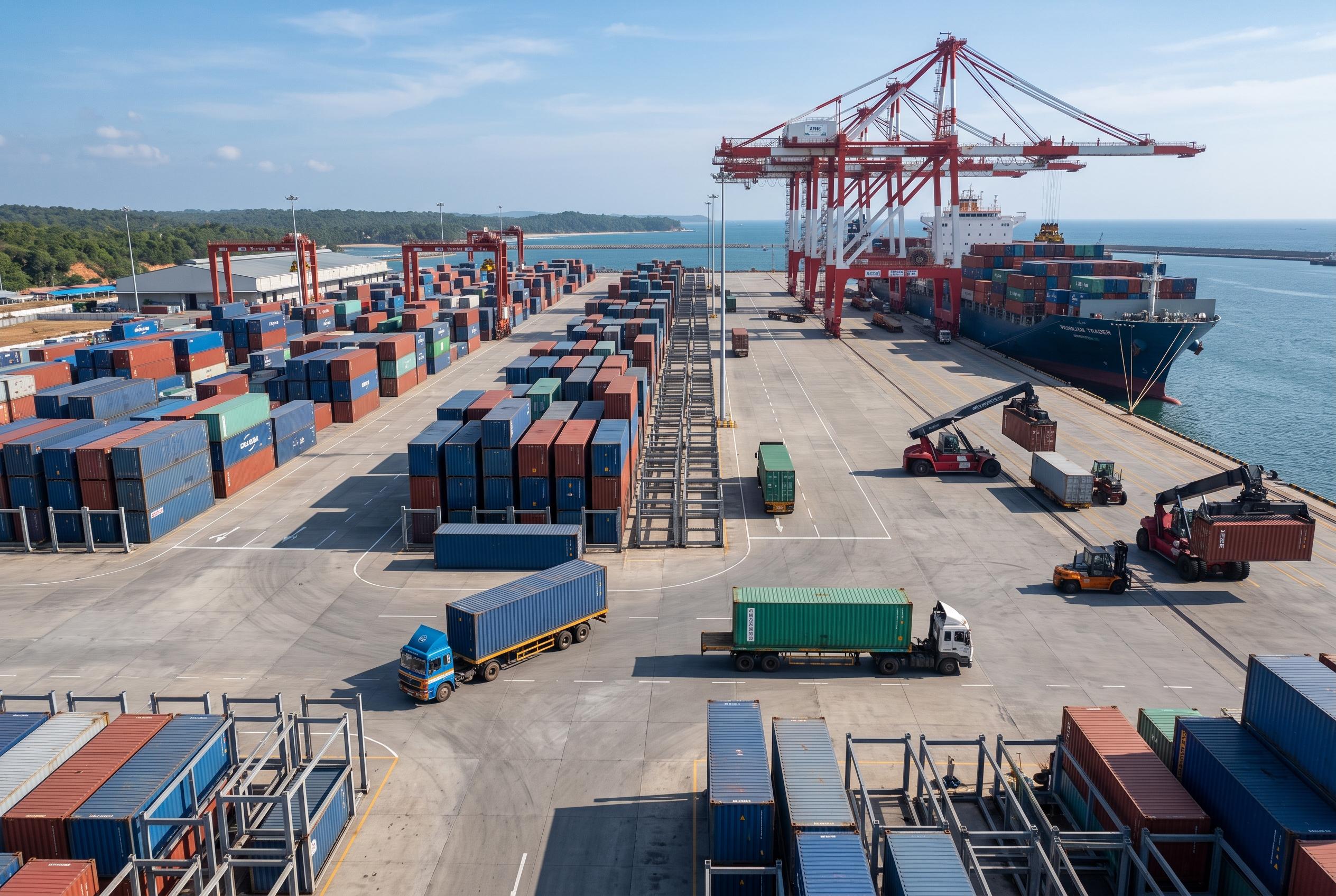

Kerala’s Vizhinjam International Seaport begins full export-import operations, marking a significant shift from transshipment to a direct global cargo gateway, promising to boost local industries and logistics infrastructure.
Vizhinjam International Seaport began full export-import operations on Tuesday, marking a move from a transshipment-only facility to a direct cargo gateway for Kerala. Chief Minister V.D. Satheesan was due to flag off the first export container as the port opened land-based EXIM movement, while Union Ports, Shipping and Waterways Minister Sarbananda Sonowal was not expected to attend. According to local reports, the opening gives Kerala-based shippers a direct route for containers entering and leaving the port rather than relying entirely on overseas hub ports.
The shift follows final Customs approval for EXIM cargo handling, which was reported in late July and set the start date for 18 August 2026. The clearance came with conditions, including restrictions tied to the absence of a dedicated container freight station, a constraint officials have tried to address through interim arrangements inside the port area. A temporary road linking the port to National Highway 66 has been completed, and a customs-bonded zone has been created for EXIM containers.
Vizhinjam’s operational base has expanded quickly. The port began trial operations in July 2024 and commercial activity five months later. By 31 July 2026, it had handled 1,057 vessel calls and more than 2.24 million twenty-foot equivalent units, according to figures cited by Logistics Insider. It now has regular and ad hoc services connecting it with more than 110 major ports across 50 countries on six continents.
For exporters, the new phase is expected to reduce the need to route cargo through Colombo, Singapore and Dubai. Sectors likely to benefit include spices, cashew, marine products, handloom and textiles, pharmaceuticals, Ayurveda, rubber and plastics, as well as electrical and electronics goods. Officials also expect the change to boost demand for warehouses, cold storage, freight stations and other logistics services in and around Thiruvananthapuram.
The Kerala government is trying to build a wider maritime economy around the port through Mission Samudra, a port-led development programme that includes industrial clusters, new urban areas and a ₹400-crore catalytic fund for connectivity and logistics infrastructure. The plan also envisages integrating the state’s minor ports with Vizhinjam and expanding private investment in ship repair, multimodal logistics and related facilities. In that sense, Tuesday’s opening is being presented not just as a shipping milestone but as the start of a broader industrial push.
Disclaimer: This article is intended to inform and educate, not to recommend or endorse any financial product, investment or strategy. Please consider your own financial circumstances and seek professional advice where appropriate before making financial decisions.