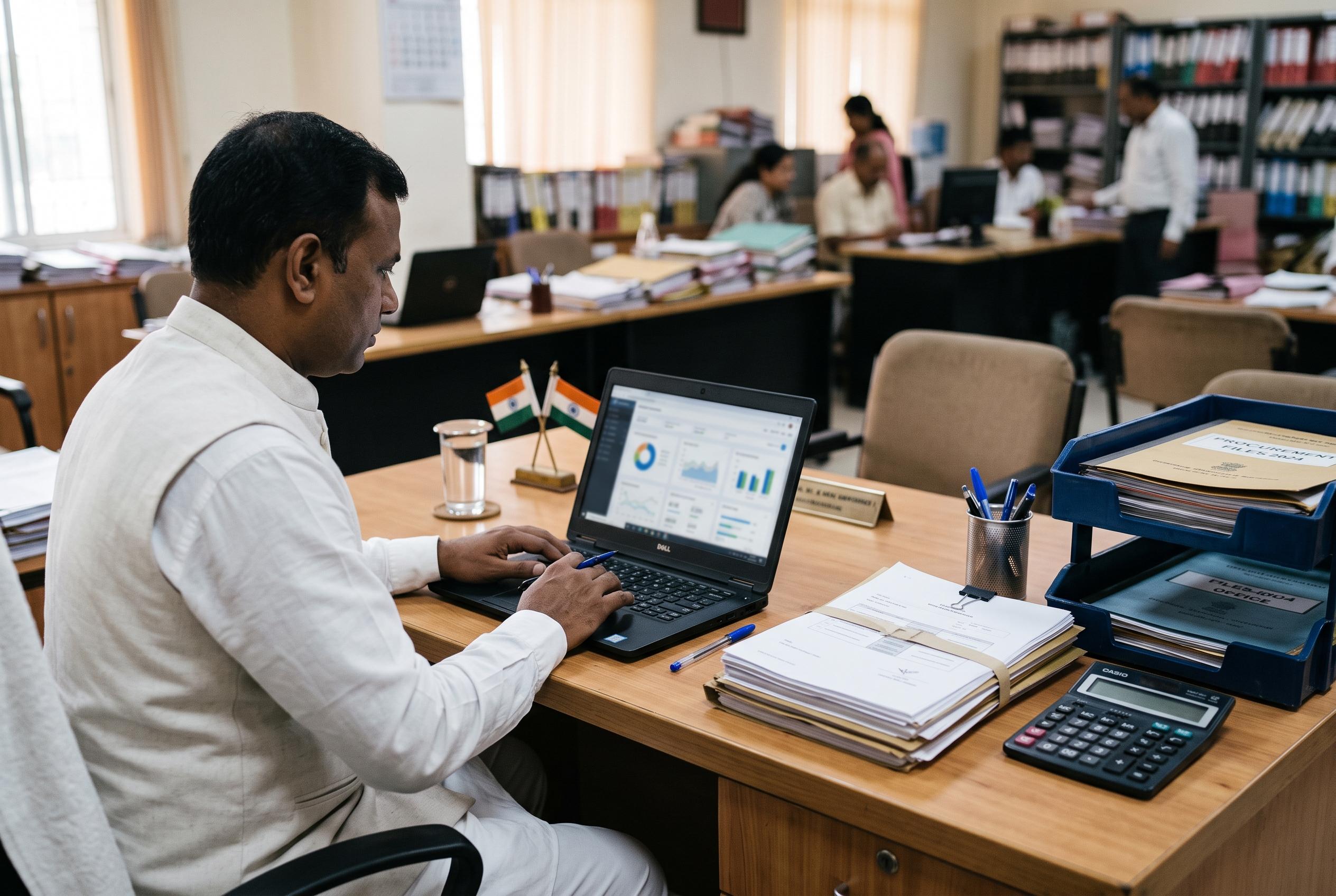

A decade after its launch, the Government e-Marketplace (GeM) has transformed transparency and participation in India’s public procurement, but its dominance by major buyers and persistent flaws highlight ongoing challenges in reforming the system.
Ten years after its launch, the Government e-Marketplace has become one of the most important windows into how India buys for the state. According to the platform’s own figures, cumulative purchases have crossed ₹20 lakh crore, with about 25 lakh sellers and more than 10,000 categories of goods and 350 categories of services now listed. The government says the system is meant to make procurement more open, standardised and efficient, but the numbers also show something else: GeM is no simple online shop, and the biggest money still flows through a small set of powerful buyers.
GeM was launched on 9 August 2016 by the Ministry of Commerce and Industry as a digital procurement platform for ministries, departments, public sector undertakings and autonomous bodies. The India government’s service portal says it is the country’s official online marketplace for public purchasing, while the Ministry of Public Enterprises has issued separate guidance to push state firms on to the system. The platform replaced the old Directorate General of Supplies and Disposals model for central buying, and its mandate was later widened to bring in more categories of buyers.
At a basic level, the process is straightforward. Buyers post a need, GeM routes it by value, and sellers compete within the platform’s rules. Smaller purchases can be made directly from the catalogue, mid-sized orders require comparison between suppliers, and larger contracts go to bid or reverse auction. On paper, that should reduce delays and keep human discretion in check. In practice, however, the platform is only one part of India’s wider procurement machinery, which also includes other portals for roads, bridges, railways and defence.
The larger story is that public procurement is enormous. India spends a huge share of national output on government purchasing, and GeM is only one channel within that system. The platform’s own data also show that it is far more than a catalogue of stationery and office chairs: it now handles everything from medicines to fibre-optic cables and sanitary products. Yet the value remains heavily concentrated. Central ministries and state-owned firms account for the bulk of annual spending, while states and union territories still make up only a modest share.
That concentration is clearest in coal. The Daily Brief’s review of the platform found that coal-related procurement, much of it through public sector companies, became the largest single source of spending on GeM. In one year, coal PSUs alone accounted for roughly ₹42,000 crore in contracts, and the biggest order on the platform was NTPC’s ₹20,400 crore mine-development deal. That is a reminder that GeM is not just a retail-style marketplace; it also carries large, long-dated service contracts with labour clauses, penalties and escalation terms.
The platform’s defenders point to inclusion. GeM says nearly 75% of active sellers are micro and small enterprises, and the government has used the platform to widen access for women-led firms, SC/ST-owned businesses and startups. But the editorial picture is mixed. Micro and small firms win a large share of orders, yet they capture less than half of total value, suggesting that the headline success in participation does not necessarily translate into equal access to the biggest contracts.
The harder question is whether the platform has fixed the deeper problems of public buying. The official answer is that digital rules, seller ratings and standard specifications make procurement quicker and less vulnerable to direct bargaining. But the Daily Brief cited examples in which the system still selected implausible offers or weakly rated vendors, and the Competition Commission recently fined HP India and its resellers for bid-rigging across GeM tenders. The same report also noted that the Comptroller and Auditor General has flagged slow payments and cases where bids were effectively directed to single sellers despite wider competition being available.
GeM’s economic case is therefore more nuanced than a simple claim of cheaper government buying. The government has cited large savings, and an IIT Delhi study estimated monetised benefits of about ₹86,000 crore over the past three years, but the usefulness of those figures has been questioned because they rely heavily on estimated reference prices. The broader lesson, as the World Bank and other studies suggest, is that digital procurement can widen participation and improve transparency, but it cannot on its own guarantee better specifications, timely inspection or prompt payment.
That is why GeM’s first decade looks less like a completed reform than a partial one. It has made public purchasing more visible and opened the door to millions of smaller suppliers. It has also shown the limits of technology in a system where buying power is concentrated, institutional discipline varies widely and some of the biggest contracts still depend on the same old administrative judgement. The platform may have modernised the front end of procurement, but the back end remains stubbornly human.
Disclaimer: This article is intended to inform and educate, not to recommend or endorse any financial product, investment or strategy. Please consider your own financial circumstances and seek professional advice where appropriate before making financial decisions.