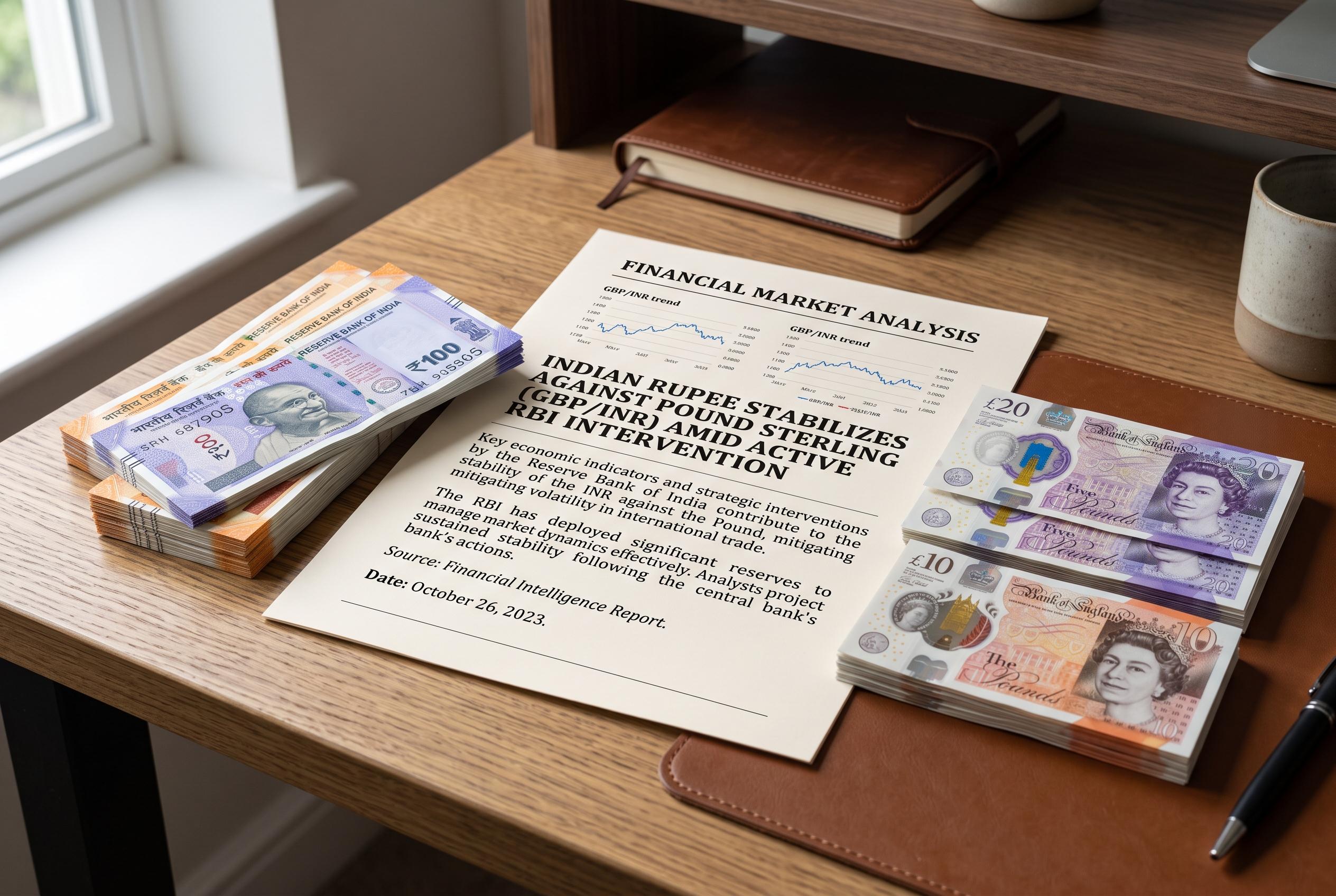

The Indian rupee remains resilient against the pound sterling, supported by Reserve Bank of India measures and falling oil prices, while UK economic signals dampen expectations of further Bank of England tightening.
Pound sterling held close to Rs128.24 against the rupee on Thursday evening, leaving the pair a fraction higher on the day but still below last Friday’s close. The rupee has found some footing after Reserve Bank of India intervention and a pullback in oil prices, while sterling’s support from stronger UK services-sector figures has been tempered by fading expectations of further Bank of England tightening.
MUFG expects the Indian currency to strengthen over the second half of 2026 and has lifted its USD/INR forecast profile only modestly. The bank sees the pair trading in a 94.00 to 95.00 range over the next three to six months before drifting back towards 96.00 later on, a path that would imply GBP/INR roughly between 126.60 and 128.00 if sterling-dollar levels remain broadly steady. MUFG said intervention and likely FCNR(B)-linked inflows should help prevent disorderly rupee weakness, reinforcing the view that the RBI will keep volatility contained.
That outlook follows a fresh policy decision from the RBI, which left its repo rate unchanged at 5.25% and kept its stance neutral. The central bank also trimmed its inflation forecasts for the current financial year while nudging its growth outlook higher to 6.7%, underlining confidence in domestic demand. Governor Sanjay Malhotra has pledged to keep curbing excessive volatility and speculative behaviour, and the RBI’s steps to attract foreign currency deposits and overseas borrowing have already produced more than $41bn in inflows.
Still, not all analysts are upbeat on the rupee. ANZ remains cautious, arguing that relatively low Indian interest rates make the currency easier to sell during periods of market stress. The bank expects the RBI to deliver two quarter-point rate rises starting in December, although softer expectations for immediate tightening have already pushed down forward-market yields. At the same time, Pantheon Macroeconomics said July’s UK services PMI and composite reading were healthy, but it sees those figures as making Bank of England rate increases less likely, leaving sterling without a fresh policy tailwind.
Disclaimer: This article is intended to inform and educate, not to recommend or endorse any financial product, investment or strategy. Please consider your own financial circumstances and seek professional advice where appropriate before making financial decisions.