

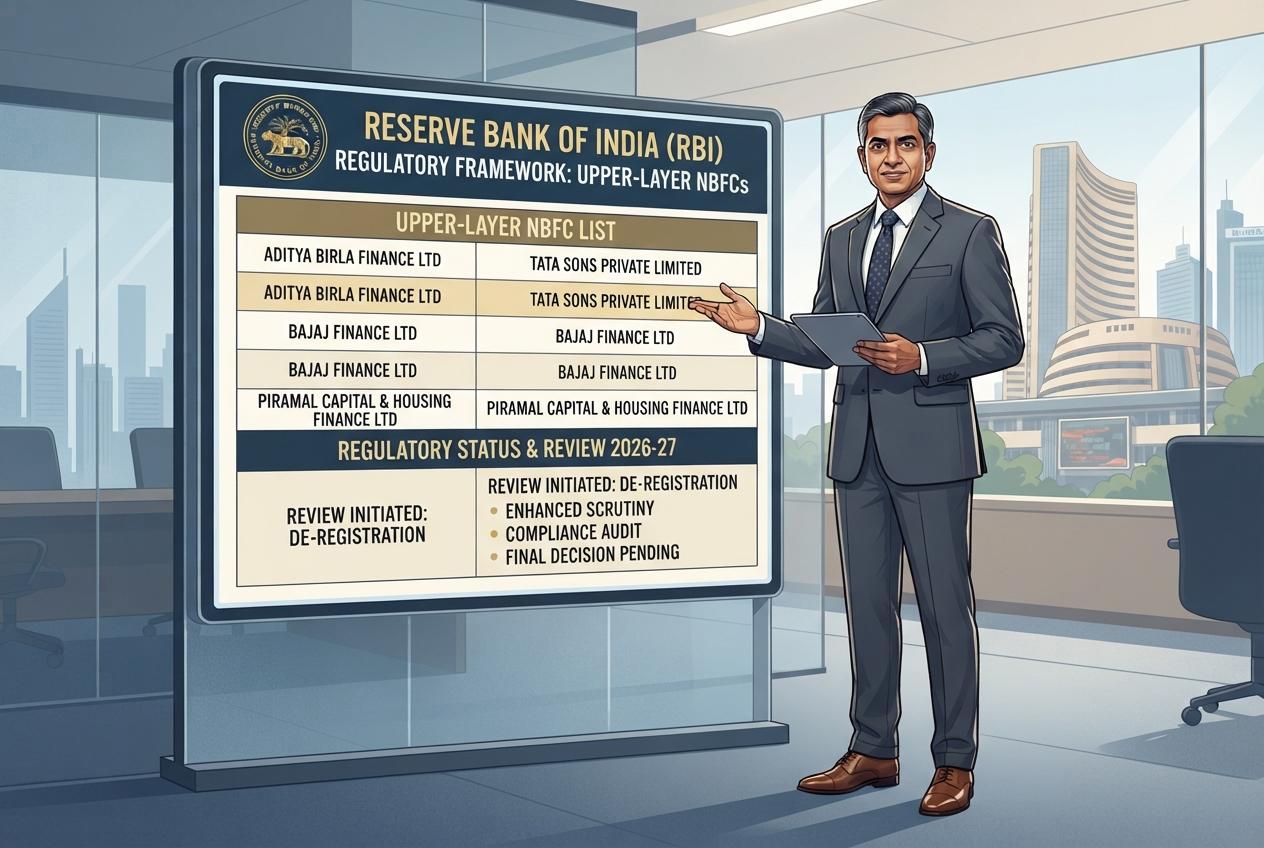

The Reserve Bank of India has retained Tata Sons on its upper-layer non-banking finance company list for 2026-27, while clarifying that its de-registration application remains under review, as the central bank shifts to an asset size threshold for classification.
The Reserve Bank of India has kept Tata Sons in its upper-layer non-banking finance company list for 2026-27, while making clear that the inclusion does not affect its pending application for de-registration. The central bank said the application is still under examination and repeated the same caveat it used when it last published the list in January 2025.
The revised list contains 17 companies, up from 15 in the previous exercises for FY24 and FY25. According to the RBI, the 2025-26 list was not issued because it reviewed the identification criteria during that year and has now rebuilt the framework around a single size threshold: any NBFC with assets of at least Rs 1 trillion based on its latest audited balance sheet can be placed in the upper layer.
That shift follows a broader overhaul of the scale-based regulatory framework the RBI outlined earlier this year. In draft proposals published in April, the central bank moved away from a scoring system that weighed size, interconnectedness and complexity, and instead said asset size would be the main trigger for upper-layer status. The final direction, announced in June, kept that approach and said the threshold would be reviewed every three years.
Three state-backed financiers have been added to the upper-layer list under the new test: REC Ltd, Power Finance Corporation and Indian Railway Finance Corporation. Other names on the roster include Bajaj Finance, Shriram Finance, LIC Housing Finance and Tata Capital. PNB Housing Finance and Sammaan Capital were previously classified as upper-layer NBFCs but no longer meet the new threshold; however, the RBI’s rules say firms that have once been placed in the category must remain subject to enhanced regulation for at least five years, so both continue to be treated as upper-layer entities.
The status of Tata Sons remains closely watched because of its core investment company structure and its long-running effort to avoid a stock market listing. Moneycontrol reported earlier this year that the group holding company sat above the new asset threshold and would therefore come under the spotlight as the RBI tightened its framework. For now, the central bank has chosen to leave Tata Sons in place while its de-registration request remains unresolved.
Disclaimer: This article is intended to inform and educate, not to recommend or endorse any financial product, investment or strategy. Please consider your own financial circumstances and seek professional advice where appropriate before making financial decisions.



