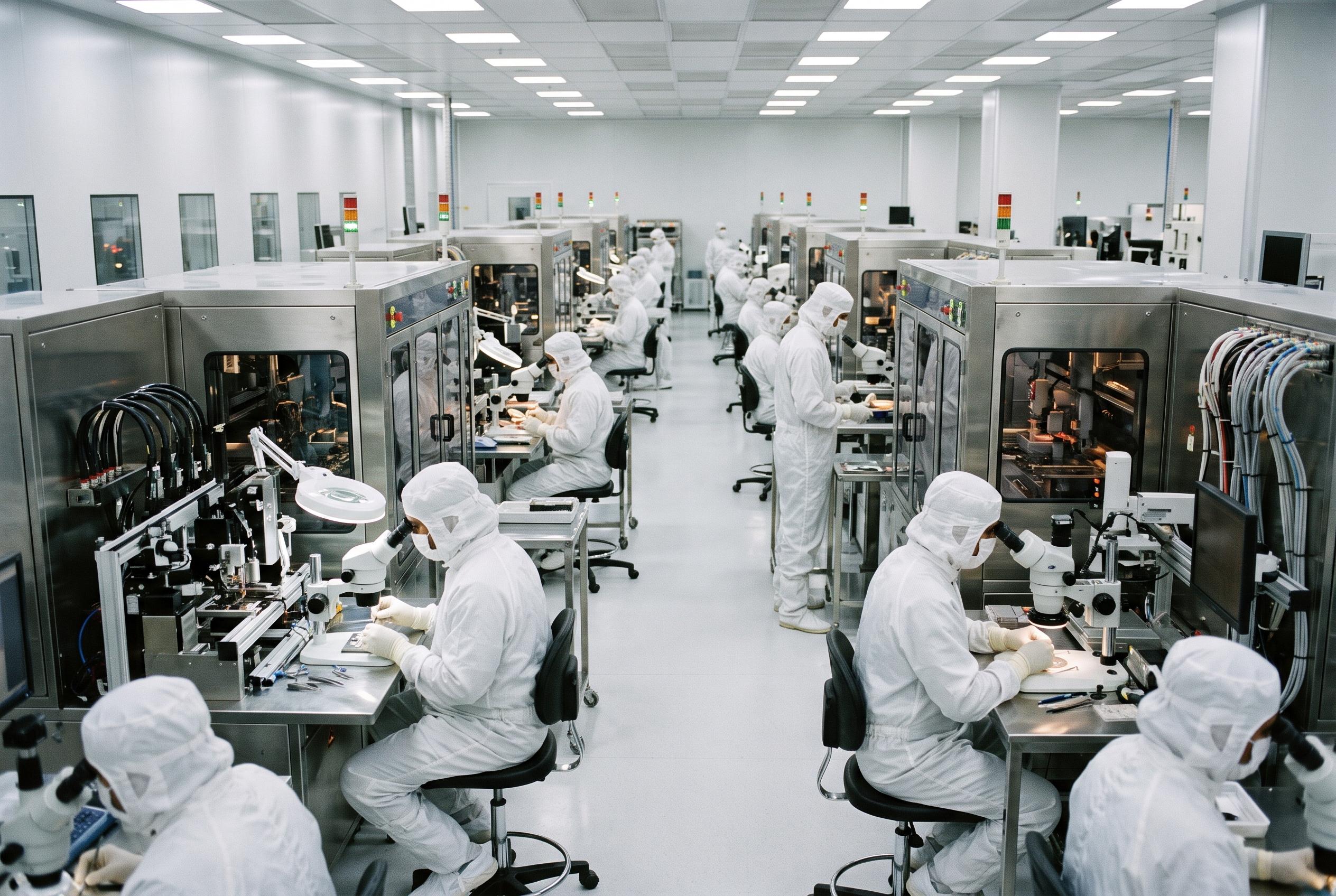

India’s first wave of semiconductor assembly plants is turning to customers in Japan, Europe and the US to keep production moving while domestic demand and buyer confidence develop.
India’s first wave of semiconductor assembly and test companies is finding that overseas customers, not domestic buyers, are what will keep the lines running for now. Backed by the India Semiconductor Mission, the new plants are signing up partners in Japan, Europe and the US as they try to build scale before local demand is strong enough to support full-capacity production.
That push has taken several forms. Kaynes Semicon, a subsidiary of Kaynes Technology India, has teamed up with Mitsui & Co. to help launch its back-end chip business in India. According to Mitsui, the Japanese trading house will support the sales of Kaynes-made products and draw on AOI Electronics’ expertise in semiconductor back-end processes. The move gives the Indian company an immediate commercial route into Japan, where long-term industrial relationships can matter as much as price.
Tata Electronics has taken a broader approach. In September, Nexperia announced a strategic partnership with Tata covering wafer manufacturing, assembly and test, technology collaboration and innovation. The agreement includes assembly and testing of Nexperia’s discrete semiconductors at Tata’s facility in Jagiroad, Assam, as well as production of Nexperia’s MOSFET portfolio at Tata’s under-construction 300mm fab in Dholera, Gujarat. The tie-up reflects a wider search among foreign chipmakers for supply-chain resilience and production outside China.
For India’s young chipmakers, those foreign links are a practical answer to a basic problem: the country’s domestic market is not yet mature enough to fill newly commissioned capacity. Large buyers in automotive, power, aviation and industrial equipment usually rely on multi-year contracts with established suppliers, and requalifying a new vendor can take months. That leaves new plants exposed if they depend too heavily on local orders that may arrive only slowly. Government procurement has also been limited so far, making export business an essential bridge to scale.
The strategy is not just about chasing volume. According to the article, Indian semiconductor ventures are building networks that blend technology transfer, customer access and manufacturing flexibility. Tata Electronics has been assembling a wide ecosystem of partners across Europe, Japan, Singapore and India, while Kaynes is leaning on Japanese relationships to support packaging work. Smaller players are also targeting overseas clients, including US customers that cannot meet the minimum order sizes set by larger assembly houses.
The broader policy backdrop helps explain why. The Centre has signalled that it does not intend to force the use of domestically made chips, preferring Indian companies to compete in global value chains while the market develops at home. That approach has been reinforced by the scale of public support already committed to fabs, compound semiconductor plants and assembly facilities. The next phase of the programme, ISM 2.0, expands the government’s ambition further by backing equipment, specialty gases and chemicals, materials, advanced packaging and design.
For now, export orders are doing the work that domestic demand cannot. They are keeping lines active, giving new plants a chance to prove themselves and helping Indian chipmakers build the credibility that local buyers may later require. In that sense, the overseas contracts now being signed are less an alternative to the domestic market than a way of preparing for it.
Disclaimer: This article is intended to inform and educate, not to recommend or endorse any financial product, investment or strategy. Please consider your own financial circumstances and seek professional advice where appropriate before making financial decisions.