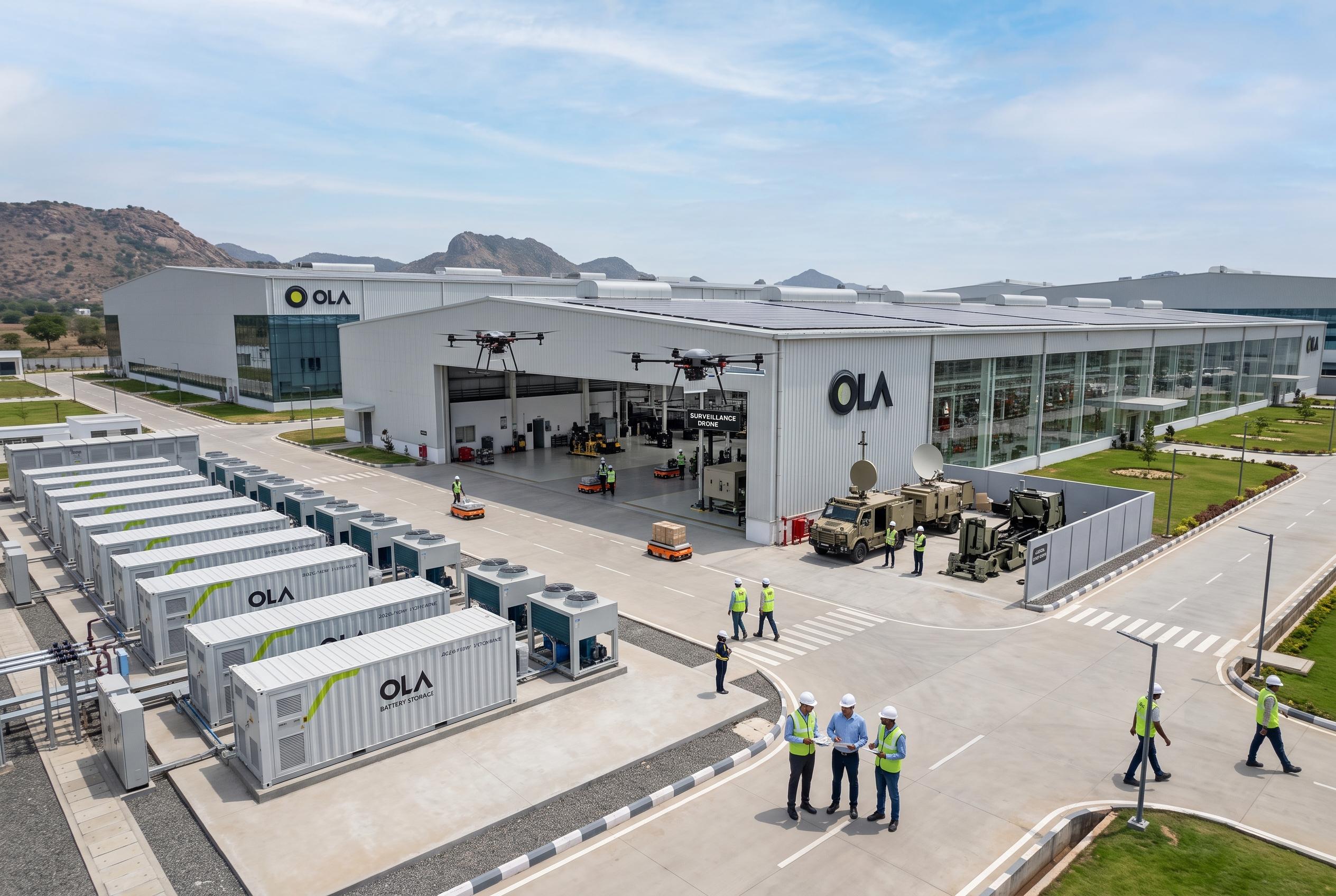

Ola Electric is transforming its Tamil Nadu Gigafactory from a scooter producer into a hub for batteries, grid storage, drones, and defence applications, signalling a significant shift in its industrial ambitions.
Ola Electric is widening its ambitions beyond scooters, positioning its Tamil Nadu manufacturing base as a platform for batteries, grid storage, drones and defence applications. At its Q1 FY27 earnings call, chairman Bhavish Aggarwal began with the quarterly recovery in vehicle sales and margins, then quickly shifted attention to a much larger bet: turning the company’s Gigafactory into the centre of a broader energy and industrial strategy.
According to NDTV Profit, the company has signed its first memorandum of understanding for Mahashakti, a utility-scale energy storage system, covering 20 GWh of deployment by 2032. Aggarwal said India would need at least 400 GWh of storage capacity over the next five to six years and argued that even official estimates may be too cautious. Ola Electric also said a cheaper lithium iron phosphate, or LFP, version of its home and commercial storage product Shakti is due on August 15.
The company’s latest shareholder letter also points to agreements spanning defence, unmanned aerial vehicles, near-space constellation platforms and renewable energy projects. Ola Electric has framed its partnership with Axis Energy as one of the largest announced domestic deployments of indigenous battery-storage technology in India, underscoring how far the business is moving from its original scooter-only proposition.
That shift rests on a dual-chemistry approach. Aggarwal told analysts that 80% of Ola Electric’s automotive line-up will move to LFP cells, which are cheaper and generally last longer, while nickel-manganese-cobalt cells will remain in use for premium models and specialised applications such as drones. All of the company’s energy-storage products will use LFP, and Aggarwal said the next-generation Shakti system should deliver gross margins that are even better than the auto business.
The vehicle operation still remains the main revenue engine. Ola Electric reported automotive revenue of ₹455 crore in the quarter, up 72% sequentially, while the cell business brought in ₹5 crore. Its service arm, which the company expects to grow from about ₹130 crore in FY26 to ₹400 crore-₹500 crore by FY28, is meant to bridge the gap between the existing scooter business and the larger energy-storage market the company is targeting.
There is still a difficult manufacturing climb ahead. Aggarwal said cell yields are running in the high 70s to 80% range, below the level many analysts consider commercially viable. The plant paused production for two months while capacity was expanded from 2.5 GWh to 6 GWh, with full output expected later this month. A further rise to 20 GWh will require a separate equity raise at the cell unit, keeping the parent company’s balance sheet insulated.
Even so, Ola Electric is signalling confidence that the same factory can serve several markets at once. S&P Global Market Intelligence said in June that the company is expected to return to revenue growth in FY27 after two years of contraction, while other industry analysis has pointed to monthly deliveries recovering to 20,000-25,000 units and the company’s broader push into in-house cell production. The challenge now is whether that multi-market expansion can be delivered fast enough to offset continuing operating losses, which the company said remain near ₹195 crore a quarter at the consolidated level.
Disclaimer: This article is intended to inform and educate, not to recommend or endorse any financial product, investment or strategy. Please consider your own financial circumstances and seek professional advice where appropriate before making financial decisions.