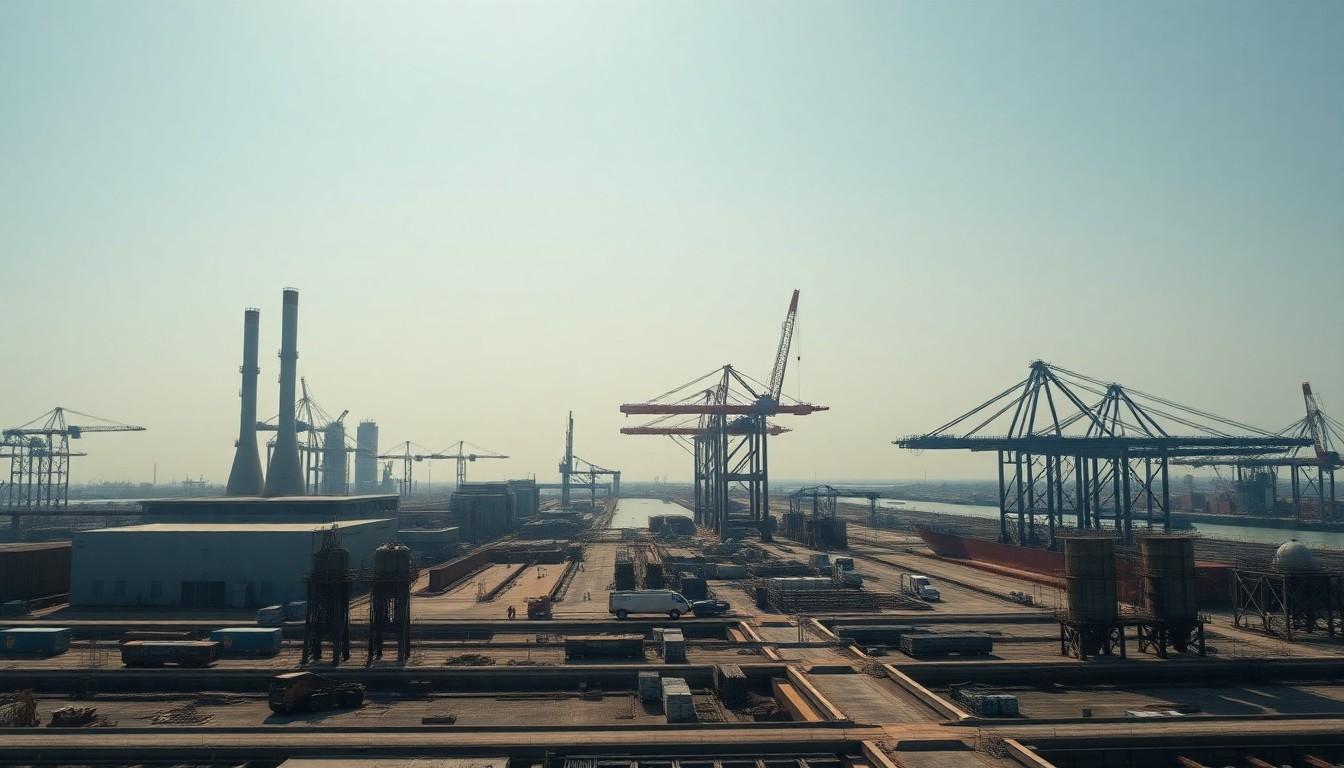

Odisha is transitioning from India’s industrial periphery to its centre, driven by substantial steel and port expansion projects that are reshaping its economic landscape amid accelerating construction and investments.
Odisha is moving from India’s industrial periphery to its centre, with steel and ports forming the backbone of a fast-accelerating investment cycle. The state’s latest push is being led by large-scale projects in Paradip, Angul and other coastal hubs, where new plants, jetties and export facilities are beginning to turn long-running plans into physical assets. Analysts and company disclosures now point to a state that is no longer trading only on potential but on construction activity already under way.
The most visible marker of that shift is JSW Steel’s new integrated plant at Dhinkia near Paradip. According to Business Standard, work has started on a project worth about ₹65,000 crore, with the facility designed for 13.2 million tonnes per annum of capacity across nearly 2,950 acres. The New Indian Express reported that Odisha Chief Minister Mohan Charan Majhi launched the construction work, while Economic Times said the plant is expected to be operational by 2029. The location also carries historical significance, as it follows the long-stalled POSCO proposal from the early 2000s, suggesting a notable change in how coastal land acquisition and community engagement are being handled.
Odisha’s steel story is not limited to JSW. The state has also drawn major commitments from Tata Steel and Jindal Steel and Power, strengthening its claim to be one of India’s most important industrial centres. Maritime Gateway reported that Tata Steel plans to invest ₹33,873 crore to expand Neelachal Ispat Nigam Ltd, lifting capacity to 6.2 million tonnes per annum, while Jindal Steel and Power has outlined a plan to more than quadruple its Angul plant to 25.2 million tonnes per annum by 2030 with about ₹70,000 crore in fresh spending. Together, those projects underline how Odisha’s mineral base and industrial land bank are being used to anchor a much larger manufacturing platform.
Ports are expanding alongside steel, and that alignment is crucial. Maritime Gateway said Paradip Port handled 156.45 million metric tonnes of cargo in FY 2025-26, its best performance since it began operations in 1966. The port’s growth, combined with planned additions at Inchuri and Bahuda, points to a wider effort to build dedicated export capacity rather than rely on a single gateway. The state is also pushing Paradip’s next phase, with expansion projects intended to support the heavier industrial traffic that new steel and downstream plants will generate.
Taken together, the investment pipeline suggests a broader industrial shift rather than a one-sector boom. Odisha’s appeal rests on a rare mix of raw materials, coast access and policy coordination, which is helping it attract capital into steel, port infrastructure and related manufacturing. The challenge now is execution: the state has secured headlines with large announcements before, but the current cycle is different because more of the money is already visible in ground works, operating expansions and port upgrades. If that momentum holds, Odisha could become one of the defining industrial corridors of eastern India.
Disclaimer: This article is intended to inform and educate, not to recommend or endorse any financial product, investment or strategy. Please consider your own financial circumstances and seek professional advice where appropriate before making financial decisions.