

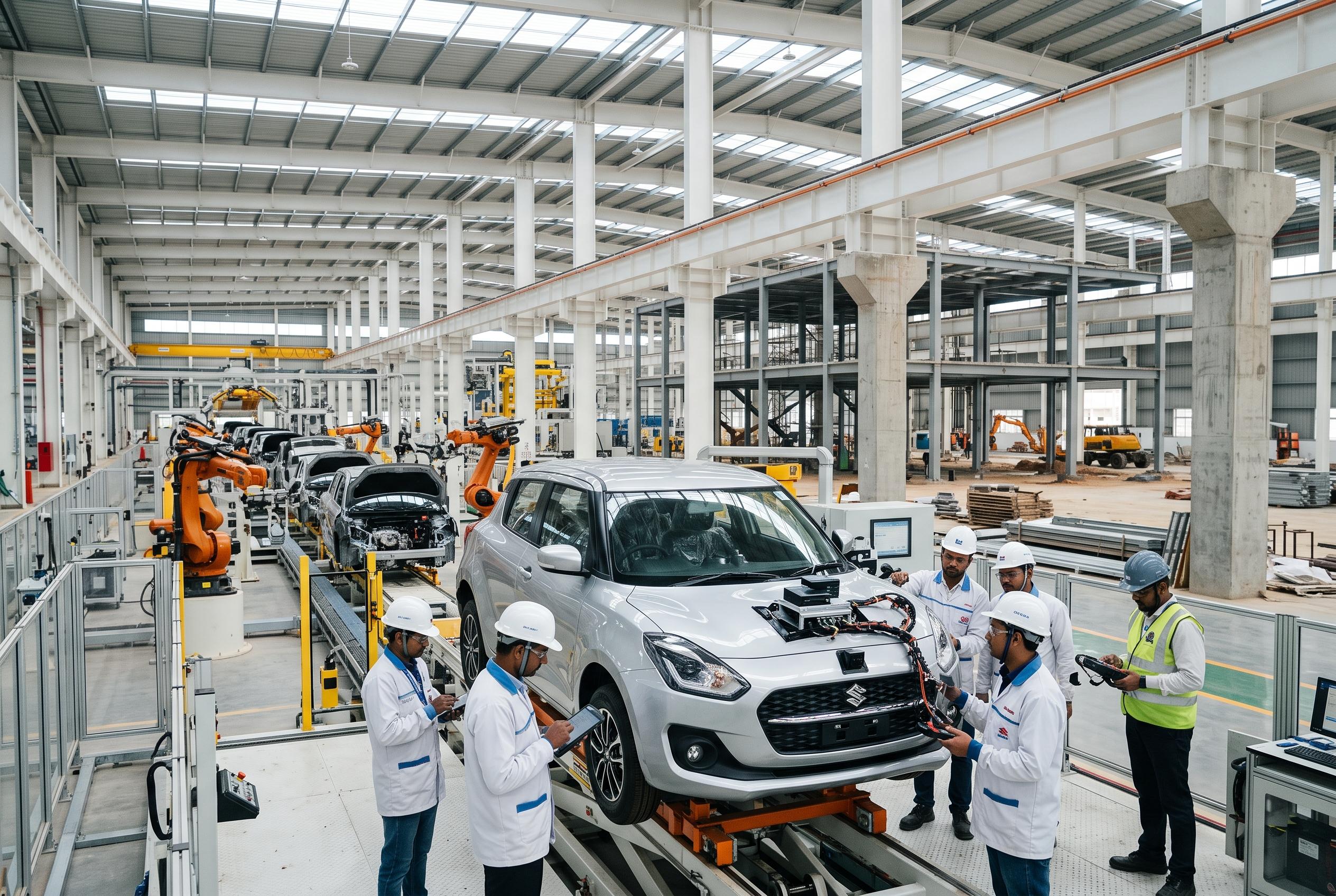

Maruti Suzuki India announces a significant increase in its capital expenditure to ₹77,500 crore between FY27 and FY31, aiming to expand manufacturing, enhance R&D, and develop new models amid shifting market dynamics.
Maruti Suzuki India is preparing its biggest investment push in years, lifting its planned capital expenditure to ₹77,500 crore between FY27 and FY31 as it moves to expand factories, develop new models and deepen its research and development work.
The plan was outlined by Hisashi Takeuchi, the company’s managing director and chief executive, at Maruti Suzuki’s 45th annual general meeting. According to reporting by Business Standard and Moneycontrol, the spending will also cover sales infrastructure, logistics and cleaner manufacturing initiatives, signalling a broader effort to strengthen the company’s position in India’s fast-changing passenger vehicle market.
The immediate step-up is already visible. Maruti Suzuki plans to spend about ₹14,000 crore in FY27, roughly 40% more than the around ₹10,000 crore invested in the previous year, as reported by AutoPunditz and Sahi.com. Business Standard said the new five-year programme is larger than the roughly ₹70,000 crore investment path Suzuki Motor Corporation outlined earlier in 2025.
Capacity build-out is expected to take a large share of the money. Maruti has been expanding at its Kharkhoda plant in Haryana and preparing additional manufacturing capacity in Gujarat, while its order book shows sustained demand. AutoPunditz reported that the company finished FY26 with about 190,000 pending customer orders, including nearly 130,000 for small cars.
Product development is another priority. The company is preparing a wider range of vehicles, with New Indian Express reporting that seven new models are expected in the coming years. That comes as Maruti seeks to defend its strong position in compact cars while competing more aggressively in SUVs and electrified vehicles against rivals including Tata Motors, Mahindra, Hyundai, Kia and Toyota.
Electrification is also part of the plan, but not the only part. Maruti has begun exporting the made-in-India e Vitara to 44 markets, according to the company’s FY26 results cited by AutoPunditz, and it continues to pursue a mix of technologies including battery-electric vehicles, hybrids, compressed natural gas, ethanol-compatible engines and other lower-emission powertrains.
Takeuchi also sought to reassure customers on ethanol-blended petrol, saying at the AGM that Maruti vehicles made from 2008 onwards are compatible with E20 fuel, according to AutoPunditz. The broader investment programme also includes more spending on renewable energy, biomass facilities and solar power at sites such as Manesar, Kharkhoda and Sanand, underlining how the company is linking growth with lower-carbon manufacturing.
Disclaimer: This article is intended to inform and educate, not to recommend or endorse any financial product, investment or strategy. Please consider your own financial circumstances and seek professional advice where appropriate before making financial decisions.



