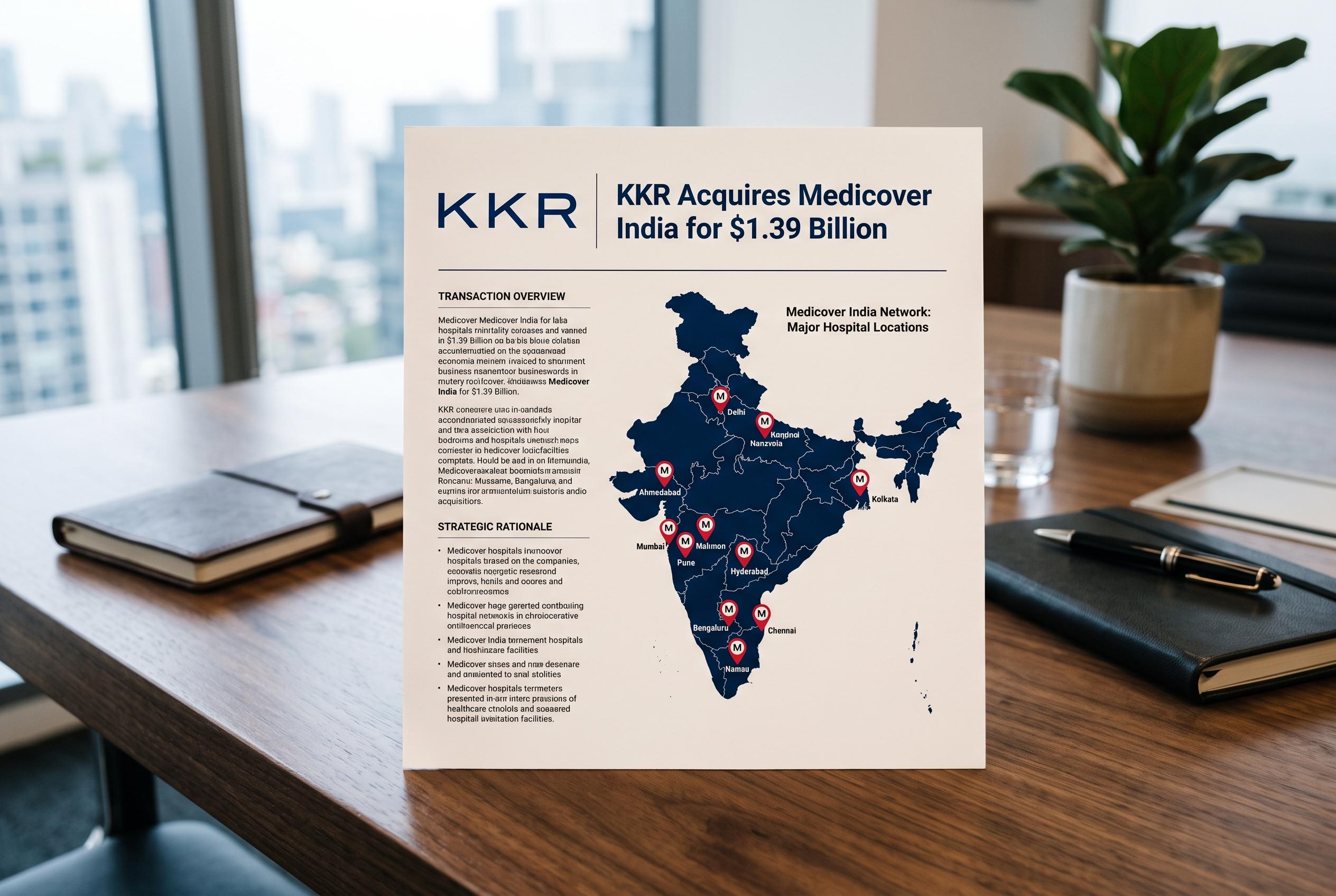

Global private equity giant KKR is set to acquire Medicover AB’s India hospital arm for $1.39 billion, marking a significant escalation in India’s hospital sector consolidation amid rising investor interest and sector scaling opportunities.
KKR is set to buy Medicover AB’s India hospital arm for $1.39 billion (€1.2 billion), in a transaction that underscores how aggressively global private equity is moving into Indian healthcare. The deal covers a 24-hospital network of about 4,800 beds across southern and western India and would give KKR another sizeable foothold in a sector where scale, specialism and regional reach are increasingly valuable.
Medicover said the sale would allow it to focus on its European businesses in Poland, Germany and Romania. The company expects the transaction to close in the fourth quarter of 2026 and to receive gross cash proceeds of €740 million. Medicover India generated annual revenue of €220.5 million on a last-twelve-months basis as of June 30, 2026, reflecting the business KKR is buying into as it deepens its hospital portfolio in India.
The acquisition would be KKR’s third hospital investment in India in as many years. In July 2024, it took a controlling stake in Kerala’s Baby Memorial Hospital, a move industry estimates valued at roughly ₹2,000 crore to ₹2,500 crore. In February 2025, it agreed to buy a controlling stake in cancer-care chain HealthCare Global Enterprises for about $400 million. Baby Memorial has since become an expansion platform of its own, agreeing to acquire a stake in Hyderabad-based Star Hospitals, while KKR also completed a majority purchase of Meitra Hospital in Kozhikode, further building its presence in Kerala.
KKR is not alone in betting that India’s fragmented hospital market is ripe for consolidation. Temasek-backed Manipal Hospitals won approval from the Competition Commission of India for its purchase of Pune-based Sahyadri Hospitals from Ontario Teachers’ Pension Plan Board, a deal that expanded an already fast-growing network that now spans nearly 49 hospitals and close to 12,000 beds. Separately, Aster DM Healthcare completed its merger with Blackstone-backed Quality Care India on July 2, 2026, creating a combined operator with 39 hospitals and more than 10,600 beds across 28 cities.
The pace of dealmaking reflects a broader shift in the sector. EY-Parthenon said hospital and diagnostics revenues and EBITDA rose by more than 15% year on year in the June 2026 quarter, while occupancy stayed in the 60% to 75% range. Analysts say investors are drawn by a simple calculation: India still has far fewer hospital beds than richer markets relative to its population, insurance penetration is rising and buying existing hospitals is quicker than building new ones from the ground up.
That logic is also helping private equity firms plan exits. Manipal’s proposed initial public offering has added another route for investors looking to cash out, which in turn has encouraged more capital to enter the market. But the consolidation wave is not without risks. Analysts have warned about the challenge of integrating hospitals with different systems and cultures, the possibility of valuations outrunning earnings and the regulatory scrutiny that comes with ownership concentration. For now, though, the momentum remains with buyers, and Medicover’s departure from India looks less like a one-off sale than another marker of a broader, still-accelerating shift.
Disclaimer: This article is intended to inform and educate, not to recommend or endorse any financial product, investment or strategy. Please consider your own financial circumstances and seek professional advice where appropriate before making financial decisions.