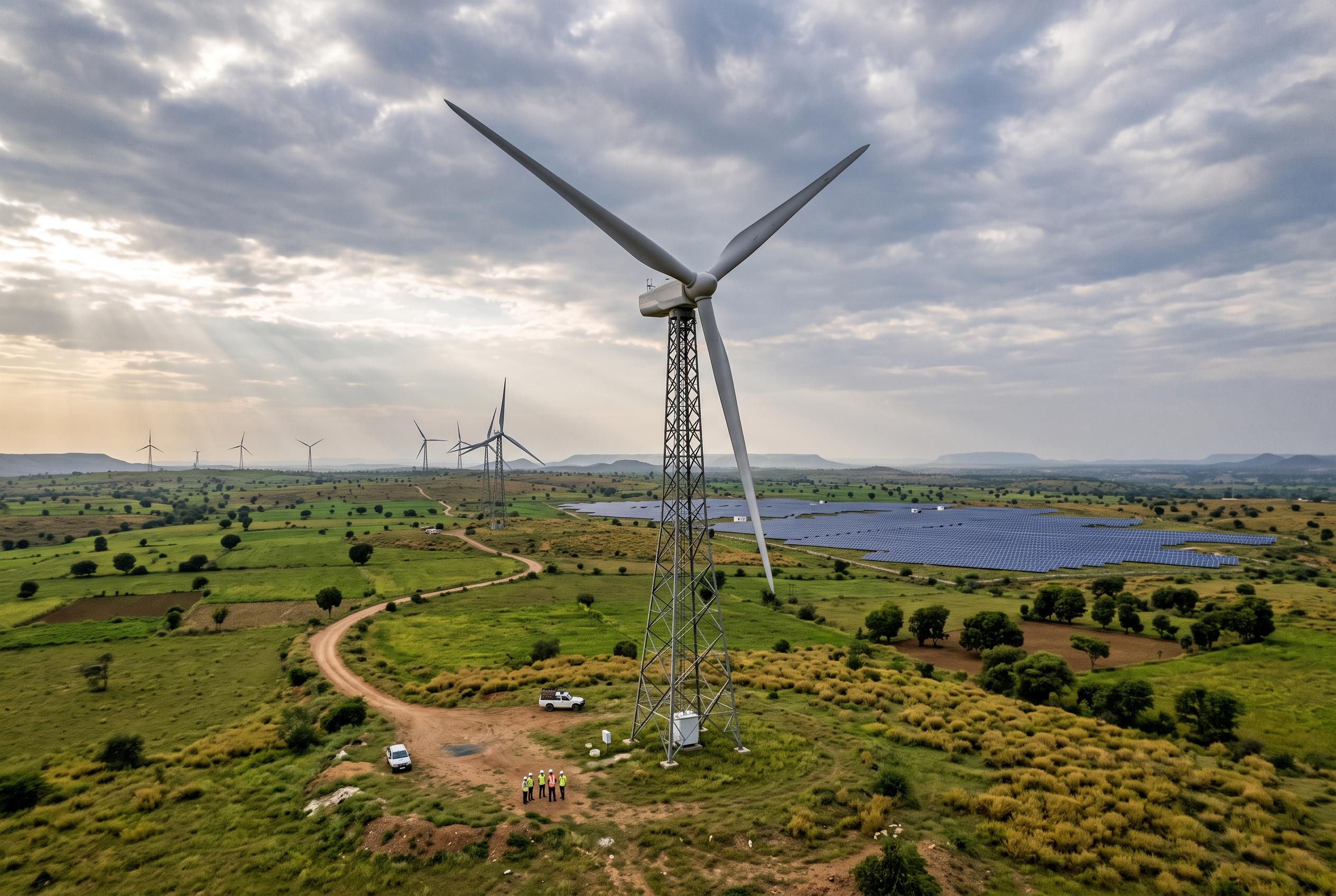

India’s wind-industry is ramping up capacity and localisation efforts, with larger turbines and expanding export markets setting the stage for a globally competitive ecosystem amid ambitious growth targets.
India’s wind-turbine manufacturing industry is entering a more confident phase, with stronger installations, bigger machines and a wider domestic supply base all pointing to a sector that is trying to turn capacity into scale. Renewable Watch reports that manufacturers now have roughly 24 GW of annual capacity, yet only about a quarter of that is being absorbed by domestic installations, leaving significant room for growth if project execution improves and demand remains steady. The Financial Express, meanwhile, said the country’s wind pipeline under construction has reached 43 GW, underscoring the size of the opportunity if those projects move through to completion.
That demand recovery has already lifted sentiment. According to the Financial Express, India added a record 6.05 GW of wind capacity in FY26, taking cumulative installations to 58.14 GW by July 31, 2026. Renewable Watch said annual additions rose by about 50% in 2024-25 and 2025-26, helping manufacturers rebuild order books after years of disruption caused by the shift to competitive bidding and the Covid-19 shock. Export growth has also become a notable part of the story, with the Financial Express reporting shipments worth more than ₹12,000 crore in FY26, suggesting Indian factories are increasingly serving markets beyond domestic projects.
Even so, the industry’s next phase is likely to be decided as much by localisation as by installed capacity. The Ministry of New and Renewable Energy says India already has 70%-80% localisation in key parts such as blades, towers and generators, and an annual production capacity of around 18,000 MW, with turbine ratings reaching 5.2 MW. IMARC Group said the market is shifting towards 3 MW to 5 MW machines, while the ministry has approved manufacturers covering turbines from below 2 MW to 5.3 MW. Renewable Watch said the harder part now is localising technically complex items such as bearings, castings, forgings, gearboxes and power electronics, where domestic supply remains thin and long qualification cycles slow entry into turbine makers’ supply chains.
The push to bigger turbines is equally important. As Renewable Watch noted, 3 MW to 4 MW machines already make up a large share of demand, and some players have launched 5 MW-plus models. That matters because many of India’s remaining wind sites are lower in wind speed than the best early locations, making taller towers and wider rotors more useful for squeezing out more generation. But the trade-off is higher capital cost, which means each site needs a careful match between turbine size, tower height and resource quality. Industry observers quoted by Renewable Watch said the sector will need not just larger machines but also a steadier project pipeline if manufacturers and suppliers are to invest with confidence.
The wider challenge, according to Renewable Watch, is to convert a solid manufacturing base into a globally competitive ecosystem. That will require smoother land acquisition, faster right-of-way clearances, grid connectivity and better coordination between original equipment makers, developers and component suppliers. It will also require more testing infrastructure, stronger research and development, and clearer rules for end-of-life blade recycling as the first generation of turbines begins to retire. WindInsider reported that the Indian Wind Turbine Manufacturers Association is now pressing an export-led strategy, while JSW Energy’s new blade plant in Gujarat shows how some companies are already moving to deepen supply-chain control and cut logistics costs. For now, the common thread across the sector is clear: India has the industrial base, but it will need scale, predictability and deeper localisation to make full use of it.
Disclaimer: This article is intended to inform and educate, not to recommend or endorse any financial product, investment or strategy. Please consider your own financial circumstances and seek professional advice where appropriate before making financial decisions.