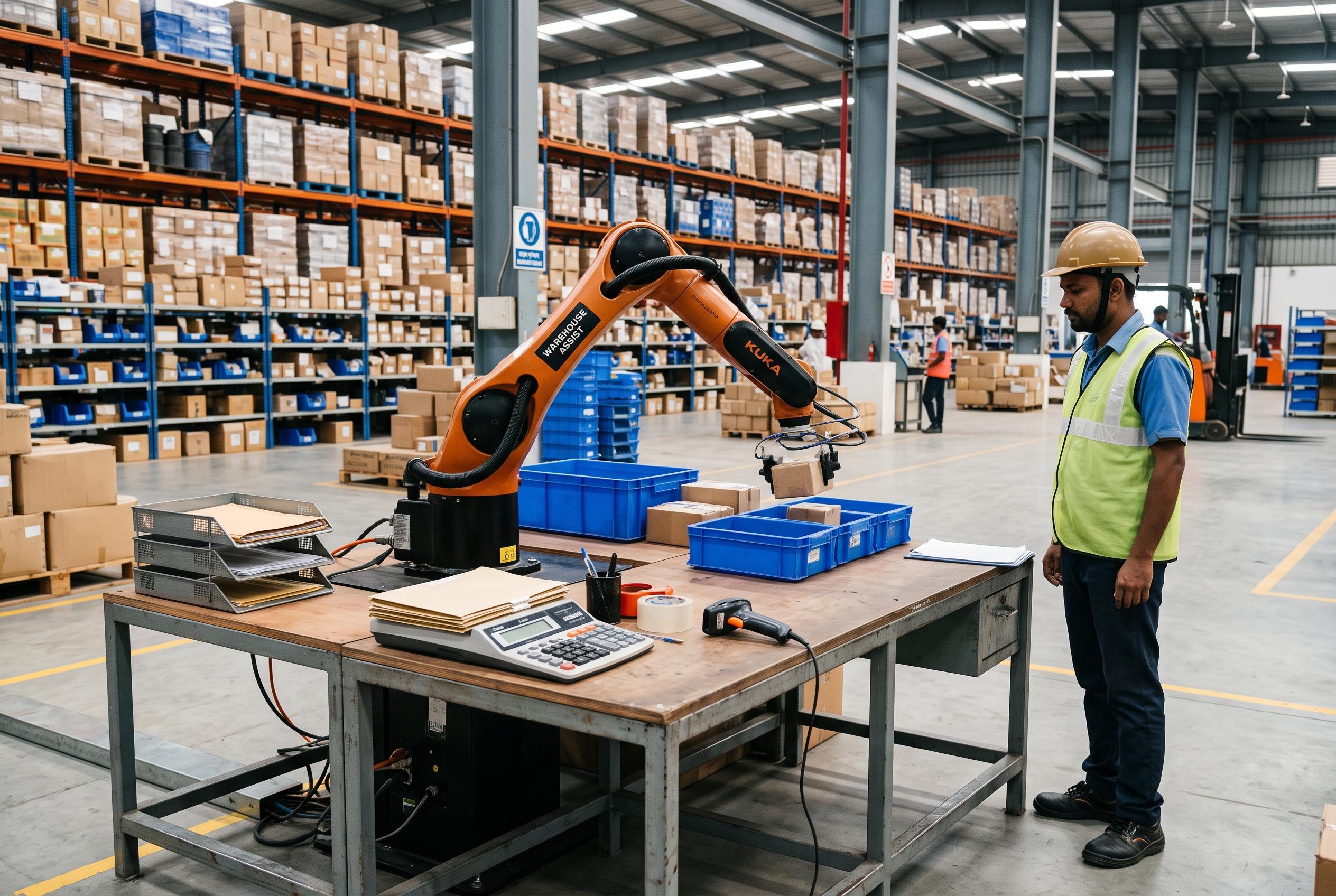

India’s robotics industry is transitioning from reliance on imports to domestically designed systems, with the warehouse automation sector accelerating rapidly and positioning the country as a rising global player in industrial technology.
India’s robotics market is still small by global standards, but it is moving from catch-up to capability. Logistics Insider, citing industry estimates, said the country had 52,570 industrial robots in operation in 2024, far below the stocks seen in the world’s most automated economies. Yet that gap is increasingly being viewed not as a permanent weakness but as room to grow, as domestic demand, engineering talent and policy support begin to align.
For years, warehouses and factories in India relied heavily on imported systems from Germany, Japan, South Korea and China because those countries had already built the precision supply chains and specialist manufacturing base robotics requires. That pattern is changing as Indian companies develop machines tailored to local conditions, where tight storage layouts, variable power quality and different labour economics can make foreign designs less effective. Logistics Insider said the wider robotics market in India was valued at $1.98 billion in 2025 and is projected to expand at 15.74% a year through 2034, while warehouse automation spending is expected to rise sharply as e-commerce and quick commerce continue to drive fulfilment volumes.
Several market forecasts point to the same conclusion: warehouse automation is becoming one of the fastest-growing parts of India’s industrial technology landscape. IMARC Group estimates the India warehouse automation market at $822.4 million in 2025, rising to $2.84 billion by 2034. RoboLabs places the warehouse and logistics robotics market at $560 million in 2025, climbing to $1.5 billion by 2031, while Grand View Research says India’s warehouse robotics market generated $271 million in revenue in 2025 and could top $1 billion by 2033. Another report from Next MSC sees the market reaching $4.26 billion by 2035. The exact numbers vary, but the direction is the same: demand is broadening quickly.
The strategic case for building robotics in India goes beyond sales. Domestic design and manufacturing keep intellectual property, skilled jobs and more of the value chain at home, while reducing exposure to shipping delays, currency swings and geopolitical disruption. It also helps companies build systems around Indian warehouse realities rather than trying to adapt imported machinery after the fact. According to Mordor Intelligence, growth is being supported by e-commerce, GST-led consolidation and production-linked incentive schemes, with vendors increasingly offering modular products that lower upfront cost and make adoption less risky.
Export potential is now becoming part of the story as well. Logistics Insider said Indian-built robotic systems are increasingly being deployed in warehouses in Europe, the US, the Middle East and south-east Asia, a sign that the country is beginning to compete on engineering rather than price alone. If that trend continues, robotics could become more than a single industrial segment: it may serve as a catalyst for broader capabilities in advanced manufacturing, semiconductors, artificial intelligence and materials science.
Disclaimer: This article is intended to inform and educate, not to recommend or endorse any financial product, investment or strategy. Please consider your own financial circumstances and seek professional advice where appropriate before making financial decisions.