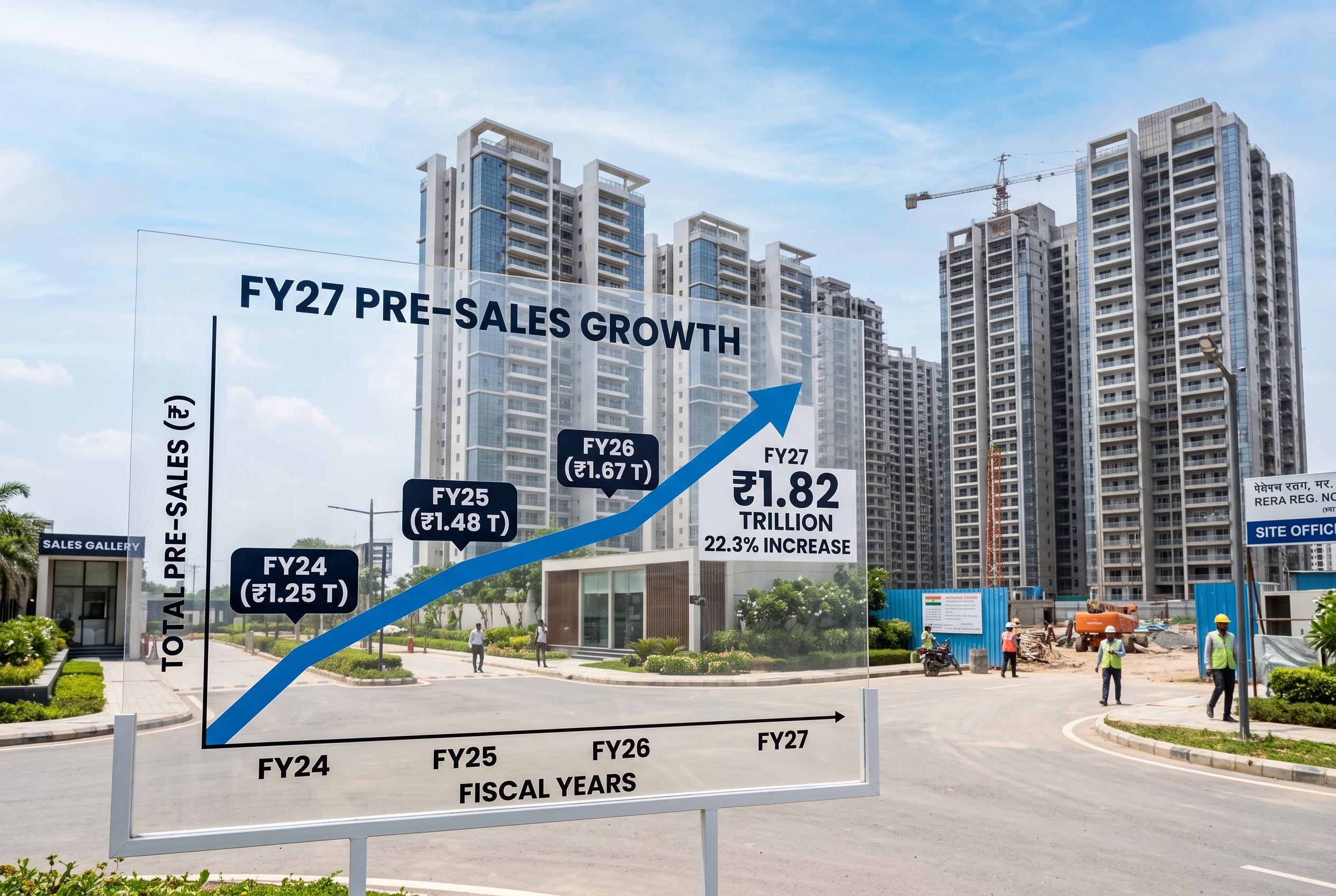

India’s top 11 listed residential developers are projected to achieve a combined pre-sales of ₹1.82 trillion in FY27, marking a 22.3% increase from the previous year amidst market resilience and strategic growth.
India’s top 11 listed residential developers are on course to report combined pre-sales of ₹1.82 trillion in FY27, according to consultancy Anarock, a rise of 22.3 per cent from the ₹1.49 trillion target set for FY26. The forecast suggests the sector is still expanding despite higher property prices, elevated construction costs and a less certain global backdrop, with demand from end users and a healthy project pipeline doing much of the heavy lifting.
Anarock’s research says 10 of the 11 developers are expected to deliver pre-sales growth in FY27, while one is likely to post a slight decline because of a difficult comparison base. Prashant Thakur, executive director and head of research and advisory at Anarock Group, said demand remains solid across major residential markets, helped by buyer confidence and a steady flow of launches. He added that the strongest companies are leaning into high-demand micro-markets and bringing projects to market in a more measured way.
The standout, Anarock said, is Oberoi Realty, which is projected to post 141 per cent pre-sales growth in FY27, while DLF is expected to be broadly flat. That comes after Anarock said earlier this year that India’s top listed developers were still on track to meet their FY26 pre-sales targets, underlining how sales momentum has held up even as the market normalises from the rapid growth seen over the past three years.
The consultancy also said the sector’s balance sheets remain relatively healthy. Based on FY27 estimates, inventory-to-annual bookings ratios range from 0.07 times to 2.70 times, with most developers holding stock worth less than 1.5 years of bookings, limiting the risk of overhang. Anarock added that aggregate net debt across a wider group of listed developers was largely steady in FY26, as much of the growth was financed from operating cash flow rather than fresh borrowing. Listed and Grade A developers have also taken a larger share of new launches in key markets, including the National Capital Region, Bengaluru and the Mumbai Metropolitan Region, as homebuyers and lenders continue to gravitate towards larger, better-capitalised names.
Disclaimer: This article is intended to inform and educate, not to recommend or endorse any financial product, investment or strategy. Please consider your own financial circumstances and seek professional advice where appropriate before making financial decisions.