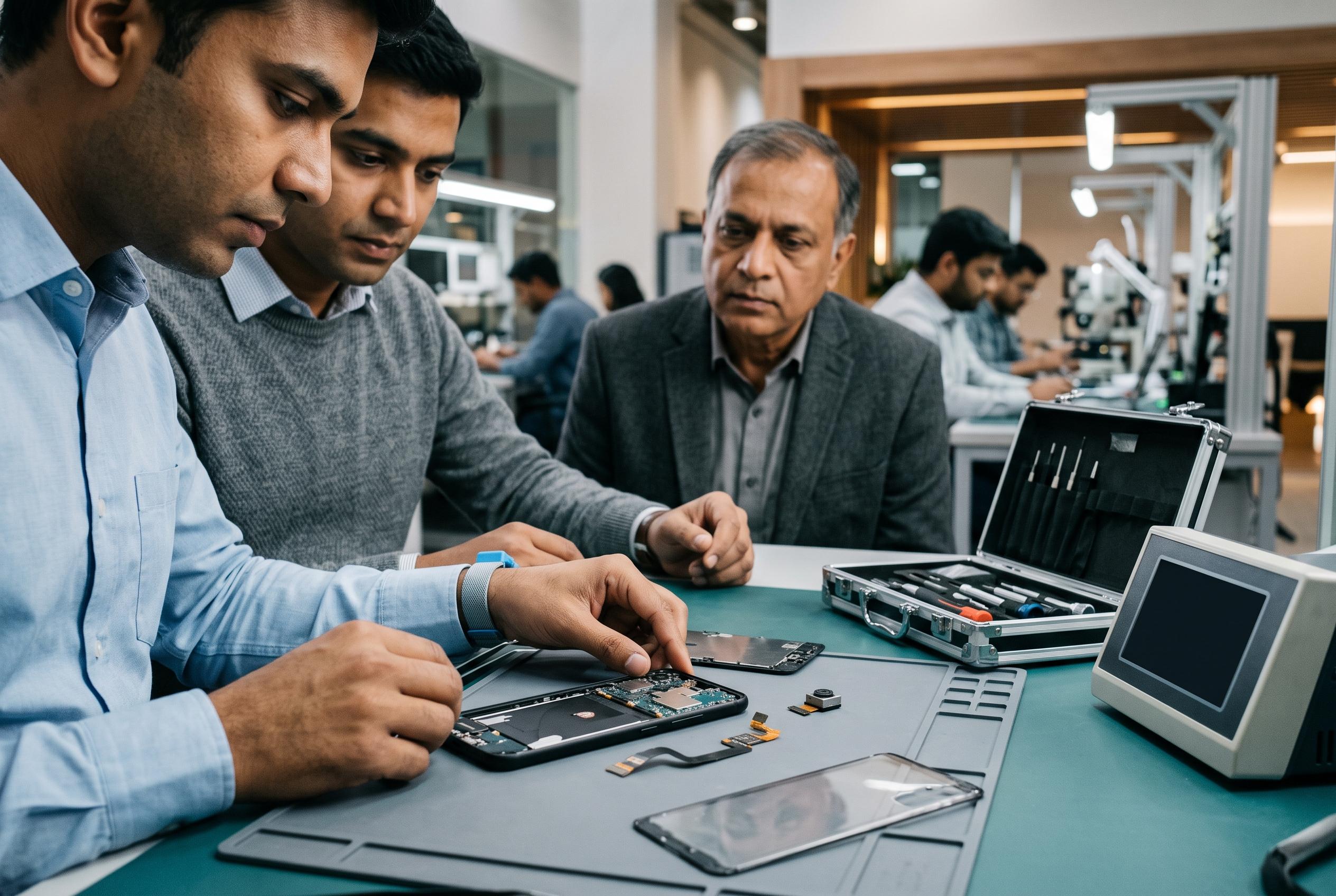

With a fresh government initiative supporting domestic mobile brands amid a largely Chinese-controlled market, India aims to forge a new wave of homegrown smartphone champions, but challenges rooted in innovation and brand recognition remain significant.
India’s long effort to build smartphone champions of its own is being revived with a fresh policy push, but the odds remain formidable. Business Standard reported that domestic brands once flourished by selling low-cost, white-label 3G handsets assembled with Chinese components, only to be swept aside when Xiaomi, Vivo and Oppo arrived with deeper pockets, stronger research capabilities and more advanced products. By 2025, Indian brands had been reduced to a negligible presence in a market overwhelmingly controlled by Chinese manufacturers, with Samsung, Apple and other non-Indian players taking the rest.
Now the government is trying a different tack. Under a ₹62,500 crore mobile phone manufacturing scheme, the Ministry of Electronics and Information Technology has set aside roughly ₹5,000 crore to support homegrown mobile brands, with officials saying additional funds could be made available if required. Ashwini Vaishnaw, the information technology minister, has said the aim is to back about three Indian brands, while eligibility rules are designed to exclude weak entrants: companies must generate at least ₹1,000 crore in annual revenue, be at least 51 per cent owned by Indian nationals and hold their own mobile patents in India.
The incentives are meant to reward more than just sales. According to the government’s notification, firms could receive support worth as much as 9.5 per cent of sales, combining a 5 per cent payment on incremental handset sales, another 1.5 per cent for sourcing key parts such as batteries and camera modules from domestic suppliers, and 3 per cent for establishing a research and development centre that would be audited by the ministry. Without such a centre, a company would not qualify.
The challenge, however, is that India has tried to nurture national handset brands before. The earlier production-linked incentive programme for mobiles helped build manufacturing scale and support exports, but it did not create a lasting domestic brand ecosystem. Of the homegrown companies that were eligible for incentives, only Dixon Technologies consistently met the required thresholds, and even then it remained a contract manufacturer rather than a consumer brand in its own right. Analysts say the previous scheme was better suited to expanding production than to creating a recognisable Indian smartphone maker.
Neil Shah, founder of Counterpoint Research, told Business Standard that the new effort risks repeating familiar mistakes if it relies on the same formula of outsourced design and low-price competition. He said many of the lessons from the Micromax, Karbonn and Lava era were never fully absorbed, warning that without meaningful intellectual property and differentiated innovation, local brands could again struggle to build durable market positions. Ajai Chowdhry, co-founder of HCL and chairman of the governing board at the National Quantum Mission, took the opposite view, arguing that India should reclaim a meaningful share of the smartphone market and build more secure devices and sovereign chips.
There are, at least, a few companies willing to test the market. Lava International, NxtQuantum Shift Technologies and Hyderabad-based Mivi have all signalled interest in the scheme. NxtQuantum, founded by Madhav Sheth, who previously helped build Realme in India, says it has already sold more than 1 million handsets under its Ai+ brand and plans to invest heavily in engineering, testing and manufacturing capabilities. Mivi, which is preparing to launch its first 5G phone, sees opportunity in the lower-priced segment, though its co-founder, Midhula Devabhaktuni, says the ₹1,000 crore revenue threshold could disadvantage newer brands.
The timing may not be entirely unfavourable. Recent market data cited by Gadgets 360, IDC and other industry trackers show that India’s smartphone market was broadly flat in 2025, with shipments around 152 million units, even as value growth outpaced volume growth. Premium models continued to gain traction, Apple moved up to become a larger force in India’s market, and demand in the sub-$150 range remained substantial but under pressure from rising component costs. That opens a narrow lane for domestic brands, but also underscores the scale of the task: to survive, an Indian handset maker would likely need more than a foothold in budget phones. It would have to move upmarket, invest in design and hardware, and convince consumers that homegrown can also mean premium.
Disclaimer: This article is intended to inform and educate, not to recommend or endorse any financial product, investment or strategy. Please consider your own financial circumstances and seek professional advice where appropriate before making financial decisions.