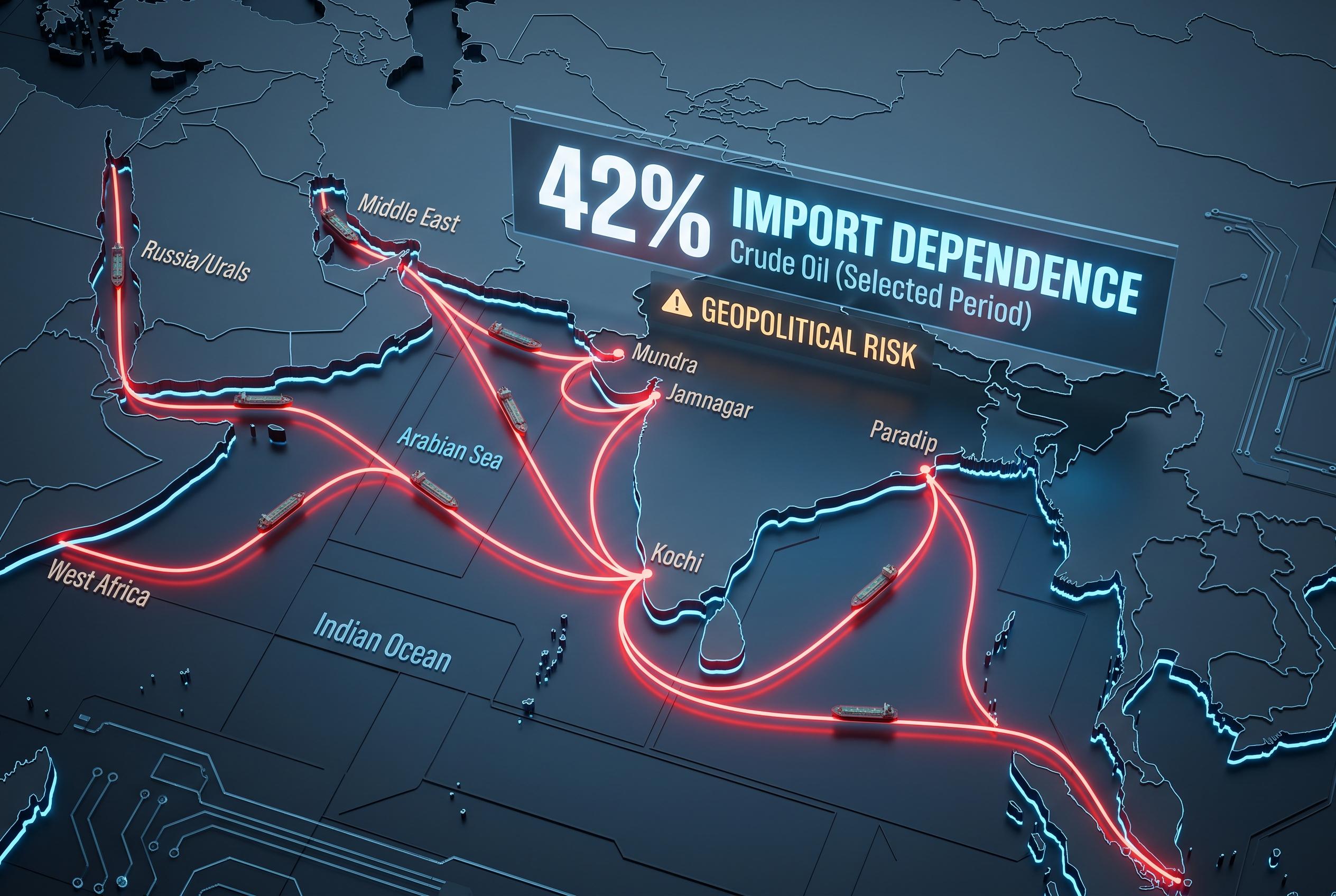

A new report reveals that India has slightly reduced its energy import dependence to 42%, but reliance on overseas crude supplies persists, highlighting ongoing vulnerabilities and geopolitical risks.
India’s dependence on imported primary energy has eased slightly, but the country remains heavily exposed to overseas crude supplies, according to a joint report by the Confederation of Indian Industry and EY released in New Delhi on Thursday. The report said overall import dependence fell to about 42% in FY25 from 47% in FY17, helped mainly by lower coal imports and stronger domestic output, even as oil continues to dominate the energy security debate.
The study found that crude oil still meets roughly 90% of India’s domestic demand, while gas import dependence has climbed to about 50% as consumption has outstripped local production. Coal is the exception: import reliance has dropped to around 18% thanks to increased output at home. EY has separately warned this year that crude import dependence has now moved above 90% in FY26, underscoring how little room India has to absorb a supply shock.
The report also showed how geopolitics continue to shape India’s fuel mix. Although supplies from Eurasia rose sharply after the Russia-Ukraine war, the Middle East remained India’s biggest crude source in FY25, accounting for about 47% to 49% of imports. For liquefied natural gas, the Middle East provided 62.9% of India’s imports in FY26, suggesting that diversification has been real but still limited. EY has said India should build larger strategic crude reserves and improve its ability to withstand external disruptions.
At the same time, the energy transition is changing the structure of demand rather than eliminating import exposure. The report said electricity is taking a larger share of final energy use and renewable capacity is expanding quickly, but long-term resilience will also depend on greater domestic production, more efficient use of energy and wider fuel diversification. EY has noted that refining efficiency improved by about 33% in FY26 compared with FY1998, which has helped cushion the economy, yet the broader reliance on imported oil remains a central vulnerability as India pursues its Viksit Bharat 2047 goals.
Disclaimer: This article is intended to inform and educate, not to recommend or endorse any financial product, investment or strategy. Please consider your own financial circumstances and seek professional advice where appropriate before making financial decisions.