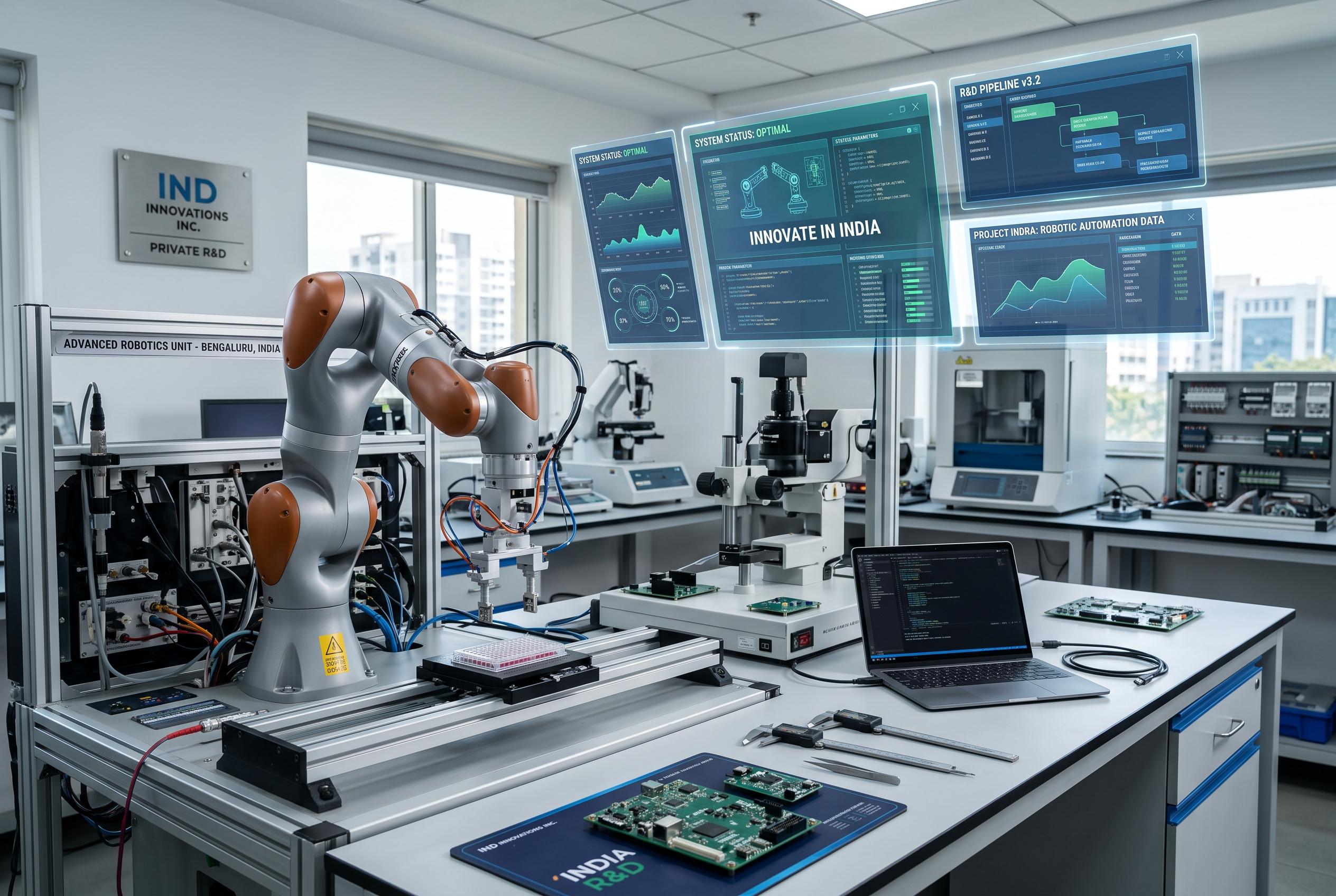

India’s ambition to become a developed economy relies on fostering indigenous innovation through increased private sector R&D investment, overcoming a long-standing funding gap that hampers technological leadership and economic growth.
India’s ambition to become a developed economy will depend less on assembling existing technologies than on creating its own, and that in turn will require a far bigger commitment from private industry, not just the state. The basic problem is well known: India has built strengths in digital public infrastructure, pharmaceuticals, space and information technology, yet research and development spending remains stuck at about 0.6% to 0.7% of GDP, far below levels seen in the US, China, South Korea and Israel, according to government figures and recent analysis by Indian media outlets.
That gap matters because research is the starting point for breakthroughs in fields such as artificial intelligence, semiconductors, biotechnology, advanced manufacturing and energy systems. Times of India reported that India’s R&D spending has more than doubled over the past decade, but the share of GDP has barely moved. Business Standard and CareEdge have both pointed out that the broader private sector remains underinvested, with corporate research concentrated in a handful of industries such as autos, pharmaceuticals, chemicals and metals.
The imbalance is especially striking when compared with innovation economies where companies fund most research and move discoveries quickly into products. In India, public institutions, laboratories and universities still carry much of the burden. That model helped build the country’s scientific base after independence, but analysts argue it is no longer enough in an era when technological leadership is increasingly tied to commercial speed, intellectual property and scale.
India’s startup boom has not closed the gap. The country now ranks as one of the world’s biggest startup ecosystems, but many young firms focus on adapting existing tools rather than funding years of high-risk research with uncertain payoffs. For that reason, the next phase of innovation is likely to depend on larger, better-capitalised companies that can sustain long development cycles in areas such as AI, quantum computing, precision agriculture, robotics and clean energy.
Government policy will still matter. Recent efforts including the Research, Development and Innovation Fund, the IndiaAI Mission and production-linked incentives are meant to encourage a stronger research culture, while university-industry collaboration remains a weak link in the system. AcademicJobs and other commentators have argued that India’s research base could gain far more if universities, startups and large firms worked more closely on patents, commercialisation and applied science.
The larger case is economic as well as technological. Higher private R&D spending can generate patents, exportable products, skilled jobs and less dependence on imported technology. It can also support national priorities ranging from healthcare and food security to cybersecurity and defence. For India, the question is not whether research is expensive, but whether the country can afford to keep treating it as an optional cost rather than the foundation of future growth.
Disclaimer: This article is intended to inform and educate, not to recommend or endorse any financial product, investment or strategy. Please consider your own financial circumstances and seek professional advice where appropriate before making financial decisions.