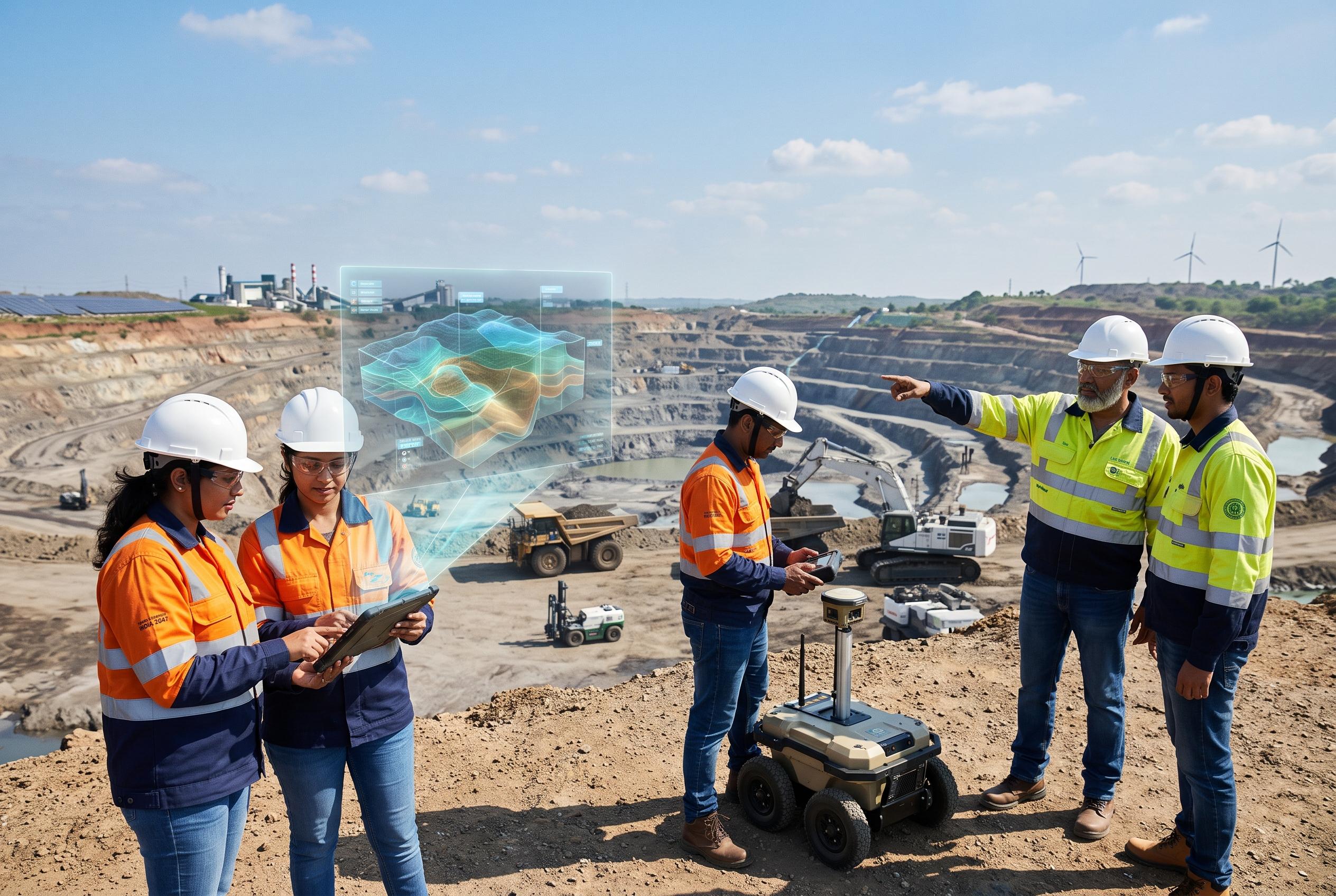

A new report projects India’s mining industry could add $500 billion to its economy and create 25 million jobs by 2047, as it shifts towards ‘Mining 5.0’ with advanced digital technologies and a focus on critical minerals for energy security and manufacturing.
India’s mining industry could become a far bigger engine of growth by 2047, with a joint Deloitte and Indian Chamber of Commerce report estimating that it may add $500 billion to the economy and support as many as 25 million additional direct and indirect jobs. The projection has drawn new attention after Maharashtra Chief Minister Devendra Fadnavis pointed to the sector’s long-term potential at a national gathering of mining engineers in Nagpur on 11 September.
The scale of the opportunity matters because mining sits at the base of much of India’s industrial economy. Coal remains vital for power generation, iron ore feeds steelmaking, limestone is essential to cement, and other minerals support construction, transport and manufacturing. Industry observers say the sector already contributes roughly 2% to 3% of GDP directly, but its broader impact runs much deeper through the supply chain. The report argues that India’s ambition of becoming a $30 trillion economy by 2047 will require far more domestic mineral production, faster project development and greater downstream processing.
Central to that shift is what the report describes as “Mining 5.0”, a model that goes beyond simple automation. It places artificial intelligence, advanced analytics, digital twins, robotics, sensors and connected digital platforms at the heart of planning and operations. According to the report, many companies have adopted elements of Mining 4.0, but digital capabilities often remain fragmented across exploration, equipment maintenance, production and safety systems. The next phase, it says, will depend on integrated decision-making and leadership rather than technology alone.
The strategic importance is even greater in critical minerals, which are increasingly tied to electric vehicles, renewable energy systems, electronics and advanced manufacturing. Fadnavis also highlighted rare earths and other critical minerals as a major opening for India. The challenge, however, goes beyond discovery: India would need to expand its capacity to explore, mine, process and refine these materials at home if it wants to capture more of the value chain and strengthen energy security.
The job gains projected by Deloitte and the ICC would also spread well beyond traditional mine sites. A more technology-driven sector could boost demand for engineers, geologists, data specialists, software professionals, equipment technicians, logistics firms and mineral processors. But automation will also change the skills mix, making training and workforce development as important as capital spending.
That capital requirement is substantial. Mines can take years to develop, exploration is risky and critical-mineral projects often need additional investment in infrastructure and processing technology. The report suggests that the real prize lies not just in producing more ore, but in finding more deposits, operating more efficiently, processing more minerals domestically and building a stronger industrial ecosystem around them.
Disclaimer: This article is intended to inform and educate, not to recommend or endorse any financial product, investment or strategy. Please consider your own financial circumstances and seek professional advice where appropriate before making financial decisions.