

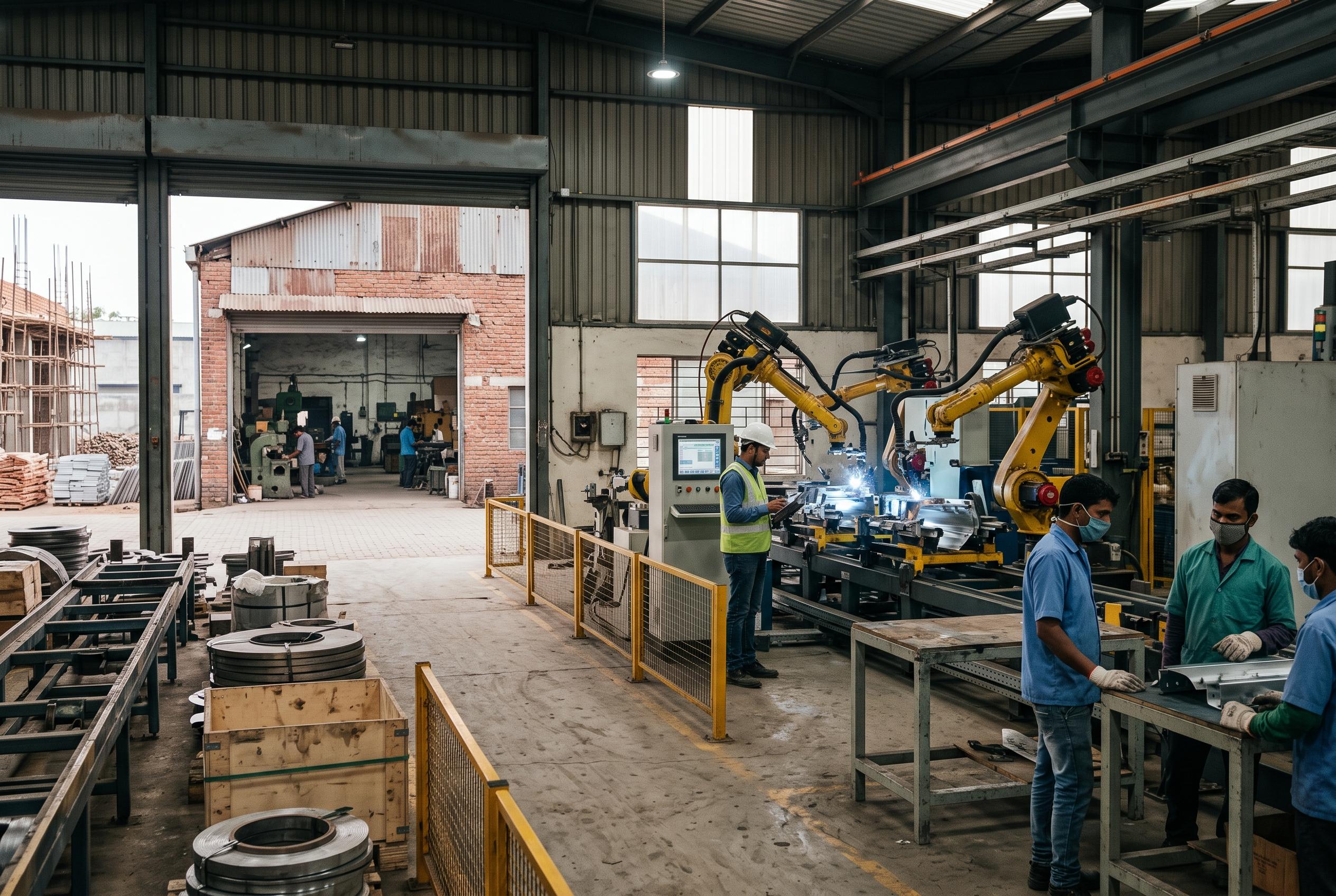

India’s manufacturing sector shows significant growth in output and capital investment in 2024-25, but employment gains are lagging, painting a picture of increasing capital intensity and regional disparities amid a narrow industry focus.
India’s registered factories added jobs in 2024-25, but the latest official survey also shows that manufacturing is still expanding far faster in capital and output than in employment. According to the Ministry of Statistics and Programme Implementation’s Annual Survey of Industries for 2024-25, the number of establishments rose 2.64% to 2.67 lakh, gross value added increased 9.59% to ₹26.94 lakh crore, and employment climbed 7.19% to 2.10 crore people. Total emoluments increased by 12.08%, underlining that pay and production are rising, even if hiring is not keeping pace with investment.
The gap matters because it points to a manufacturing sector that is becoming more capital-intensive rather than labour-intensive. Livemint reported that registered manufacturing added more than 1.4 million jobs in the year, but said the pace of hiring still lagged behind the rise in fixed capital, which increased 10.54%, and industrial output, which grew 7.81%. That broader pattern suggests that factories are scaling up, but not at a rate that would absorb India’s large pool of jobseekers.
The sector’s gains are also concentrated in a limited number of industries. The official summary and reporting by the Press Information Bureau show that basic metals, motor vehicles, chemicals, pharmaceuticals and food products accounted for more than 45% of manufacturing value added. Livemint said those same industries were among the biggest contributors to job growth as well. Even so, the distribution leaves many labour-heavy segments outside the centre of the story, making the overall recovery look narrower than the headline numbers imply.
That is important in a country where policymakers have long argued that manufacturing should help move workers out of agriculture and into better-paid industrial jobs. The survey indicates that the average number of people employed per operating factory rose from 92 to 96, which implies some expansion within existing units rather than a dramatic rise in the number of new labour-absorbing plants. Over the longer term, the gap has been even starker: output, capital and earnings have risen much more quickly than employment over the past decade.
The regional picture is similarly concentrated. The five biggest states by employment , Tamil Nadu, Maharashtra, Gujarat, Uttar Pradesh and Haryana , account for about 56% of manufacturing jobs, while Maharashtra, Gujarat, Tamil Nadu, Karnataka and Uttar Pradesh generate about 54% of manufacturing value added. That overlap reinforces the impression of a sector that is growing, but unevenly, with much of the activity clustered in a handful of industries and states. For now, the evidence suggests that India’s factory base is getting larger and more productive, but not yet creating jobs at the scale needed to deliver a broad-based industrial employment boom.
Disclaimer: This article is intended to inform and educate, not to recommend or endorse any financial product, investment or strategy. Please consider your own financial circumstances and seek professional advice where appropriate before making financial decisions.



