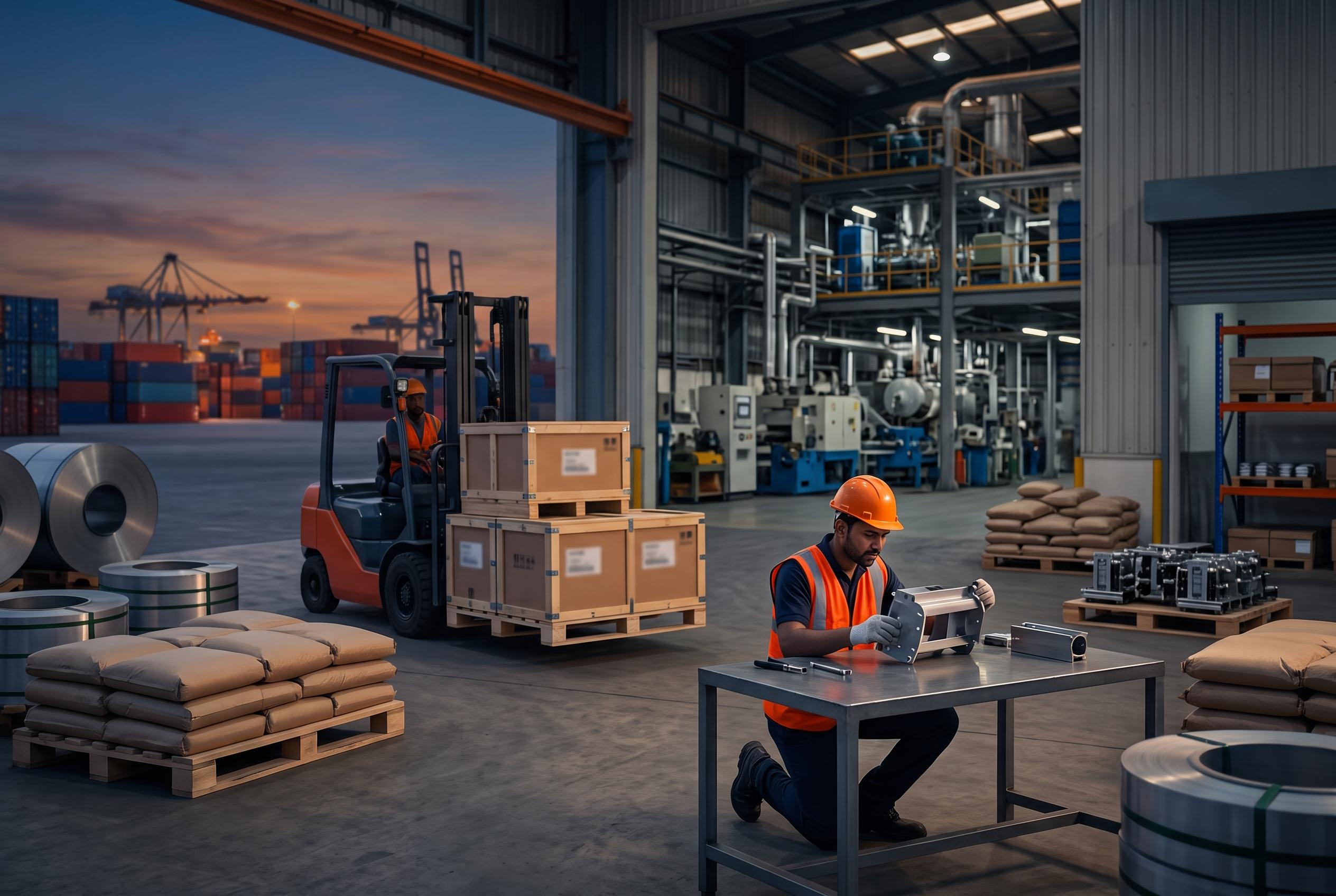

India’s manufacturing sector faces a persistent challenge with a decreasing ability to add domestic value, relying increasingly on imports and low-margin inputs, undermining the government’s Viksit Bharat vision for a robust industrial base.
India’s manufacturing ambitions face a stubborn problem: too much of what the sector produces appears to rely on too many imported or low-margin inputs. Data cited by Business Standard and a Press Information Bureau release show that the Gross Value Added-to-Gross Value of Output ratio, a simple measure of how much value industry creates from each unit of output, has been weakening across manufacturing and the wider economy.
The ratio rose from 21.96% in FY15 to 24.57% in FY18, but then began to slip and fell below its FY15 level by FY22. Since FY23, the numbers have moved down further, even after a change in the base year. A lower ratio means firms are using more intermediate goods to produce the same output, which usually signals weaker efficiency and thinner value addition.
The problem is especially visible in sectors that have become central to India’s export story. According to the Business Standard analysis, petroleum products and telecom equipment, including smartphones, were among India’s top exports by value in FY26. Yet the same sectors had some of the lowest value-addition ratios in FY24, at 12.33% for petroleum products and 8.86% for communication equipment, according to official data cited by the paper. That points to a dependence on components, refining inputs and other intermediates, much of which may still be sourced from abroad.
Not all export-linked industries look the same. Iron and steel, transport equipment and electrical goods have relatively stronger ratios, suggesting they retain more value within the domestic production chain. The distinction matters: low value addition is not necessarily a weakness if a country is also building a strong base of upstream suppliers. But if intermediate goods are imported, the gains to employment, supply-chain resilience and industrial upgrading are more limited.
That is why the numbers matter for the government’s Viksit Bharat target. The broader aim is not just to raise output, but to deepen domestic manufacturing so that more of the value of production stays in India. Business Standard has also reported that manufacturing’s contribution to the GVA of listed firms has slipped since the pre-pandemic period, while NSO data show that a small group of industries still accounts for more than half of formal manufacturing GVA. Taken together, the trend suggests that India’s manufacturing base remains narrow, input-heavy and unevenly distributed, even as policy continues to push for a more competitive industrial economy.
Disclaimer: This article is intended to inform and educate, not to recommend or endorse any financial product, investment or strategy. Please consider your own financial circumstances and seek professional advice where appropriate before making financial decisions.