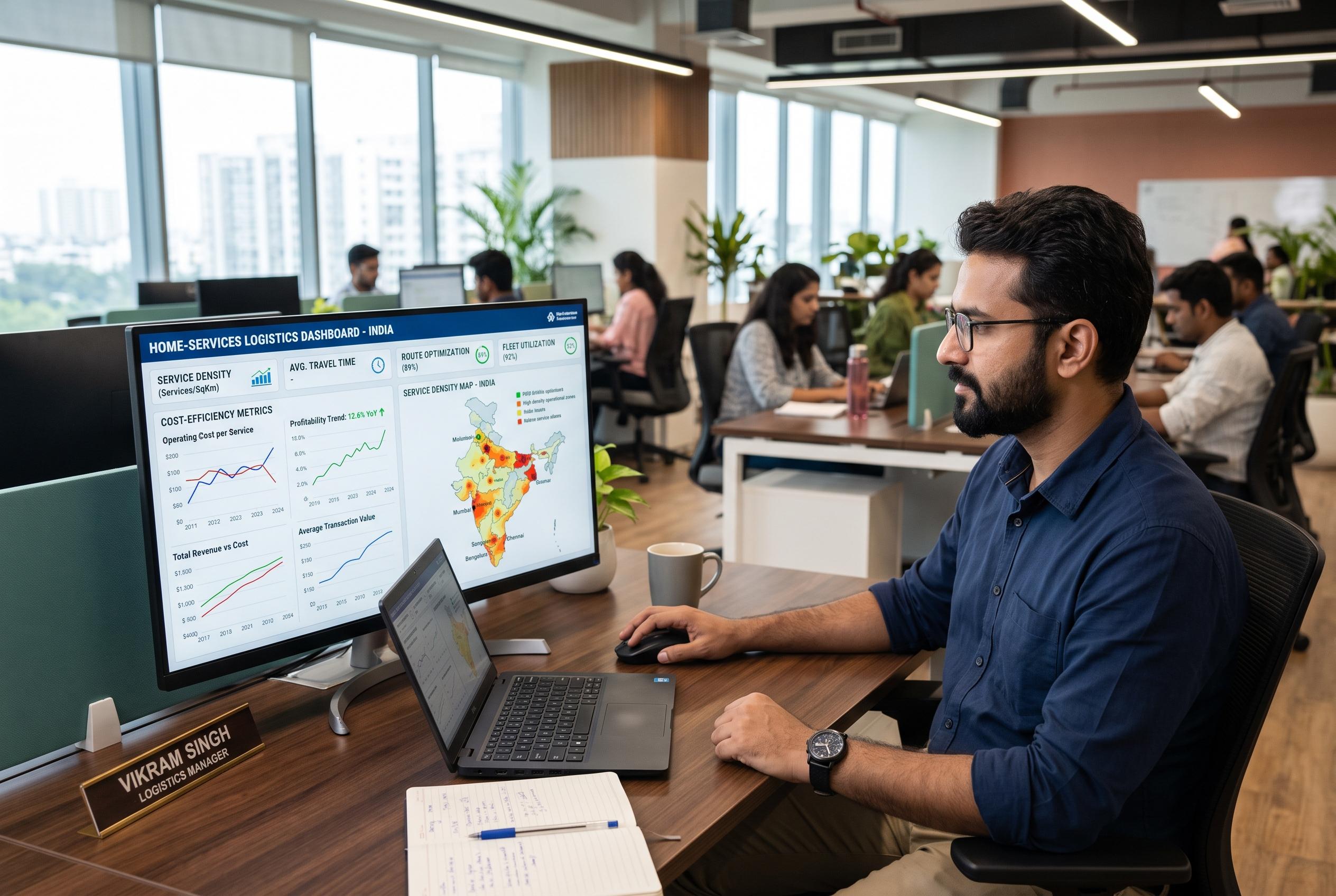

Indian instant home-services platforms are moving beyond rapid demand growth to confront challenges of cost management, user retention, and service density, signalling a strategic shift towards sustainable profitability.
India’s race to build instant home-services platforms is shifting from headline-grabbing growth to harder questions about efficiency, according to Inc42. The category has moved beyond early demand testing: Urban Company’s InstaHelp is said to have crossed 100,000 daily orders in August, Snabbit claims 115,000 jobs a day and Pronto is handling about 60,000 orders daily. Monthly order frequency has also risen sharply, from roughly 1 to 1.5 bookings earlier to 3.4 to 4 now, suggesting users are returning more often than before.
The sharper strategic focus is density. By concentrating demand within compact neighbourhoods, operators can cut travel time, improve worker utilisation and bring down fulfilment costs. Inc42 said that approach is already showing up in the numbers: InstaHelp’s EBITDA loss per order fell 23% from the previous quarter to ₹346 in Q1 FY27, while Snabbit’s burn per job dropped 29% sequentially to below ₹250. Still, investors caution that some of the improvement appears to come from operating leverage rather than a true structural reset in costs.
Urban Company’s InstaHelp has been one of the clearest examples of how quickly the model can scale. StartupFeed reported that the unit posted an EBITDA loss of ₹119 crore in Q4 FY26, or ₹447 per order, after heavier spending on customer acquisition, incentives and supply onboarding. Entrackr said the service passed 50,000 daily bookings in February and BW Retail World reported that it crossed 1 million monthly bookings in March, underscoring how quickly demand has broadened across major cities including Mumbai, Bengaluru, Delhi NCR, Hyderabad and Pune.
Even with faster order growth, profitability will depend on three tests: lower customer acquisition costs, better worker productivity and tighter control of labour expenses. Industry watchers cited by Inc42 say the next phase will also require more than efficiency gains. Platforms will need customers to keep coming back without deep discounts, workers to complete more jobs within denser clusters and labour supply to expand without forcing payouts higher. That is why many players are now looking beyond cleaning and housekeeping into cross-sell services such as pet care, elderly assistance, repairs and subscriptions, with the aim of raising spend per user while keeping acquisition costs contained.
Disclaimer: This article is intended to inform and educate, not to recommend or endorse any financial product, investment or strategy. Please consider your own financial circumstances and seek professional advice where appropriate before making financial decisions.