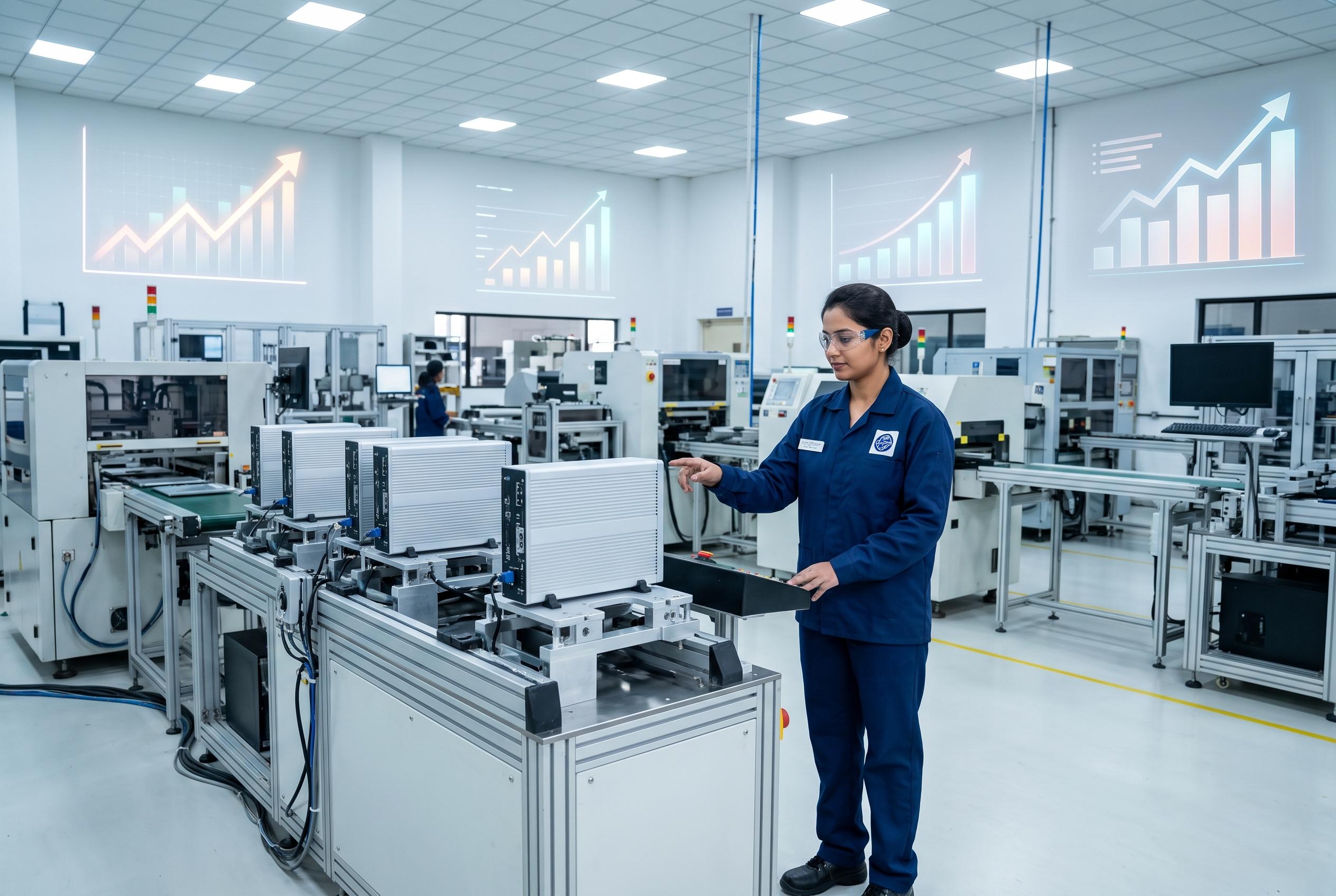

India’s industrial PCs market is projected to expand steadily over the next decade, driven by factory modernisation and localisation efforts, amid concerns over heavy reliance on imports from China and south-east Asia.
India’s industrial PCs market is set for steady expansion over the next decade as manufacturers invest more heavily in automation, digital monitoring and local electronics assembly, according to an IndexBox report. The market is expected to grow at a compound annual rate of roughly 10% to 13% between 2026 and 2035, driven by factory modernisation, infrastructure digitisation and policy support for domestic electronics production. IndexBox also said the market remains heavily dependent on imports, with 55% to 70% of industrial PCs and core computing modules still arriving from China, Taiwan and south-east Asia.
That reliance sits against a wider picture of India’s industrial supply chain vulnerability. The Financial Express reported this week that the Global Trade Research Initiative has warned of deepening dependence on Chinese industrial inputs, while The Economic Times said China now supplies more than 30% of India’s industrial goods. Those findings do not refer specifically to industrial PCs, but they underline the structural risk facing sectors that depend on imported electronics, machinery and components.
Within the industrial PCs segment, pricing is shaped more by specification than by basic hardware. IndexBox said entry-level box PCs and fanless embedded systems typically cost between ₹35,000 and ₹85,000, while ruggedised panel PCs and DIN-rail industrial computers used in process industries often sell for ₹1.2 lakh to ₹4.5 lakh each. The report said demand is shifting away from standalone human-machine interface panels towards integrated edge-computing systems that combine data collection, machine vision and industrial internet gateway functions, which is lifting average selling prices.
The report also pointed to a gradual rise in domestic value addition. While imported processors, chipsets and industrial-grade memory still dominate the bill of materials, Indian suppliers are increasingly active in assembly, enclosure fabrication, thermal design and system configuration, particularly in industrial clusters in the south and west of the country. IndexBox said local vendors are competing on customisation and service, with buyers favouring shorter lead times, local stock and on-site support as supply-chain resilience becomes a bigger concern.
Despite the stronger outlook, the market faces familiar constraints. Import dependence exposes buyers to currency swings, semiconductor cycles and long lead times for specialised ruggedised systems. Certification requirements, including safety, electromagnetic compatibility and growing cybersecurity expectations, can also raise project costs and delay deployment in regulated sectors such as power, transport and pharmaceuticals. Even so, the combination of factory automation, smart manufacturing and infrastructure investment suggests industrial PCs will remain a small but strategically important part of India’s broader industrial upgrade.
Disclaimer: This article is intended to inform and educate, not to recommend or endorse any financial product, investment or strategy. Please consider your own financial circumstances and seek professional advice where appropriate before making financial decisions.