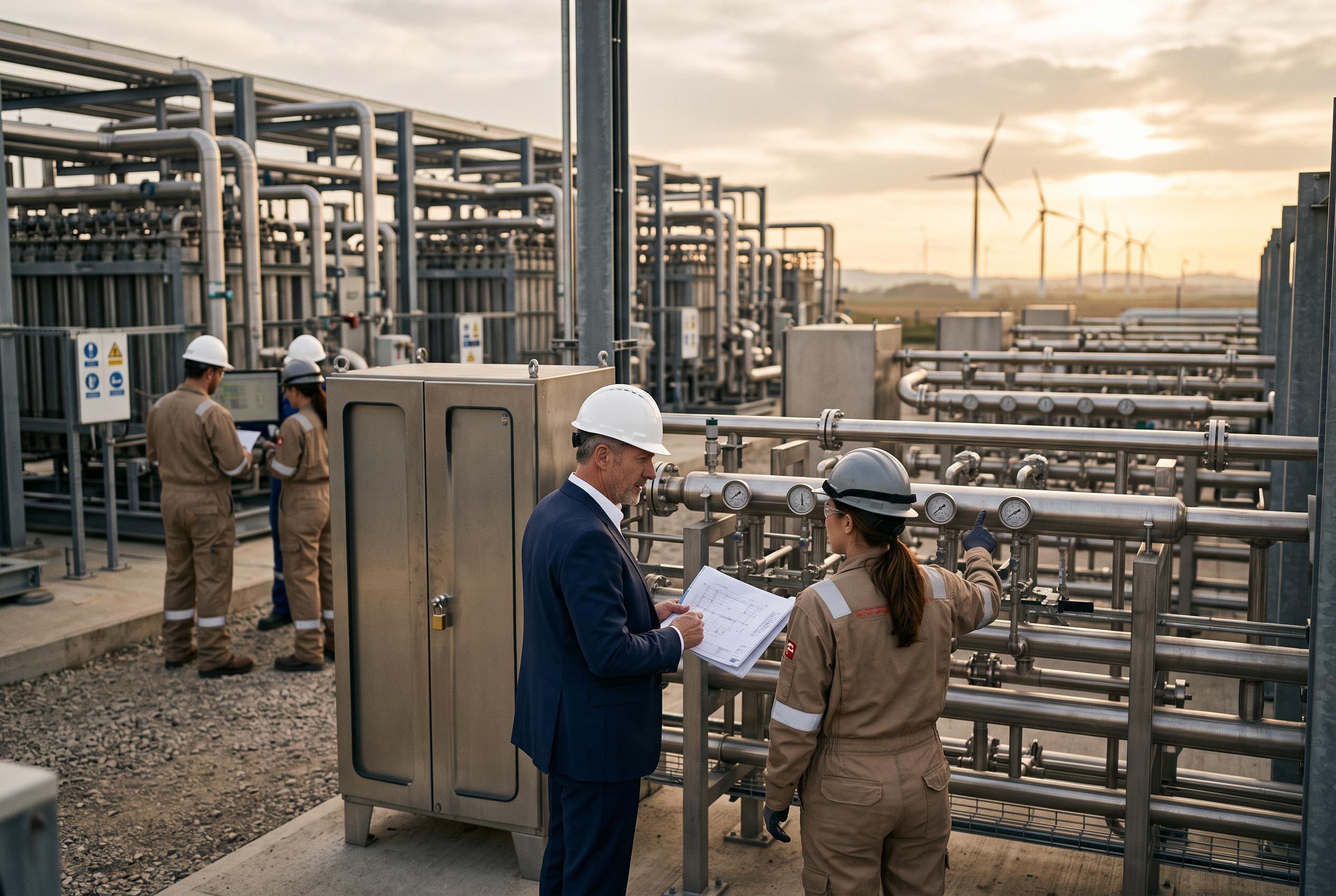

India’s expansive green hydrogen plans are slowed by weak demand, high costs, and international export challenges, risking stranded assets despite significant government incentives and industry investments.
India has spent the past few years building the scaffolding for a green hydrogen industry, but the harder part has been finding buyers. Costs remain far above those of conventional grey hydrogen, and although policy support has helped push down prices from early levels, demand is still too weak to absorb the capacity being planned or announced. According to Business Today, that mismatch has left about Rs 17,490 crore of incentives under the SIGHT scheme unclaimed, out of a total mission outlay of Rs 19,744 crore, as the market waits for clearer signals.
The gap between ambition and execution is already visible in corporate plans. Business Today reported that Larsen & Toubro has paused work on expanding electrolyser manufacturing at its Hazira plant in Gujarat from 400 MW to 1 GW. Industry sources also said Reliance Industries and the Adani Group, which had announced 3-GW and 5-GW electrolyser projects respectively, have slowed their roll-outs. A company spokesperson told Business Today that Reliance’s plant is still under construction and that the timing of production remains unclear, while its broader plan to produce 3 million tonnes of green hydrogen and derivatives is expected to begin later in the decade. The spokesperson also repeated Mukesh Ambani’s view that the fuel becomes viable only once its price falls below $1 per kilogram.
That caution is consistent with the wider market picture. In 2020, the OECD said hydrogen produced through electrolysis cost about INR 400, or $5.1, per kilogram in India, compared with INR 140 to INR 180, or $1.8 to $2.3, for hydrogen made by traditional methods. More recent reporting by Business Standard said India’s green hydrogen sector is advancing, but demand, supporting infrastructure and economics remain central obstacles. Business Today cited similar cost ranges, saying production now sits at roughly $3.5 to $5 per kilogram without subsidy and $2 to $3.75 with it, still well above grey hydrogen. The article also said India produces about 6.5 million tonnes of grey hydrogen for captive use, mainly in refineries and fertiliser plants, where switching to green hydrogen would sharply raise operating costs.
Analysts have been warning for months that the supply build-out is moving faster than demand. Business Today quoted the Institute for Energy Economics and Financial Analysis as saying in late 2025 that 94% of planned capacity had not moved beyond the announcement stage and that only 2.8% was operational. A presentation reviewed by Renewable Watch in April 2026 said six projects had been commissioned with 70 MW of electrolyser capacity, yet demand-side constraints still meant India could reach only about 13% of its National Green Hydrogen Mission target without stronger buyers. The Chintan Research Foundation has likewise argued that the mission has built an impressive supply architecture, but still lacks committed demand.
That leaves policymakers with a difficult sequencing problem. The National Green Hydrogen Mission aims to produce 5 million tonnes a year by 2030 for use in refineries, fertiliser plants, city gas, steel, road transport, shipping and high-altitude mobility. But as Business Today noted, the demand-creation measures built into the mission, including consumption targets and procurement guidelines, have yet to be put into force. Industry leaders want the government to go further by requiring a minimum share of green hydrogen use and its derivatives. Debajit Palit and Akanksha Jain of the Chintan Research Foundation warned that if demand does not pick up, the result could be stranded assets and weaker investor confidence. They argued that India may need a mix of price support, long-term contracts, carbon pricing and purchase obligations, similar to approaches used in the European Union, Germany and Japan.
Exports are often presented as the escape route, but they bring their own hurdles. Business Today reported that the mission assumes India can compete internationally on cost and tap overseas markets that may lack land or renewable resources. Yet the global backdrop is less straightforward. The Hydrogen Council said in September 2026 that committed investment had passed $130 billion, covering 6.9 million tonnes a year across more than 570 projects, but Business Today noted that the rise from 6 million tonnes in 2025 was modest, suggesting persistent demand problems worldwide. Reuters has also reported through 2025 and 2026 that investors are trimming back electrolyser and hydrogen project plans because of high costs and weak demand. Even if India can produce cheaply enough, exporting to the European Union may be difficult unless it aligns with the bloc’s rules on new renewable power, hourly matching and geographic correlation between power generation and electrolysis. As TERI School of Advanced Studies expert Gopal Sarangi told Business Today, India’s current certification framework is far looser, focusing mainly on emissions intensity, which may not satisfy key overseas buyers.
The risk, then, is that India repeats a familiar industrial pattern: building factories before the market is ready. Business Today compared the green hydrogen drive with the country’s solar photovoltaic manufacturing push, where supply expanded faster than demand and utilisation rates have remained under pressure. The lesson for green hydrogen is not that the sector lacks promise, but that promise alone does not create offtake. Without stronger demand signals at home, and clearer export standards abroad, India may find itself with infrastructure, incentives and ambition, but not enough customers.
Disclaimer: This article is intended to inform and educate, not to recommend or endorse any financial product, investment or strategy. Please consider your own financial circumstances and seek professional advice where appropriate before making financial decisions.