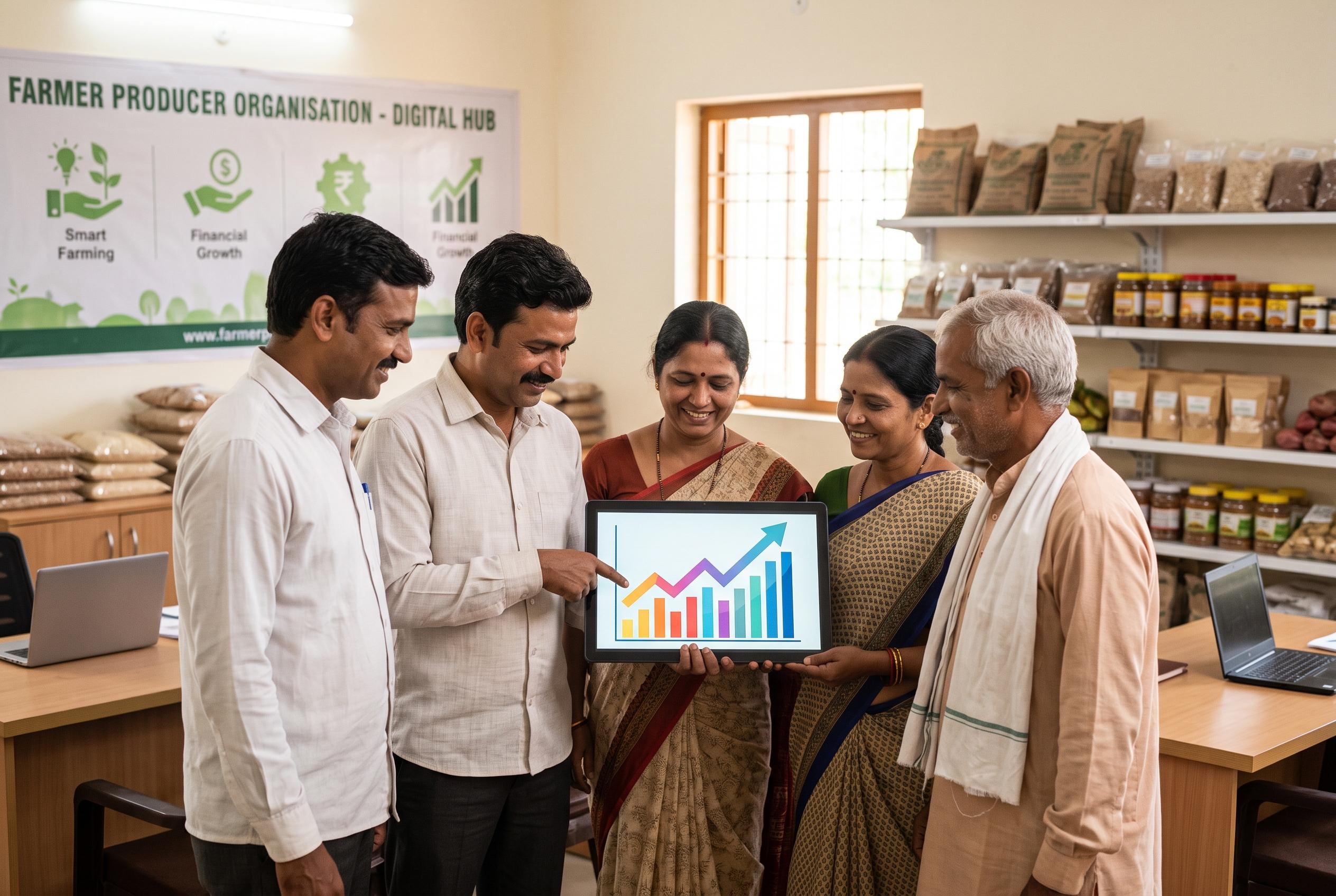

Indian farmer collectives are evolving from mere aggregation points towards sustainable, market-integrated enterprises, with digital tools and access to finance playing a crucial role in their transformation.
Farmer producer organisations are entering a new phase in India, one that is less about scale of formation and more about whether they can function as viable businesses. Biswajit Behera, director at Palladium India, argues that too many of these collectives still act mainly as aggregation points for growers, rather than as enterprises with clear commercial strategies, professional management and reliable access to capital. According to his comments to AgroSpectrum, the next test is whether FPOs can move farmers into formal value chains and deliver better incomes, not just higher output.
The underlying problem, industry analysis suggests, is structural. A recent review of FPOs in India found recurring gaps in finance, infrastructure and market information, while other studies have pointed to weak management, limited operational scale and poor market linkages. In practice, that means many FPOs struggle to secure working capital, invest in post-harvest assets or negotiate with bigger buyers, leaving them unable to capture the full value of what their members produce.
Behera says policy should now focus on making FPOs investment-ready. That would mean easier credit, credit guarantees and blended finance, along with shared facilities such as warehouses, packhouses, grading centres and processing units. He also points to the importance of digital tools, including traceability systems, registries and stronger links to e-NAM and ONDC, which can improve price discovery and market access. The broad message is that formation alone is not enough; sustainability will depend on business discipline and market integration.
The same logic applies to rural food processing, where small enterprises often fail because of thin margins and weak distribution networks. Behera says credit, food safety compliance, packaging and branding remain major hurdles, but he argues that these can be overcome when finance, infrastructure and market support are built together. Palladium’s work under the PM Formalisation of Micro Food Processing Enterprises scheme in Odisha, he said, has helped channel more than $13 million in credit-linked support to more than 1,700 enterprises and train more than 9,300 beneficiaries.
Behera also sees regenerative farming and carbon markets as an additional income layer for smallholders, provided farmers are organised at scale. He said practices such as crop diversification, reduced chemical use and better water management can lift profitability while improving resilience. Carbon finance, in his view, is likely to grow from a niche idea into a mainstream part of agricultural development, but only if farmer collectives help reduce transaction costs and ensure that the gains are shared fairly.
Women and young people, he added, will determine whether that transformation is inclusive. Palladium’s programmes in Odisha and Bihar, he said, have shown that when women hold ownership and leadership roles, enterprises tend to be stronger and more resilient. He also described India’s mix of farmer collectivisation and digital public infrastructure as a potential model for other developing economies, saying the country has a chance to demonstrate how smallholder agriculture can be both competitive and inclusive.
Disclaimer: This article is intended to inform and educate, not to recommend or endorse any financial product, investment or strategy. Please consider your own financial circumstances and seek professional advice where appropriate before making financial decisions.