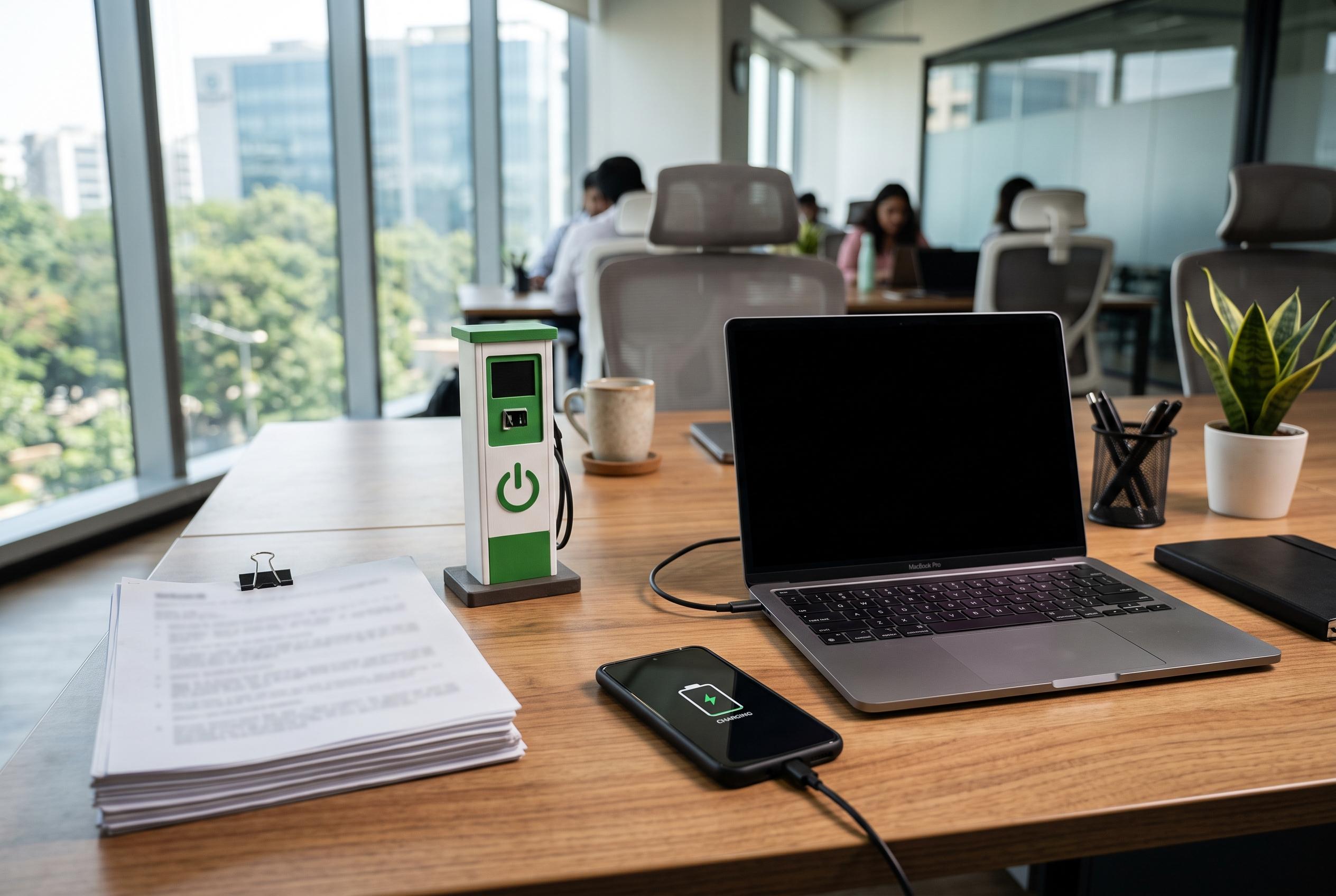

India’s EV charging sector experienced a transformative week, marked by a push towards interoperability, strategic infrastructure development, and increased manufacturing investments, signalling a maturation of the market and new avenues for growth.
India’s EV charging sector had a busy week, with the clearest sign of change coming from the push towards interoperability. Pulse Energy said it has linked a network of more than 10,000 chargers to Unified Bharat eCharge, the national framework designed to let drivers find participating stations, start sessions and pay through a single interface. The ministry-backed system is meant to reduce reliance on multiple apps and separate wallets, while also giving operators a way to keep their own hardware and brands. Pulse’s move comes as other software providers have also been trying to bring charge point operators on to the platform at little or no upfront cost. According to the Ministry of Heavy Industries and Pulse Energy, the broader aim is to make charging easier to access and more consistent across networks.
The sector’s economics were brought into focus by reports that Petronas-backed Gentari is exploring a sale of its Indian charging business. Gentari’s network spans roughly 3,000 charging points across 11 states, but the possible transaction is notable less for its scale than for what it may say about investor confidence in charging assets. Public charging has often been discussed in terms of installed numbers, yet a network’s value ultimately depends on utilisation, site rentals, electricity costs, maintenance and payback periods. Gentari’s own website describes a sizeable charging presence in India, though the reported sale process suggests the market is still testing which ownership models are financially durable.
Another development pointed to a more flexible infrastructure model. Indofast Energy and GLIDA said they will develop sites that combine fast charging with battery swapping, beginning with 10 Quick Interchange Stations in Chennai, Bengaluru and Hyderabad and expanding towards 50 sites with more than 100 swapping stations within a year. The idea is to use the same land, grid connection and customer footfall to serve different vehicle types, which could improve site economics. That matters in a market where two-wheelers and three-wheelers often have very different energy needs from passenger cars, and where one energy hub may be able to serve more than one business model at once.
Policy and public land use also moved up the agenda. Maharashtra is considering charging stations at MSRTC depots and regional transport offices, and has also floated a public-private partnership model for sites near flyovers, according to local reporting. The logic is practical: one of the hardest parts of charging deployment is not the charger itself, but securing land with power access and reliable traffic. Himachal Pradesh is taking a similarly strategic approach, but with tourism in mind. The state has notified six Green Corridors covering about 2,000 km of highways, including routes to Shimla, Manali, Dharamshala, Chamba and Spiti, while tenders cover 41 charging locations and another 80 petrol-pump sites have been identified. The state’s model shows how charging demand can be built around visiting traffic rather than only local EV ownership.
Manufacturing was another area drawing capital. Plugzmart said it has signed a memorandum of understanding with the Tamil Nadu government to invest ₹100 crore in charger manufacturing, research and development, and the wider charging ecosystem. The company makes AC and DC systems ranging from 3.3 kW to 360 kW, along with controllers, communication modules and charging software. It plans to scale production at its Oragadam/Vallam facility and create more than 500 direct skilled jobs over three years. That underlines a broader shift in India’s charging build-out: as deployment expands, value is not only captured by network operators, but also by firms making the electronics, software and control systems that sit behind the charger.
The week also highlighted how charging is becoming more specialised. Bolt.Earth received Automotive Research Association of India certification for its Blaze DC 3 kW dual-gun charger, a product aimed specifically at electric two- and three-wheelers using Type 6 and Type 7 connectors. At the other end of the customer journey, ChargeZone and Landmark Cars said buyers of EVs through Landmark dealerships can receive charging credits for ChargeZone’s public network, effectively tying charging access to the vehicle-sales process. Together, those developments show a market moving in two directions at once: towards products tuned to narrow vehicle categories, and towards commercial bundles that bring charging into the moment when a driver buys the car.
Disclaimer: This article is intended to inform and educate, not to recommend or endorse any financial product, investment or strategy. Please consider your own financial circumstances and seek professional advice where appropriate before making financial decisions.