

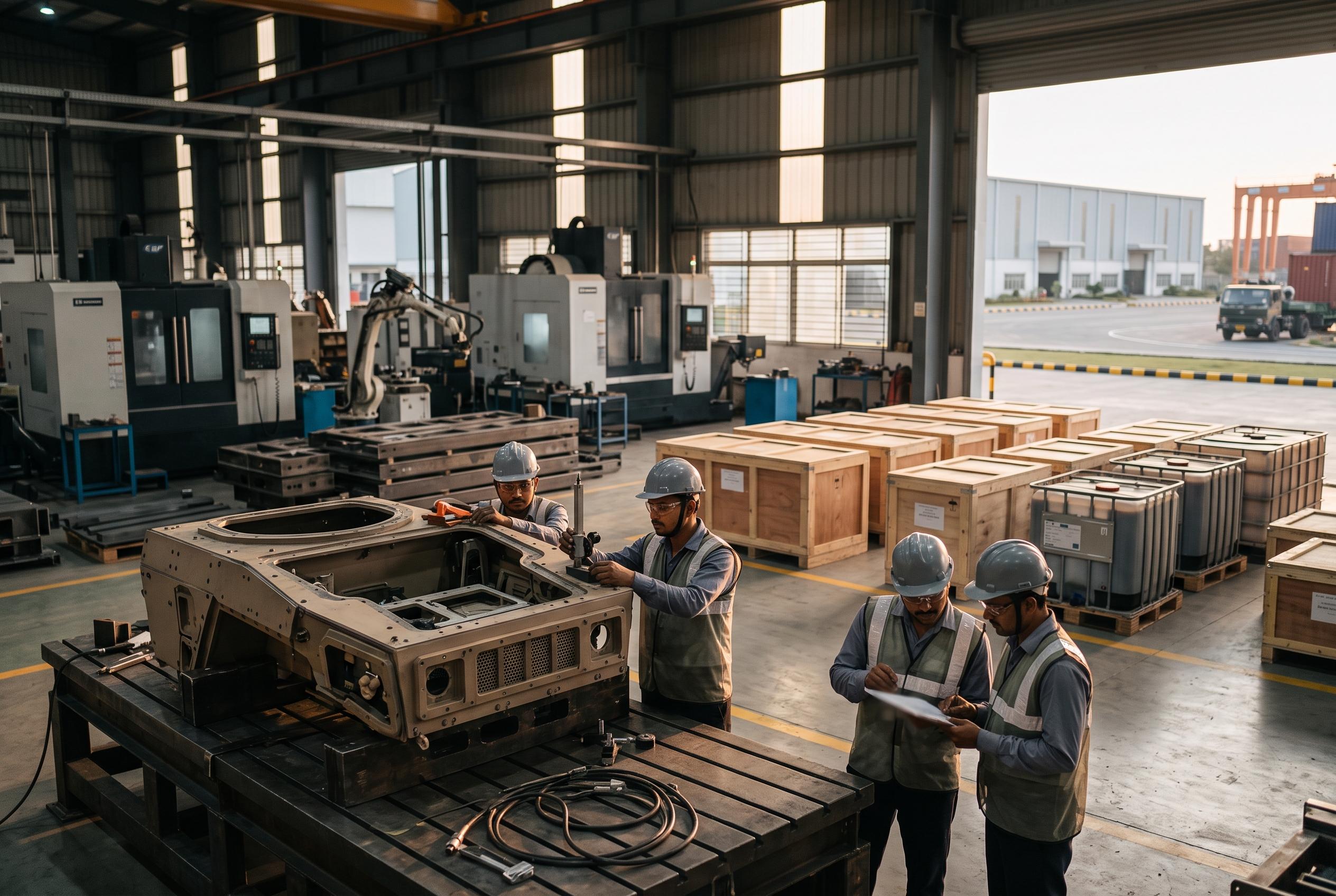

India shifts from import dependence to a robust, export-oriented defence sector, with record production and increased private sector participation, signalling a new era of strategic autonomy.
India’s defence industry has moved from heavy dependence on imports to a far more ambitious model built around local manufacturing, research and exports. According to figures cited by the domestic press, annual defence production climbed to a record 1.78 lakh crore rupees in 2025-26, up sharply from 1.54 lakh crore the previous year and far above the 43,746 crore recorded in 2013-14. At the same time, exports rose to 38,424 crore rupees, extending a run of rapid growth that now puts Indian-made arms and equipment in more than 80 countries.
The pace of that expansion reflects a broader shift in government policy. Defence spending has risen steeply over the past decade, with the overall budget increasing from 2.53 lakh crore rupees in 2013-14 to 7.85 lakh crore in 2026-27, while allocations for acquisitions and new equipment development have reached 2.19 lakh crore. Reuters-style reporting from industry sources has linked that rise to New Delhi’s effort to build strategic autonomy, reduce import dependence and give domestic firms a larger role in the supply chain.
Private companies are taking a bigger share of the market, even though state-owned producers still dominate overall output. Government data reported by Indian business publications shows the private sector accounted for 24% of total production in 2025-26 and 45.16% of exports, while public-sector defence units made up the rest. That is a notable change from a system long dominated by state factories, and it suggests Indian manufacturers are increasingly able to compete for complex orders at home and abroad.
The policy framework behind the shift has also been tightened. The Defence Procurement Procedure of 2016 and the Defence Acquisition Procedure of 2020 both pushed more purchasing towards local design and production. Officials have said more than 6 lakh crore rupees’ worth of systems designed by the Defence Research and Development Organisation and built by Indian industry have received acceptance in principle, including major orders for Tejas Mk-1A fighter jets and Prachand light combat helicopters. Start-ups and smaller technology firms are also being drawn in through schemes such as Innovations for Defence Excellence, ADITI and the Technology Development Fund.
India’s export push now reaches beyond mass production and into strategic partnerships. BrahMos, the supersonic cruise missile developed with Russia, has become one of the country’s best-known defence products, while Armenia has emerged as a major customer for Indian systems including Pinaka rocket launchers, Akash air defence equipment and ATAGS artillery. That cooperation has been accompanied by a wider effort to develop research, co-production and technology transfer arrangements, even as India continues to diversify suppliers towards France, the United States and Israel. The trend points to an industry that is still evolving, but is no longer confined to meeting domestic needs alone.
Disclaimer: This article is intended to inform and educate, not to recommend or endorse any financial product, investment or strategy. Please consider your own financial circumstances and seek professional advice where appropriate before making financial decisions.



