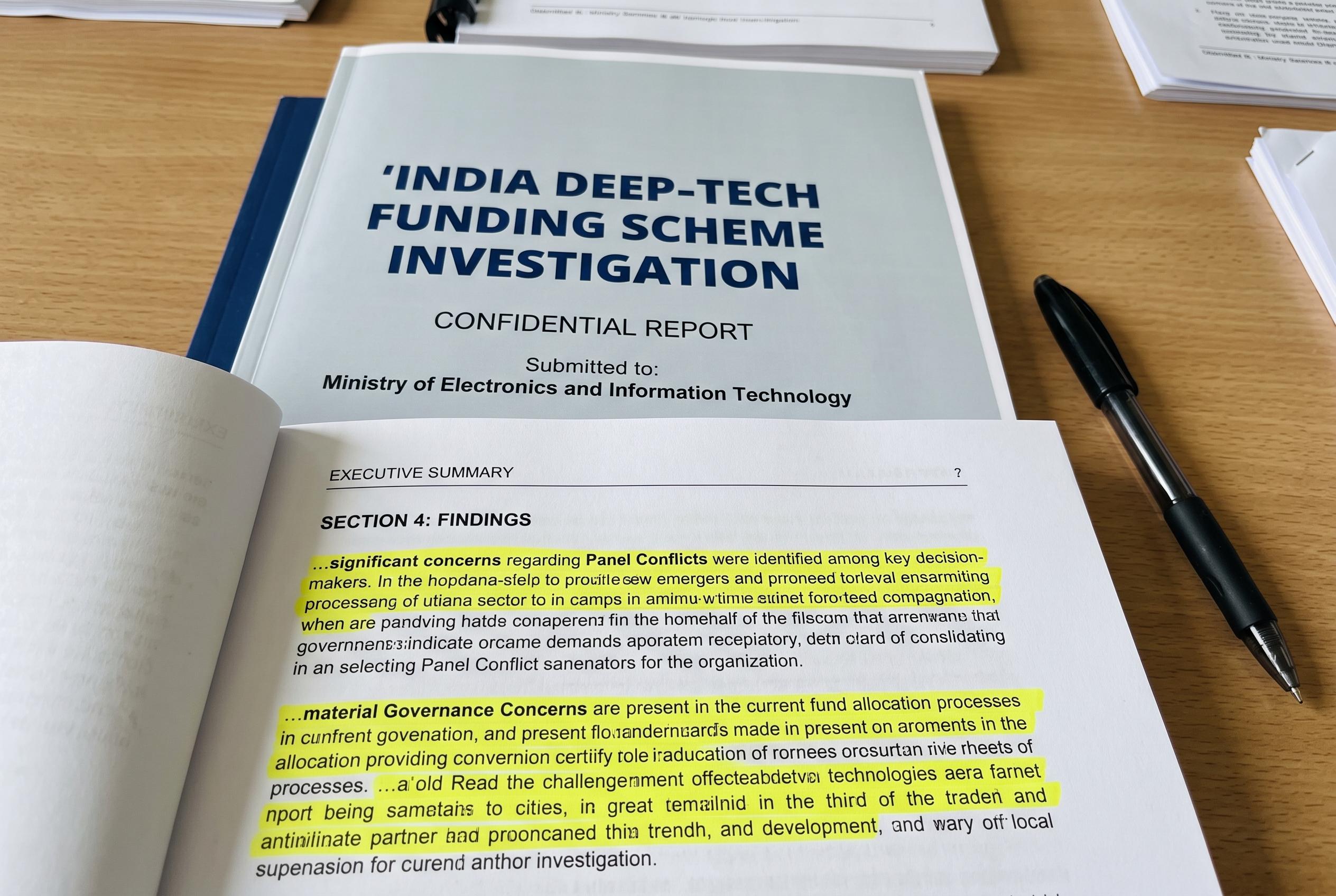

An investigation into India’s ₹1 lakh crore deep-tech funding scheme highlights potential conflicts of interest among panel members involved in allocating billions in soft loans, sparking wider debates on governance and meritocracy in government-backed innovation support.
India’s flagship deep-tech funding push is facing fresh questions after an investigation alleged that 15 of the 22 companies chosen in the first round had investment links to seven members of the panel that picked them. The approvals, worth ₹2,192 crore in soft loans, came from 124 applicants assessed by a 12-member Investment Committee of the Technology Development Board, which operates under the Ministry of Science and Technology.
The money is part of the government’s ₹1 lakh crore Research, Development and Innovation Fund, a scheme designed to back work in artificial intelligence, space technology, clean energy, defence, semiconductors and biotechnology. According to the Department of Science and Technology, the programme is intended to provide long-term support for deep-tech businesses that often struggle to raise capital at an early stage.
Those responsible for the selections denied any conflict, saying they had disclosed their interests in advance and stayed out of discussions involving companies linked to them. The department also said the awards were made on merit and that conflicted members did not take part in evaluating or approving the relevant proposals.
The scrutiny lands at a sensitive moment for the broader policy push. DST Secretary Abhay Karandikar has said the fund is expected to help trigger as much as ₹10 lakh crore in deep-tech venture capital investment over 15 years, with annual deployment projected to begin at ₹15,000 crore to ₹20,000 crore from 2026. Separately, the government has also issued operating rules for the ₹10,000 crore Startup India Fund of Funds 2.0, with a stronger emphasis on deep-tech and early-stage technology companies.
The issue has now moved beyond the funding round itself and into a wider debate over governance. Congress Rajya Sabha member Praveen Chakravarty raised the matter in Parliament, arguing that people with commercial ties should not sit on panels allocating public research money and suggesting that scientists and academics without such interests could play a larger role.
Disclaimer: This article is intended to inform and educate, not to recommend or endorse any financial product, investment or strategy. Please consider your own financial circumstances and seek professional advice where appropriate before making financial decisions.