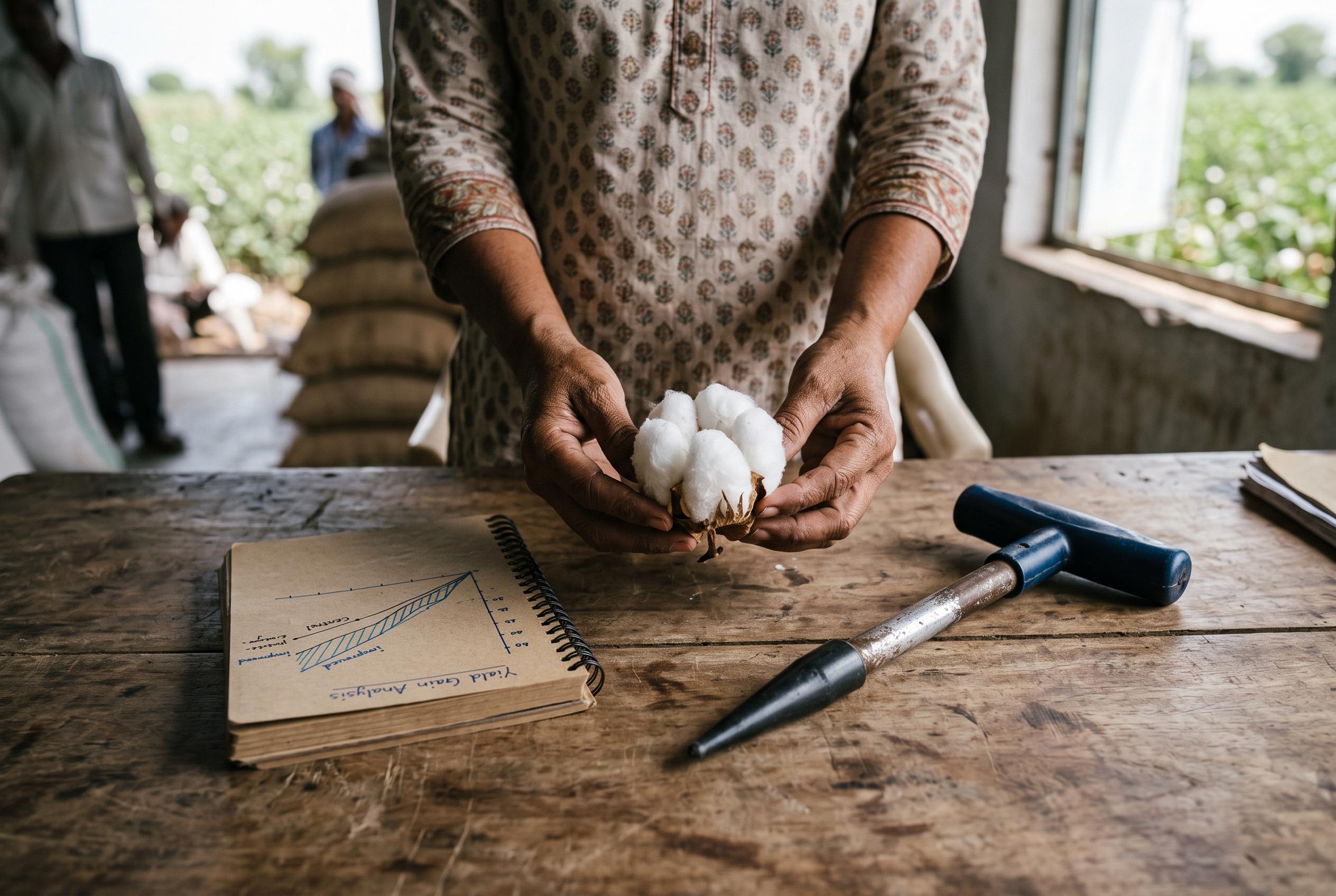

Modest changes in planting methods are boosting cotton yields in India, complementing government efforts to bridge productivity gaps and enhance global competitiveness in the sector.
India’s cotton farmers are finding that modest changes in how they plant can make a substantial difference to output, offering a practical answer to a sector long blighted by low productivity and pest pressure. In Gujarat’s Rajkot, 66-year-old Vinodbhai Virjibhai Vadodriya shifted to a High-Density Planting System and saw his harvest rise to 15 quintals an acre, roughly 30% to 35% more than before. In Maharashtra’s Jalgaon, Bhaskar Tapiram Chaudhary, who adopted the same approach in 2025, lifted his yield from 8 quintals an acre to 11, even after a dry spell that would normally have cut production.
The appeal of the system lies in its simplicity. Farmers use closer spacing, shorter-duration varieties and tighter crop management, which can also help them harvest earlier and reduce losses from the pink bollworm, one of cotton’s most damaging pests. A Press Information Bureau release said farmers in both states reported stronger results after changing spacing and improving fertiliser and pest management. Field trials cited by the government have shown yield gains of about 40% under high-density planting and more than 32% under closer spacing.
The wider backdrop is a cotton industry that is central to rural livelihoods but still underperforms relative to its scale. India has about 114.84 lakh hectares under cotton, around 38% of the world total, and grows all four known cotton species. Yet the country remains only the second-largest producer, because yields per acre lag behind those in countries such as Brazil and the US. Official figures put 2025-26 output at 290.91 lakh bales against domestic demand of 328 lakh bales, underlining the gap policy makers are trying to close.
New Delhi has responded with a mix of price support, procurement expansion and technology-led reform. The Minimum Support Price for 2026-27 was raised to INR 8,267 per quintal for medium-staple cotton and INR 8,667 for long-staple cotton, while the Cotton Corporation of India expanded its buying network and purchased 105.09 lakh bales worth INR 41,530 crore this season, according to government figures. The five-year Mission for Cotton Productivity, launched in 2025-26 with INR 5,659 crore, aims to nearly double output by 2031 and reach 32 lakh farmers across 140 districts. Officials are also pushing the Kapas Kisan app, now used by more than 41 lakh farmers, and Kasturi Cotton Bharat, a traceability programme using QR codes and blockchain to market premium Indian cotton abroad. If those efforts scale alongside better planting methods, India may begin to turn acreage leadership into real production strength.
Disclaimer: This article is intended to inform and educate, not to recommend or endorse any financial product, investment or strategy. Please consider your own financial circumstances and seek professional advice where appropriate before making financial decisions.