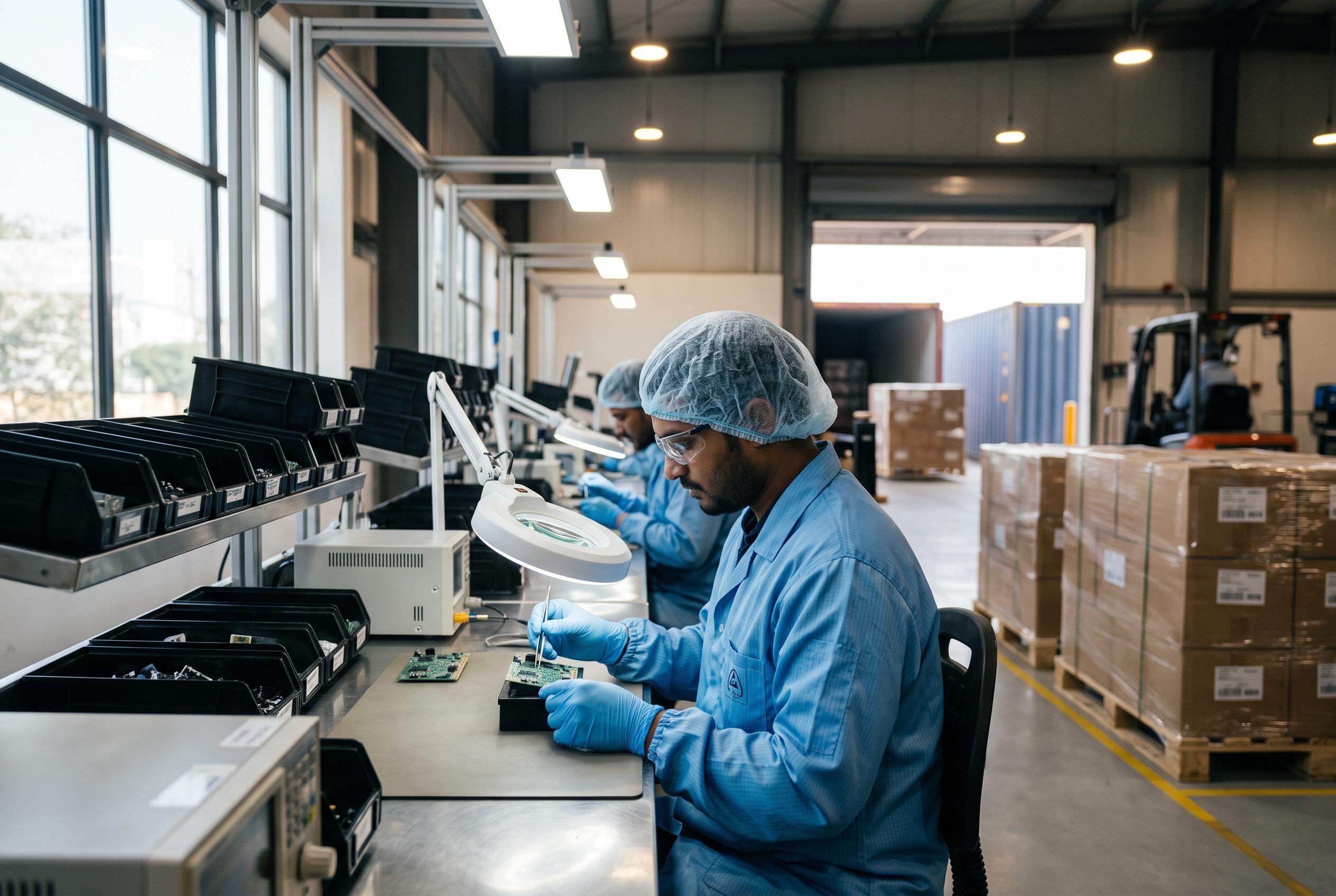

India’s emerging semiconductor assembly ventures are diversifying overseas sources amid geopolitical and logistical pressures, but face complex hurdles in achieving self-sufficiency within their supply chains.
India’s fledgling chip assembly industry is trying to do something that has long proved difficult in electronics manufacturing: build a supply chain that is less exposed to China before production fully scales. Communications Today reported that the country’s five emerging outsourced semiconductor assembly and test ventures are each widening their vendor base beyond China, a response to export restrictions, tariff uncertainty and disruptions that have rippled through global logistics and gas supplies. That effort comes as companies entering the market, including Tata Electronics, Micron Technology, Kaynes Semicon, CG Power and the HCL-Foxconn joint venture, prepare to move from construction and commissioning to commercial output.
The biggest project in the group is Tata Electronics’ assembly and test plant in Jagiroad, Assam, which the company says is backed by an investment of Rs 27,000 crore and is designed to scale to 48 million chips a day. According to reports from Communications Today and Mint, Tata has lined up suppliers from Singapore, the Netherlands, Japan and Malaysia, including ASMPT, Nexperia, Fujifilm and Kelington, in an effort to avoid the concentration that still characterises much of the sector’s procurement. Tata’s parallel fabrication project in Dholera, Gujarat, is also drawing on overseas expertise, with Tom’s Hardware reporting that ASML has signed an agreement to provide lithography equipment, while Taiwan’s PSMC is acting as a process technology partner.
Other Indian ventures are following a similar pattern, though each is shaping its network differently. Communications Today said Kaynes Semicon’s Sanand plant relies heavily on Japanese partners such as AOI Electronics and Mitsui, while CG Semi in Sanand has built its programme around Renesas of Japan and Stars Microelectronics of Thailand. The same report said Micron’s assembly, testing, marking and packaging facility in Sanand began commercial shipments to Dell and HP soon after opening, and that the HCL-Foxconn venture in Jewar is still at an earlier stage, with operations targeted for 2028. That broader push is part of a wider strategic shift: Tom’s Hardware reported that India has joined the U.S.-led Pax Silica initiative, which aims to tighten cooperation across semiconductor and other advanced-technology supply chains and reduce dependence on China.
Yet the more these projects advance, the clearer it becomes that India’s bottleneck is not only final assembly but also the thinness of the domestic materials and equipment base beneath it. Communications Today said lead frames are still mostly imported from South Korea and the Philippines, while bonding wire, epoxy moulding compounds and speciality gases continue to come from a small group of established global suppliers. The report also noted that INOX Air Products, Linde, HySpec Chemicals and other firms are expanding Indian capacity for semiconductor-grade gases and chemicals, while the government’s second-phase chip mission is seeking to attract companies such as Applied Materials and Lam Research to localise more of the equipment stack.
That dependence matters because semiconductor production is expensive to localise and slow to de-risk. Communications Today estimated that materials make up roughly 45% to 50% of outsourced assembly and test costs, with 60% to 70% still sourced abroad, and said supplier qualification can take one to two years, or longer for automotive-grade parts. CG Semi has put the build-out of a local supply layer at at least three years, while India’s semiconductor mission has spoken of a 10- to 15-year horizon for a fully mature ecosystem. In that sense, the current wave of investment marks progress, but not self-sufficiency: India is reducing its exposure to one geography without yet escaping the industry’s wider reliance on a narrow global supplier base.
Disclaimer: This article is intended to inform and educate, not to recommend or endorse any financial product, investment or strategy. Please consider your own financial circumstances and seek professional advice where appropriate before making financial decisions.