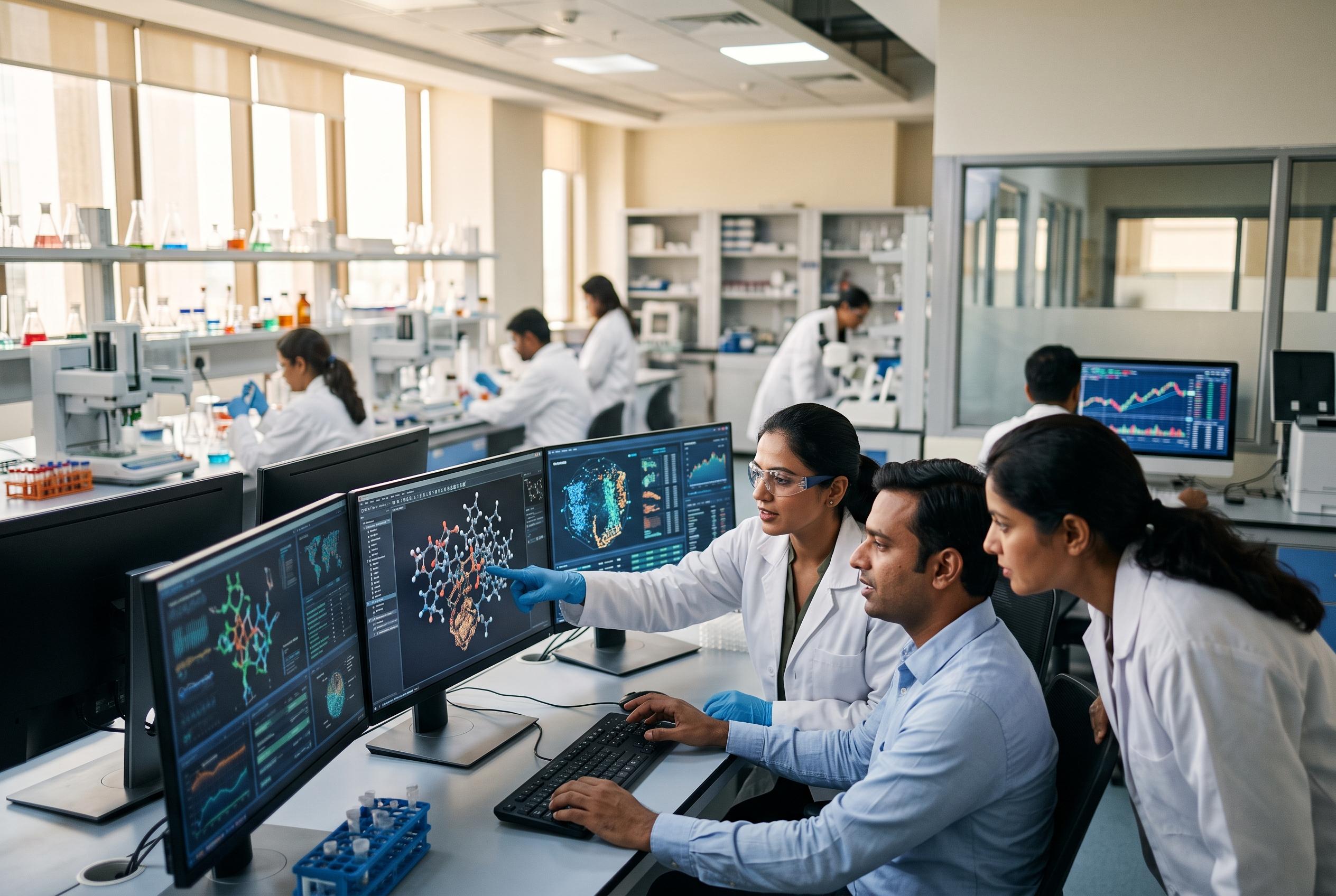

New funding and AI tools are helping Indian drug developers cut the cost of finding promising compounds, but experts warn that weak preclinical and clinical capacity could stall the journey to approved medicines.
India is stepping up its push into drug discovery at a moment when artificial intelligence is making the earliest stages of research cheaper and faster, but experts say software alone will not be enough to turn ideas into medicines. In September, the Department of Pharmaceuticals approved about 16 billion rupees, or US$168 million, for 41 pharmaceutical and med-tech research projects, including work on novel drug discovery and clinical development. The broader policy direction also includes gap funding for early-stage drug discovery start-ups and small firms under the Promotion of Research and Innovation in Pharma and MedTech scheme, according to Business Standard.
Researchers and company founders say AI is already helping Indian biotech groups narrow the field before they spend heavily on lab work. Megha Goyal, a drug-discovery scientist and co-founder of Abhinavayan Biotech, said AI is assisting smaller firms with identifying drug targets, screening compounds and designing molecules before laboratory experiments begin. “AI has not made drug discovery easy; it has made it more accessible and more efficient,” she said. Separately, reports on new AI-native platforms in India, including work by Rasayan Labs with the Institute of Chemical Technology in Mumbai, suggest that design-to-candidate timelines in early research can be compressed significantly.
Even so, the harder test lies beyond discovery. Noubar Afeyan, co-founder and chairman of US-based Moderna, told CNA that the country needs much stronger preclinical and clinical capacity if promising science is to become approved treatment. “It’s probably more important to get preclinical and clinical capabilities established at scale than just AI,” he said. “I don’t think AI will fix that.” The point matters because India’s pharmaceutical ambitions extend beyond exports: government data show drug shipments rose 2.1 per cent to about US$31 billion in the financial year ended March 2026, while the domestic burden of disease remains heavy.
That backdrop helps explain why officials are framing AI as part of a wider industrial upgrade rather than a replacement for hands-on research infrastructure. According to the Department of Pharmaceuticals, AI is expected to affect the full pharmaceutical chain, from discovery through regulation and post-market monitoring. The policy challenge is especially acute in a country where non-communicable diseases accounted for 49 per cent of deaths in 2021, and where households still pay a large share of health costs out of pocket. For Indian drug developers, the opportunity is clear: AI may lower the cost of getting to a viable compound, but the real measure of success will be whether those compounds can survive the long, expensive journey through human trials.
Disclaimer: This article is intended to inform and educate, not to recommend or endorse any financial product, investment or strategy. Please consider your own financial circumstances and seek professional advice where appropriate before making financial decisions.