

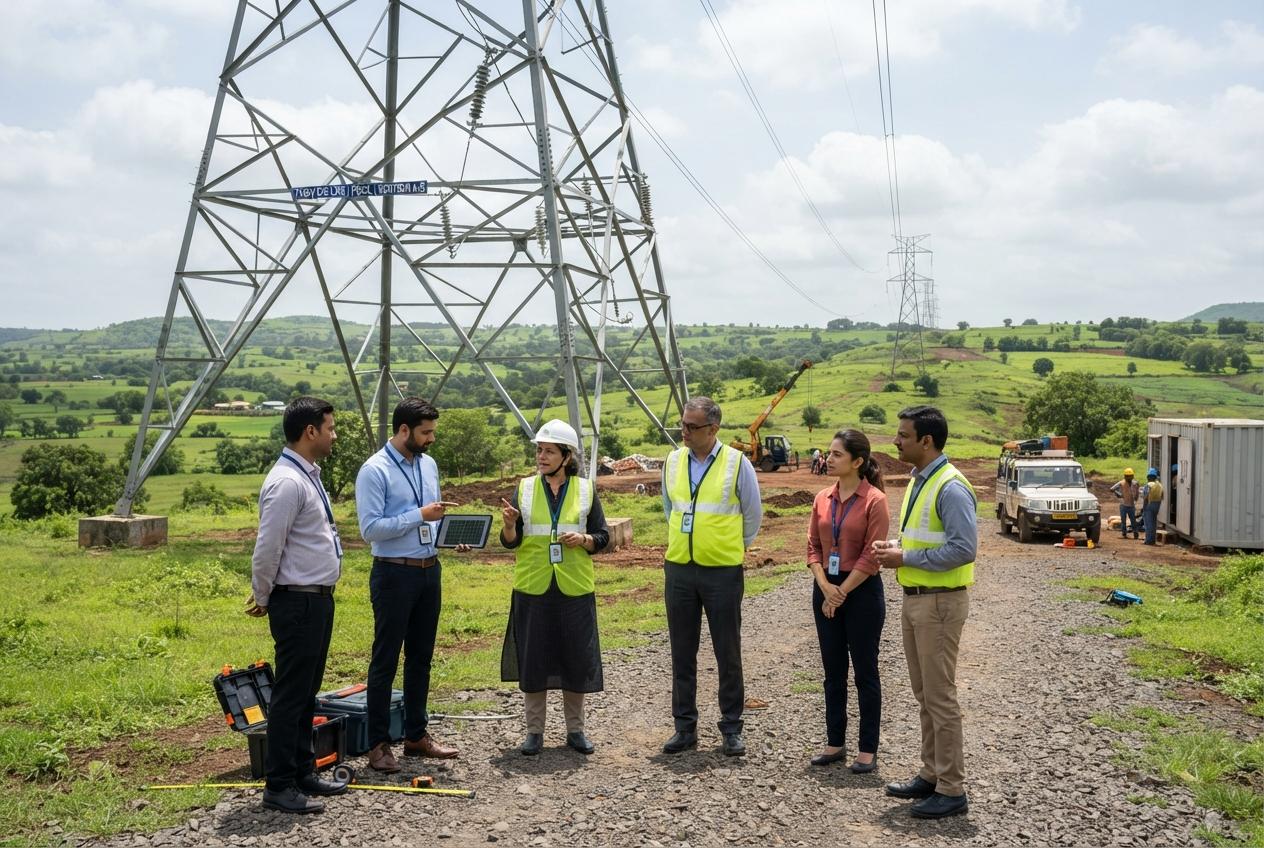

India aims to expand its national transmission network by over 35% by 2032 to support soaring renewable energy targets, but faces logistical, institutional, and industry capacity challenges that threaten execution.
India’s power transmission build-out is moving on an enormous scale, but the ability of domestic contractors and project teams to deliver it is coming under strain. The National Electricity Plan envisages a rise in the national transmission network to about 6.48 lakh circuit kilometres by 2032, up from more than 5 lakh circuit kilometres today, while government planning also points to a sharp increase in inter-regional transfer capacity over the next few years. That expansion is central to integrating renewable generation and keeping power flows reliable across the country.
The challenge is that execution conditions have become far less forgiving than in earlier rounds of grid expansion. Transmission work increasingly takes place in live systems, where outage windows are tighter, coordination with grid operators is more complex and missing a commissioning date can strand renewable capacity as well as upset grid reliability. The article’s central argument is that the ambition of the pipeline has outgrown the institutional depth of the domestic EPC sector, which is still dealing with shortages of experienced supervisors, long working capital cycles and uneven manufacturing sequencing.
Right of way remains the most persistent bottleneck. Business Standard reported in March that delays in inter-state transmission projects continue to be driven in part by land access problems, while the broader policy challenge is that compensation and clearance processes still vary widely across states. The result is that contractors often mobilise early, incur procurement costs and then wait for permissions they cannot control, turning schedule risk into a financial burden.
The scale of what is at stake is striking. Government plans set out in the National Electricity Plan call for about ₹9.12 lakh crore of spending on transmission infrastructure by 2032, alongside major additions in lines and transformation capacity. The Press Information Bureau has said the target is to support projected peak demand of 388 GW by 2032, while other reporting on the plan points to a network that must be ready for as much as 600 GW of renewable energy by 2032.
Against that backdrop, the remedies are as much contractual as technical. The article argues for a national framework on right of way and statutory clearances with defined timelines and escalation routes, rather than the current patchwork approach. It also calls for a more realistic treatment of payment timing and bank guarantees, since the gap between site work and billing can squeeze liquidity even for established contractors. In parallel, the EPC industry itself is being urged to invest more in front-end engineering, so that tower spotting, foundation design and access planning are settled before mobilisation begins.
Amit Dutta, chief operating officer at Jyoti Structures, also points to an improvement in coordination between some developers and contractors, especially where clearance management is being treated as a shared responsibility rather than a problem pushed wholly on to the EPC side. Digital monitoring tools are helping too, by improving visibility over dispersed work fronts and making progress tracking and billing more accurate. Even so, the article’s wider conclusion is clear: India’s transmission expansion will depend not only on capital and policy, but on whether the industry can align risk, cash flow and execution discipline with the realities of delivering power infrastructure at scale.
Disclaimer: This article is intended to inform and educate, not to recommend or endorse any financial product, investment or strategy. Please consider your own financial circumstances and seek professional advice where appropriate before making financial decisions.



